
A 10 kV indoor current transformer runs from about US$59 to US$180 on one manufacturer's published catalogue, and the ratio is not what separates the two ends. The core grade, the copper, the casting and the test scope separate them. This guide breaks the price down by line item, using NAHU's published indicative figures and the datasheets behind them, so a buyer can see which specification decisions move the number.
It is written for procurement engineers, panel builders and utility asset teams who receive three quotations for "10 kV, 600/5 A" and have to explain why they differ by a factor of two. Every figure below is either a published catalogue value or a planning range with its condition stated; none of it replaces an itemised quotation, but all of it lets you read one.
What does a 10 kV current transformer cost?
The table takes the indicative prices NAHU publishes for its 10 kV and 35 kV models and sets them against construction type, current range and the accuracy combinations each datasheet lists. The figures are FOB Ningbo with export packing, minimum order one piece, and they are given as a band because the final number depends on the accuracy pair, the rated output per core and the quantity on the order.
| Model | Construction | Primary current | Classes listed on the datasheet | Indicative price |
|---|---|---|---|---|
| LMZJ-10 | Busbar (window) type, indoor | 300–8000 A | 0.2/10P10 to 10P15/10P15 | US$24–140 |
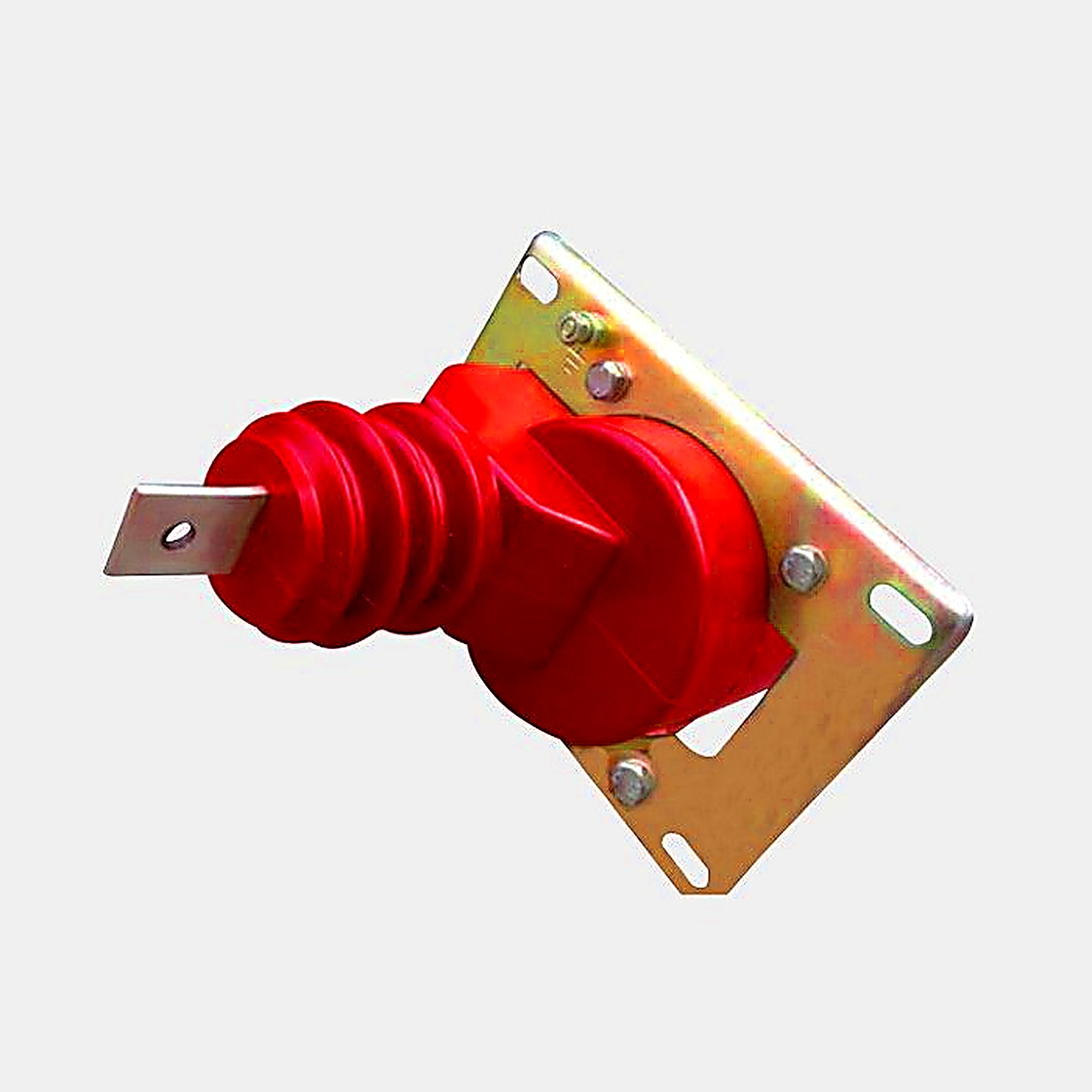
| LZZBJ9-10S | Post type, indoor | 5–600 A | 0.2S/0.2/0.5 | From US$59 |
| LA-10 | Indoor | 5–1000 A | 0.2S/0.5/10P10 | From US$74 |
| LZZBJ9-10 | Post type, indoor | 5–3000 A | 0.2S/10P10, 0.5S/10P10 | From US$80 |
| LAZBJ-10 | Post type with primary bar, indoor | 5–1000 A | 0.2S/10P10 to 0.5/10P15 | From US$85 |
| LZZBJ9-10C2 | Post type, indoor | 5–3150 A | 0.2S/0.5/10P30 | From US$179.25 |
| LZZBJ71-35 | Outdoor, 35 kV | On request | On request per project | From US$430 |
Two things in that table usually surprise a first-time buyer. The first is that the 10 kV band is roughly three to one from cheapest to dearest, across one voltage class. The second is that price does not track primary current: the busbar type covers 300 to 8000 A inside a US$24–140 band, while a post-type unit at 3150 A starts near US$179. The current range is not the cost driver; what the unit has to hold, and how accurately, is.
Read the figures as a budget floor rather than a quotation. They cover a standard unit with routine tests and a routine test certificate. They do not include a witnessed type test, third-party calibration, a 1 A secondary where the standard build is 5 A, tropicalised packing for a long sea transit, freight, or import duty. On a 200-unit feeder package those exclusions are where a budget overrun actually comes from, not from the unit price.
Which four items make up the unit price?
Strip an epoxy-cast current transformer down and four cost centres account for most of what you pay: the magnetic core, the copper winding, the cast body, and the test and documentation package. The shares below are planning ranges for a 10 kV indoor single-phase unit ordered in the hundreds per year, and they shift with the accuracy class and the body size.
| Cost centre | Share of unit price | What moves it |
|---|---|---|
| Magnetic core | 25–35% | Core grade, cross-section, accuracy class, saturation requirement |
| Copper winding, primary and secondary | 15–25% | Copper mass, number of secondary turns, rated output in VA |
| Epoxy resin, mould and casting | 15–25% | Body volume, creepage profile, insulation level, tooling amortisation over the batch |
| Testing and documentation | 5–10% | Routine tests only, or a witnessed type test and calibration certificates |
| Hardware, terminals, packing | 5–10% | Secondary terminal block, nameplate, mounting bracket, export packing |
The core is the item to watch when a price comes in well below the rest of the field. It sets both the accuracy at low current and the point at which the unit saturates, and it is invisible after casting. A supplier who wants to shave 20% off a quotation can do it in the core grade, in the anneal, or in the finished cross-section, and nothing on the nameplate will tell you which happened.
The winding is the most predictable line. A 600/5 A unit carries 120 secondary turns, and the copper mass follows from the rated output: the same model rated at 15 VA needs more copper than the same model at 10 VA. That is why the datasheet quotes output per core rather than a single figure for the unit, and why a request for "0.2S/10P10, 10 VA" is a different purchase from "0.2S/10P10, 15 VA".
Casting carries the tooling. Body volume rises with insulation level, and creepage ribs add surface without adding electrical function. A 35 kV body is a substantially larger casting than a 12 kV body for the same current, which is most of the step from a 10 kV price to the US$430 start of an outdoor 35 kV unit. Where a project needs a non-standard terminal position or an unusual mounting footprint, expect a new mould and a one-off charge on the first batch.
Test scope is the last cost centre and the easiest to compare, because it is written down. Routine tests on every unit are the baseline. A witnessed type test, an independent calibration of ratio and phase error, or a customer-specific routine test plan all add cost per batch, and they are the first items a cheap quotation quietly leaves out.
Why does class 0.2S cost more than class 0.5?
Class 0.2S has to hold its error limits down to a small fraction of rated current, not just at rated current. That is a core requirement: the same physical size that meets 0.2 at full load will not meet 0.2S at 5% of rated current without a better grade of strip, a larger cross-section, or both. The extra money buys magnetic material, not assembly time.
The datasheets show how the class pairs interact with output. On the LAZBJ-10 the 0.2S and 0.5S metering windings are rated 10 VA across the whole 5–1000 A range, while the plain 0.2 and 0.5 metering windings are rated 10 VA up to 400 A and 15 VA from 500 A upwards. On the LZZBJ9-10 the metering winding is 10 VA and the 10P10 protection winding is 15 VA. Two cores in one casting means two specifications, two bores and two test routines.
Where the class premium is wasted is at the panel ammeter and the local indication point. A 0.5 core is adequate for indication, for a local display and for non-revenue sub-metering. Reserve 0.2S for the cores that feed a revenue meter or a billing multiplier. The premium per unit looks small beside a switchgear package; multiplied across every feeder in a substation it is not, and it buys nothing on a core nobody bills from.
| Class | Where it is used | What it adds to the price |
|---|---|---|
| 0.2S | Revenue metering; accuracy held from low current to rated current | Highest core grade, larger cross-section, full-range error test |
| 0.5 / 0.5S | Panel metering, indication, sub-metering | Baseline metering core, standard test |
| 10P10 / 10P15 | Feeder overcurrent protection, typically 15 VA | Copper sized to hold the accuracy limit factor at the stated burden |
| 5P20 | Differential and unit protection, 30 VA on the 35 kV LZZBJ4-35 | Large core, high accuracy limit factor; Class PX where the scheme demands it |
Does the primary design cost more than the accuracy class?
Often, yes. The range includes through-window, bar-primary, cast-resin protection and split-core designs, and the construction decides how much copper and how much insulation the unit carries before any accuracy class is discussed. A busbar-type unit borrows the customer's own busbar as its primary; a post-type unit brings its own bar, its own insulation around it and a mounting arrangement to hold it in the panel.
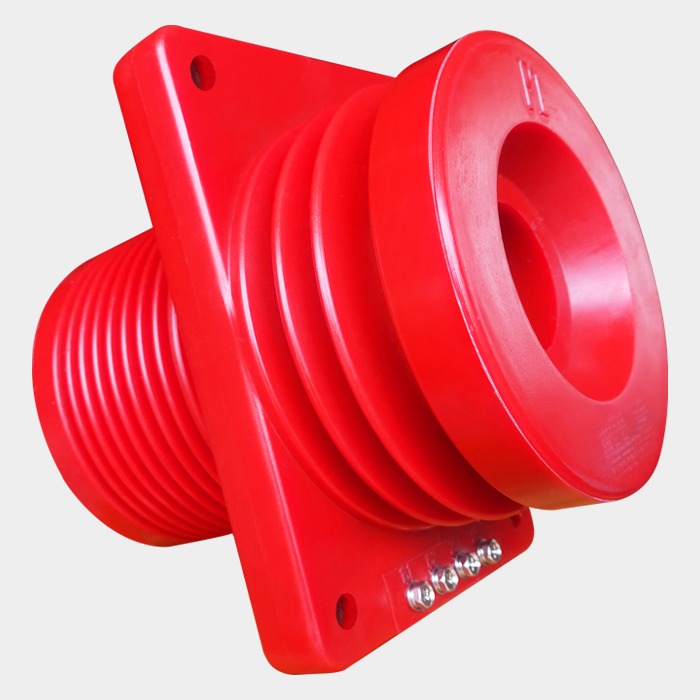
That is the mechanism behind the price inversion in the first table. The LMZJ-10 window type covers 300 to 8000 A across a US$24–140 band because the primary conductor is supplied by the installation, so the works only has to cast a window and wind a core around it. At 3000–8000 A the same model is listed with 60 VA metering and up to 100 VA protection outputs, which is where the upper end of that band comes from. The post-type LZZBJ9-10C2, by contrast, starts near US$179 at 3150 A: the primary bar, its insulation and the through-current withstand are all inside the price.
The practical consequence for a buyer is that the window type is the cheaper answer only if the panel is designed around it. It needs bar clearance, a defined bar position and enough compartment depth for the window body plus the secondary terminal block. Retrofitting one into a compartment designed for a post-type unit is where the saving disappears into bracket fabrication and cable re-routing.
Split-core designs sit at the other end. They exist to be clamped over a cable that cannot be disconnected, and the hinged core, the clamp and the lower magnetic performance that comes with a two-part core all carry a premium. They are worth it in a live retrofit and rarely worth it in new construction, where a window type does the same job for less.
Three single-phase units or one three-phase combined unit?
A three-phase combined unit puts three windows in one casting, marked A, B and C, with the ratio and classes cast into the front face and a single secondary terminal block for all three phases. It is the compact answer for a panel where three separate post-type units would compete for depth and for wiring space.
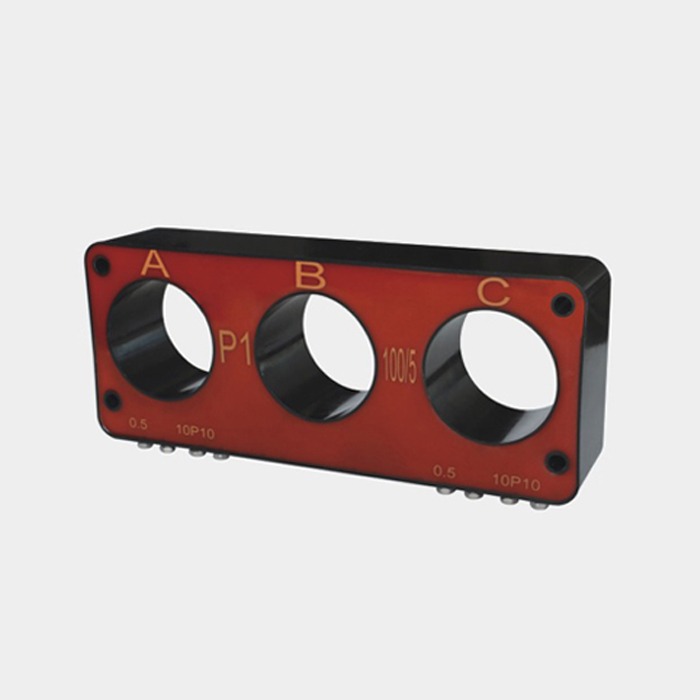
The cost comparison has to be total installed cost, not unit price. Three single-phase units mean three prices, three sets of mounting brackets, three secondary cable runs and three sets of terminal blocks; one combined unit means one price, one footprint and one wiring point. In new panel construction the combined unit usually wins that comparison. In an existing panel where one phase has failed, three separate units win, because you replace one unit rather than a casting that carries all three cores.
What has to be specified either way is identical: rated primary current and ratio per phase, secondary current, the accuracy class and rated output for each core, the short-time thermal current, and whether the three cores are independent. A combined unit whose three cores share a common magnetic circuit is a different instrument from three independent cores in one body, and the price difference between those two builds is real.
Where does short-circuit withstand show up in the quotation?
In the bar and the casting, which is why the same model can be quoted at two prices for the same ratio. On the LZZBJ9-10 the one-second thermal current runs from 0.75 kA at 5 A primary to 45 kA at 600 A and 80 kA at 3000 A, with the rated dynamic current following from 1.8 kA to 160 kA. On the LAZBJ-10 the 5–200 A rows carry 90 kA thermal and 200 kA dynamic, while the 300–400 A rows carry 24.5 kA and 44 kA.
Those figures have to be matched to the fault level at the installation point, not copied from a neighbouring project. For a 10 kV distribution feeder with a 25 kA one-second fault level, a unit rated 25 kA or above is adequate; specifying 31.5 kA where 25 kA is the real duty adds copper and a heavier casting to every unit in the order. Under-specifying is worse: the CT is then the weakest element in the compartment, and the failure mode is mechanical rather than electrical.
The ratio and the withstand interact. A low-ratio unit on a strong busbar is the hardest combination to build, because the primary has to survive a large fault current while the core still resolves a small one. That combination is where a through-bar design earns its price, and where a quotation that looks cheap for "600/5 A, 10 kV" deserves a question about the thermal rating.
Which specification mistakes cost the most money?
The expensive mistakes are almost never electrical. They are specification omissions that only surface at inspection, at commissioning, or two years later when a meter reads low. Five of them recur often enough to be worth checking before an order is placed.
- One core doing metering and protection. The accuracy that suits a meter does not suit a relay at ten times rated current, so the compromise is a second order.
- Rated output quoted without the secondary lead burden. A 10 VA core on a 100 m run may be operating outside its rated burden before it reaches the relay.
- Ratio chosen on today's load only. A feeder that doubles in three years needs a new CT and a new outage, not a new setting.
- No accuracy limit factor and no instrument security factor in the enquiry. The supplier then picks a default, and the default is not your scheme.
- 0.2S ordered across every feeder. It is the right class for revenue cores and an unnecessary premium on indication cores.
Each of these converts into a known commercial loss: a re-order with a new lead time, a rejected inspection because the certificate does not match the datasheet, a delayed energisation while a replacement is shipped, or a spare-part mismatch where the store holds a unit that does not fit the panel. Against a unit price in the tens of dollars, one delayed energisation pays for the entire accuracy class discussion several times over.
What should the RFQ contain to make two quotes comparable?
Two quotations for the same headline description are comparable only when the enquiry fixed every variable that moves the price. The list below is the minimum that turns a price into a specification, and it is short enough to attach to a tender without rewriting the technical schedule.
- System voltage, insulation level and whether the position is indoor or outdoor.
- Rated primary current and ratio, with any dual-ratio requirement, and the secondary current (5 A or 1 A).
- Per core: accuracy class, rated output in VA, accuracy limit factor for protection cores, instrument security factor for metering cores.
- Short-time thermal current and rated dynamic current, matched to the fault level at the installation point.
- Construction preference: window, bar-primary, post, or combined three-phase; mounting and terminal orientation.
- Tests and documents: routine test certificate as standard, plus any witnessed type test, calibration certificate or third-party inspection.
- Ambient temperature, altitude, pollution level and seismic requirement where they differ from standard service conditions.
- Quantity per ratio, packing and marking requirements, delivery point and Incoterm.
Send that list and the quotations will differ by a percentage, not by a factor of two. Send "10 kV CT, 600/5 A, class 0.5" and you will receive three different products at three prices, none of which you can defend at an inspection. The wording of the accuracy pair alone, 0.2S/10P10 versus 0.5/10P15, changes both the core and the copper, and therefore the price.
Where Nahu Group Fits
Nahu Group manufactures epoxy-cast current transformers from 0.66 kV to 40.5 kV, in through-window, bar-primary, cast-resin protection and split-core designs, alongside voltage transformers and metering equipment. The models priced in this article are catalogue items in the current transformer, including the LAZBJ-10 post-type unit, the LMZJ-10 busbar type, and the LZZBJ9-10 up to 3000 A. Where the CT is part of a revenue metering installation, the metering box is specified with it, because the box and the cores have to be approved together.
To get a configuration and a firm price, send the single-line diagram or panel drawing with the CT position marked, the system voltage and fault level, the ratio and accuracy pair per core, the rated output and any limit factors, the quantity per ratio, and the delivery point. That is enough to select the model, confirm the construction, and issue a dimension drawing for approval before the order is released. If the ratio sits outside a standard row, say so in the enquiry rather than after the award: for the primary ratio selection, the growth allowance is the one variable worth arguing about early.
Frequently asked questions
Why do two suppliers quote such different prices for 10 kV, 600/5 A?
Because "10 kV, 600/5 A" does not describe a product. Core grade, number of cores, accuracy class per core, rated output, short-time current and test scope are all open, and each of them moves the price. Two quotations are comparable only when the enquiry fixes those variables, which is why the RFQ list above matters more than the unit price.
Is a higher accuracy class always more expensive?
At the same ratio and output, yes, because the core has to be better and larger and the error test runs over more current points. The premium is modest per unit and repeats across every feeder. For indication and non-revenue sub-metering, class 0.5 is normally sufficient and the extra money buys nothing you will bill from.
Why is a busbar-type CT cheaper than a post-type at the same ratio?
The busbar type does not supply its own primary conductor; the installation's bar passes through the window. That removes copper, removes the primary insulation around it and simplifies the casting. The saving is conditional on the panel being designed for a window unit, with the bar position and compartment depth already fixed.
Can a class 0.5 core be used for protection?
No. A metering core saturates early by design, so that a fault current cannot damage the meter; that is what the instrument security factor describes. A protection core has to remain accurate up to its accuracy limit factor instead. Using a metering core in a protection circuit gives a relay that under-reads exactly when it is needed.
How much does a witnessed type test add to an order?
It depends on the witness arrangement and the number of units covered, so ask for it as a separate line. A type test is done once on a design and a witnessed copy is a documentation and attendance exercise; routine tests run on every unit. Quotations that differ by a small percentage are often differing only in which of the two is included.
Does the secondary lead length affect which CT I should buy?
Yes, and it is the most commonly forgotten input. Long secondary runs add burden, and a core rated 10 VA may already be at its limit before the relay is connected. Where the run is long, either specify a higher output or use a 1 A secondary; the calculation is set out in the burden and lead size guide.
Sources and further reading
- IEC 61869-2:2012 — Instrument transformers, Part 2: Additional requirements for current transformers — the accuracy classes, rated output and test requirements the datasheets above are written against
- Class PX current transformers — what changes when a differential scheme needs a knee point instead of an accuracy class
Published Nov 23, 2026 · Nahu Group (NAHU Electric Technology)