
A medium voltage current transformer is the component that steps a live feeder current down to a standard, safe secondary signal, typically 5 A or 1 A, for meters, relays, and control devices. In switchgear and substation projects, that same medium voltage current transformer often serves two masters: revenue meters rely on its accuracy to bill energy correctly, while protection relays depend on its output to detect overcurrent and earth faults. Choosing the wrong unit can distort your energy data, delay protection operation, or force a rework of the whole panel, which is why the specification deserves more attention than a single line on a bill of materials.
In this article, Nahu Group (NAHU Electric Technology) explains what “medium voltage” means for current transformers, how indoor and outdoor designs differ, why cast-resin construction dominates this class, how metering and protection cores are rated, and the parameters a complete specification sheet should carry.
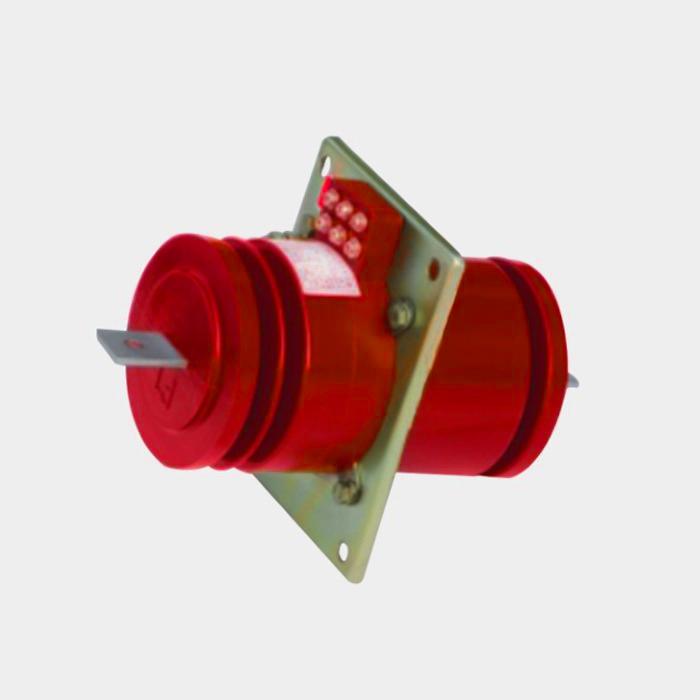
What “medium voltage” means for a current transformer
In switchgear practice, “medium voltage” covers equipment designed for system voltages above roughly 1 kV and up to the 40.5 kV class, the level used across secondary distribution networks, industrial plant distribution, ring main units, and many renewable and commercial installations. Nahu Group’s instrument transformer range spans 3 kV to 40.5 kV, so the guidance below maps directly onto products the company supplies for utility and industrial projects.
A medium voltage CT must do more than a low-voltage current transformer: it has to withstand much higher power-frequency voltage and lightning impulse levels, provide adequate creepage distance for its insulation system, and keep the secondary circuit safely isolated from the primary conductor. Its role in the power system is straightforward but critical. Metering CTs feed energy meters, power analyzers, and revenue settlement systems; protection CTs feed overcurrent, earth-fault, and differential relays. The same physical transformer frequently contains several cores, one for each duty.
Indoor vs outdoor medium voltage CTs
The first split in any specification is the installation environment. Indoor medium voltage CTs live inside switchgear panels, ring main units, metering cubicles, and metal-enclosed switchboards, where they are protected from weather but still face heat, electric field stress, and occasional condensation. They are usually more compact, with a smaller creepage profile and a simple post, busbar, or window mounting that suits panel assembly.
Outdoor units, by contrast, are mounted on poles, structures, or open substations where they are exposed to sun, rain, salt, and industrial pollution. Their insulation must carry long creepage paths and weather sheds, and the terminals and casing must tolerate temperature swings and moisture for decades. When a project specifies an outdoor CT, the pollution class and altitude of the site are just as important as the voltage and current ratings, because both influence the creepage distance and dielectric design.
Cast-resin construction: why it dominates this class
Most medium voltage current transformers sold today use cast-resin (epoxy) insulation. The winding and core are embedded in epoxy resin under vacuum, which gives the unit a solid, homogeneous dielectric that resists moisture, dust, and partial discharge far better than open or taped constructions. Cast resin also provides mechanical strength, so the transformer can be mounted directly on the switchgear busbar chamber, and it keeps the primary-to-secondary and primary-to-earth insulation consistent across production.
For outdoor versions, the resin body is molded with weather sheds and formulated for UV and pollution resistance. For indoor units, the casting is usually smooth and compact. Either way, the casting protects the internal winding during handling and installation, which matters on busy construction sites where panels are moved, lifted, and terminated under time pressure.
Metering cores vs protection cores
A single CT can carry several secondary cores with different performance targets, and confusing them is one of the most common specification errors. Metering cores are designed for accuracy around normal operating current, where billing and energy data live. They use classes such as 0.2S and 0.5S, where the S denotes high accuracy down to 1% of rated current, exactly the region where meters must be correct. Protection cores, on the other hand, are designed to keep transforming faithfully at many times rated current, so relays can see fault current before the core saturates. They are rated with classes such as 5P and 10P together with an accuracy limit factor, for example 5P10, meaning the composite error stays within 5% up to 10 times the rated primary current.
When a feeder needs both revenue metering and protection, engineers typically request a CT with separate metering and protection cores instead of trying to make one core do both jobs. Each core is then connected to its own devices, with its own burden, so the protection relay never drags the meter’s accuracy and the meter never compromises the relay’s fault performance.
How to specify a medium voltage current transformer
A complete medium voltage CT specification answers the questions below. Missing items usually surface later as change orders or commissioning delays, so it is worth filling every line before you send the enquiry.
- System voltage and insulation level: The nominal system voltage, such as 12 kV or 35 kV, plus the rated power-frequency and lightning impulse withstand levels required by the switchgear.
- Primary and secondary current: The rated primary current at full load and the standard secondary output of 5 A or 1 A.
- Current ratio: The turns relationship, such as 600/5 A, and whether a multi-ratio or tapped arrangement is needed for future load growth.
- Accuracy classes per core: Metering class (0.2S or 0.5S) and protection class (5P or 10P) with its accuracy limit factor, assigned core by core.
- Rated burden (VA): The total load presented by connected meters, relays, pilot wiring, and terminal blocks, so the chosen VA rating covers it with margin.
- Short-time thermal and dynamic withstand: The rated short-time thermal current (for example 31.5 kA for 1 s or 4 s) and the dynamic peak current the CT must survive during faults.
- Frequency: Usually 50 Hz or 60 Hz depending on the country and project.
- Mounting and window: Post-type, busbar-type, or winding-type mounting, plus the window or busbar size and fixing dimensions for the panel.
- Standard compliance: Conformity with IEC 61869-1 and IEC 61869-2, which govern general requirements and current transformer performance.
Nahu models and how to confirm your selection
Nahu Group’s medium voltage current transformer line is organized around the same two environments. The LA-10 indoor current transformer is an indoor epoxy-resin cast post-type current transformer for the 3–12 kV voltage class, offering metering accuracy of 0.2S/0.5S and protection accuracy of 5P/10P, with custom ratios available on request. For indoor switchgear that needs a compact cast-resin solution with 0.2S metering performance, the LZZBJ9-10 is the indoor cast-resin CT that appears across Nahu’s published product information. Where the project moves to outdoor service, the outdoor 35 kV class is served by models such as the LZZW and LZZBJ71-35, whose names confirm their weather-facing design but whose exact ratings should always be confirmed against the current datasheet.
Because every installation differs, the strongest specification is one built from real project data: a single-line diagram, the feeder full-load current, the relay and meter models, the wiring length, and the panel drawings. With those inputs, the parameters above can be fixed in minutes rather than guessed. If you are sourcing current transformers for a medium voltage project, browse the current transformer product range at Nahu Group or contact the engineering team with your system voltage, ratio, and accuracy requirements.
Published September 2, 2026 · Nahu Group (NAHU Electric Technology)