
The line that decides whether a vacuum circuit breaker nameplate is acceptable is the pair formed by rated normal current and rated short-circuit breaking current. A plate reading 2000 A with 31.5 kA is a different product from one reading 2000 A with 20 kA, and only that pair tells you which fault level the switchgear can actually clear.
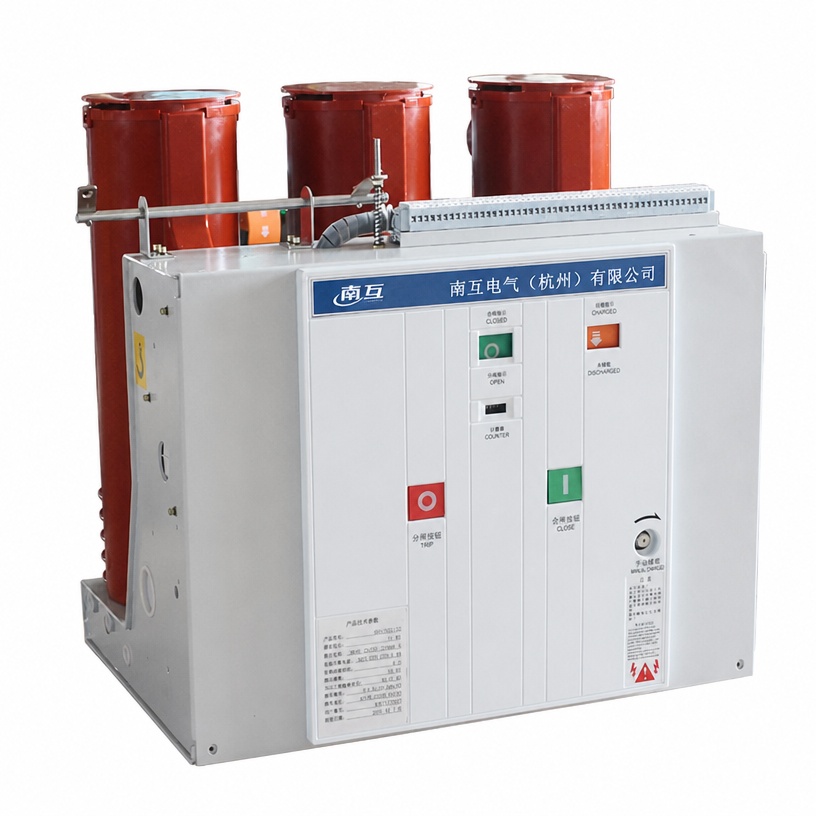
Everything else either supports that pair or records the identity of the unit: model and serial number, year, insulation level, withstand current with its duration, mechanical life, and the standard the ratings are declared against. The governing document for this family is IEC 62271-100, and a plate whose ratings cannot be mapped onto that standard cannot be inspected against it.
Which two lines on the plate decide whether the unit is acceptable?
Rated normal current is the continuous current the breaker carries within its temperature limits; rated short-circuit breaking current is the symmetrical fault current it can interrupt at rated voltage. They are declared as a pair because the current path that carries 3150 A continuously is not the hardware that interrupts 20 kA. On the vacuum circuit breaker, the indoor ZN63A (VS1)-12 is offered at 20/25 kA, 31.5 kA and 40 kA, each with its own current set: 630 or 1250 A at 20/25 kA, up to 3150 A at 31.5 kA, and 1250 to 3150 A at 40 kA. A plate reading 2000 A at 20 kA is not a cheap version of the same breaker; it is a different rating that fails the fault-level check for the board it is fitted to.
What do the breaking, making and withstand currents commit the breaker to?
Three current values are frequently confused, and each answers a different question. Breaking current is what the breaker interrupts. Making current, given as a peak, is what it can close onto without welding the contacts. Short-time withstand current, given with a duration, is what the closed breaker survives while the upstream protection clears. Across the range the peak values run at roughly 2.5 times the breaking current: the ZW32-12 declares 20 kA breaking with 50 kA peak, the AB-3S-40.5 declares 31.5 kA with 80 kA, and the ZN63A-12 declares 100 kA peak at 40 kA. That factor is worth memorizing, because a plate quoting 40 kA with a 63 kA peak is internally inconsistent, and a device bought only to switch load is a different comparison altogether.
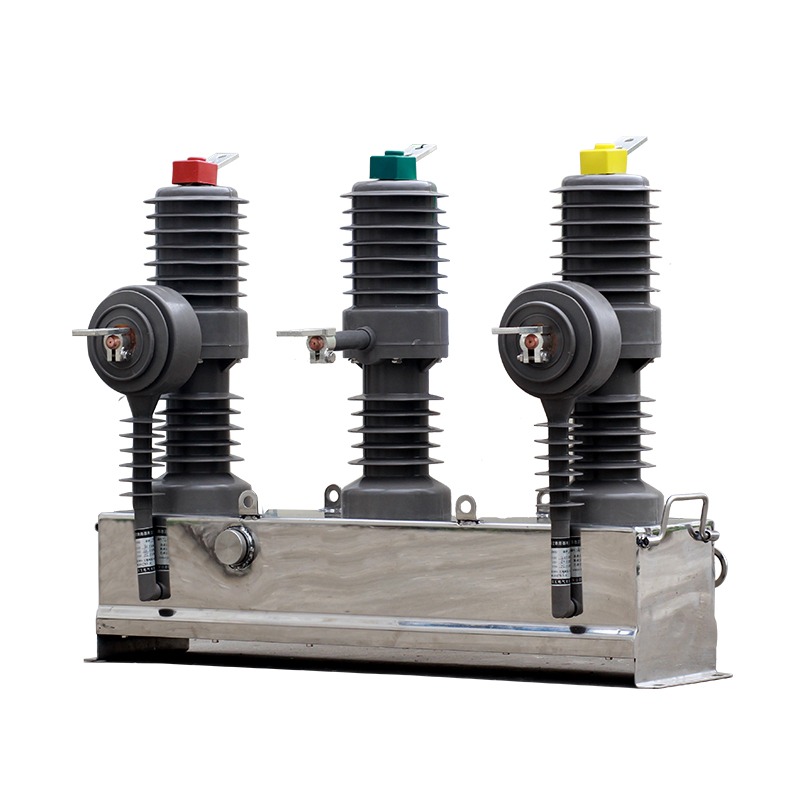
The duration is where plates are weakest. The AB-3S-40.5 states its 31.5 kA short-time withstand for 4 s; the ZW32-12 datasheet states 20 kA and leaves the duration to the standard. On a tender comparison that gap is invisible, yet a 1 s and a 4 s declaration are not the same product. The operating sequence belongs on the plate for the same reason: O-0.3s-CO-180s-CO on the ZN63A-12 describes the duty cycle the mechanism is expected to survive, not a marketing claim.
What do the insulation lines on the plate actually prove?
Two numbers, not one. The lightning impulse level is the peak voltage the insulation survives from a surge; the power frequency value is the one-minute AC test voltage. For 12 kV equipment in this range both are consistent: 75 kV impulse and 42 kV AC, whether the breaker is the indoor ZN63A (VS1)-12 or the outdoor ZW32-12. Outdoor plates split the AC value into wet and dry, which is why the ZW32-12 reads 42/48 kV, and may split the impulse value across the open break at 75/85 kV. At 40.5 kV the same two lines read 185 kV and 80/95 kV on the AB-3S-40.5. These values prove the insulation was designed to a level; they do not prove it was tested on your unit, which is what the routine test report is for.
How do three common plate sets compare, line by line?
The table below puts the declared values of the three families side by side as they appear on the product pages, so a buyer can hold a supplier plate against a known set instead of reading each value in isolation.
| Plate entry | ZN63A (VS1)-12 indoor | ZW32-12 outdoor | AB-3S-40.5 pole-mounted |
|---|---|---|---|
| Rated voltage | 12 kV | 12 kV | 40.5 kV |
| Rated normal current | 630 to 3150 A by breaking level | 630 A | 1250 / 1600 A |
| Rated breaking current | 20/25, 31.5, 40 kA | 20 kA | 31.5 kA |
| Rated peak making current | 63 / 80 / 100 kA | 50 kA | 80 kA |
| Short-time withstand | 20/25, 31.5, 40 kA | 20 kA | 31.5 kA for 4 s |
| Insulation level | 75 kV impulse, 42 kV AC | 75/85 kV impulse, 42/48 kV AC | 185 kV impulse, 80/95 kV AC |
| Mechanical life | 10 000 operations | 10 000 operations | 20 000 operations |
| Fault current interruptions | 50 | 30 | 30 |
| Control supply | Not stated on the page | Not stated on the page | DC 220 V, permanent magnet |
Which entries are manufacturing record rather than rating?
The serial number, year of manufacture, standard reference, mass and drawing number are not performance claims, but they make the claims checkable. The serial number is the key to the routine test report for that unit; the year tells you which edition of the standard it was declared against; the mass matters when a pole-mounted unit has to be lifted onto a crossarm. Control voltage sits between the two groups: it is a rating, and it is the one most often mismatched, because a permanent magnet mechanism declared at DC 220 V will not operate from a 110 V station battery. To see how much of the device the plate leaves out, the four parts that decide VCB life are a better guide.
What goes wrong at inspection when the plate and the purchase order disagree?
The most expensive failure is not a wrong breaker; it is a right-looking breaker with one wrong line. Four mismatches account for most rejections: a breaking current one step below the ordered level, a withstand current quoted without its duration, a control voltage that does not match the station battery, and a mechanical life figure copied from a spring mechanism onto a permanent magnet unit. Each is a few characters on a plate and a full commercial event on site. A 20 kA unit delivered against a 25 kA order forces the fault level study, the relay settings and the board inspection to be redone after shipment. A 10 000-operation mechanism against a 20 000-operation requirement shows up years later as an early replacement, with no spare on the shelf.
| Check at goods-in | Compare against | Accept only when |
|---|---|---|
| Rated current and breaking current | Approved drawing and PO line | Both values match the ordered pair, not just the current |
| Short-time withstand | Specification clause | Current and duration both stated on the plate or datasheet |
| Insulation level | System voltage class | Impulse and AC values suit the class, wet and dry where outdoor |
| Control voltage | Station battery and tripping scheme | Coil and mechanism voltage match the DC supply on site |
| Serial number and year | Routine test report | Report exists for that serial and travels with the unit |
What should the RFQ require the supplier to mark on the plate?
Write the plate content into the enquiry as a requirement, not as a hope. It must carry rated voltage and insulation level, normal current, breaking current, peak making current, withstand current with its rated duration, the operating sequence, mechanical life and interruption count, control and motor supply voltages, the standard edition, serial number, year of manufacture and mass. Add three practical clauses: the plate is fixed to the mechanism housing and legible after painting, lettered in English with a second language only if the project asks for it, and a photograph of the plate is sent with the routine test report before packing. If the specification is still being drafted, the 11 kV VCB specification clauses keep plate and rating text consistent, so the two documents cannot contradict each other at inspection.
Where Nahu Group Fits
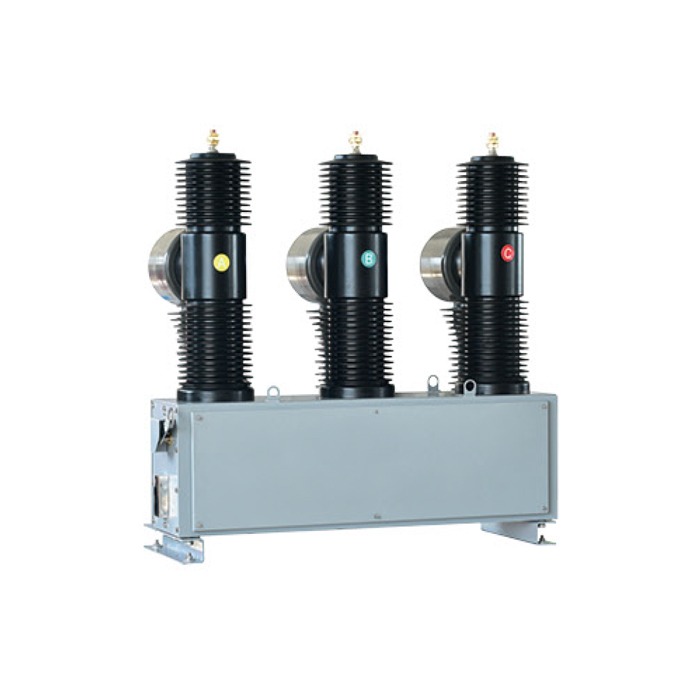
Nahu Group manufactures vacuum circuit breakers for 12 kV and 40.5 kV distribution: the indoor ZN63A (VS1)-12 for switchgear panels, the outdoor ZW32-12 for pole-mounted distribution, and the AB-3S-40.5 permanent magnet breaker for 35 kV substation outgoing circuits. Ratings, mechanism type and plate content are confirmed against the approved drawing before production. Send the single line diagram or panel drawing, the rated voltage and current, the fault level, the control supply voltage and the quantity, and the engineering team will return a configuration with the plate data written out.
Frequently asked questions about reading a VCB nameplate
What are the main details on a vacuum circuit breaker nameplate?
A plate normally carries the model and serial number, year of manufacture, rated voltage and insulation level, rated normal current, rated breaking current, rated peak making current, short-time withstand current with duration, the operating sequence, mechanical life and interruption count, the control supply voltage, the reference standard and the mass of the unit.
Is rated current the same as breaking current?
No. Rated current is the continuous current the breaker carries without exceeding its temperature limits, and it is usually given in amps. Breaking current is the fault current it can interrupt, given in kiloamps. The two are declared as a pair because a breaker rated for a high continuous current is not automatically able to interrupt a high fault current.
What does a short-time withstand current without a duration mean?
It means the declaration is incomplete. A withstand current only means something with the time it must be withstood, commonly 1 s or 4 s. Ask the supplier to state both, and compare the pair against the protection clearing time on your network rather than accepting the current figure on its own.
Why does an outdoor breaker show two insulation values?
Because outdoor insulation is tested both dry and wet, and the wet value is the lower one. Indoor breakers usually show a single power frequency value. Outdoor plates may also split the impulse level across the open break, for example 75 kV to earth and 85 kV across the contacts.
What should I do if the plate does not match the purchase order?
Do not accept the unit into stock. Photograph the plate, quote the serial number and the mismatched line in writing to the supplier, and hold the inspection until a corrected plate or a replacement unit is agreed. A plate that disagrees with the order is a documentation failure even when the breaker itself would function.
Published Nov 18, 2026 · Nahu Group (NAHU Electric Technology)