
An 11kV vacuum circuit breaker specifications document is a procurement instrument before it is a technical brochure: it fixes the ratings, the operating mechanism, the interlocks, the enclosure and the test evidence a supplier must deliver, and it is written so that every requirement can be checked at delivery. If a clause cannot be verified against a datasheet or a test report, it does not belong in a specification.
Disputes on medium-voltage switchgear packages rarely begin with a breaker that failed. They begin with a specification that left one parameter unstated, so the supplier filled the gap with the cheapest option available. Read a specification as a contract: rated voltage and insulation level, rated normal current, rated short-circuit breaking current, rated short-time withstand current with its duration, mechanism type, interlock scheme, enclosure and IP rating, auxiliary contacts, and the tests the supplier must evidence.
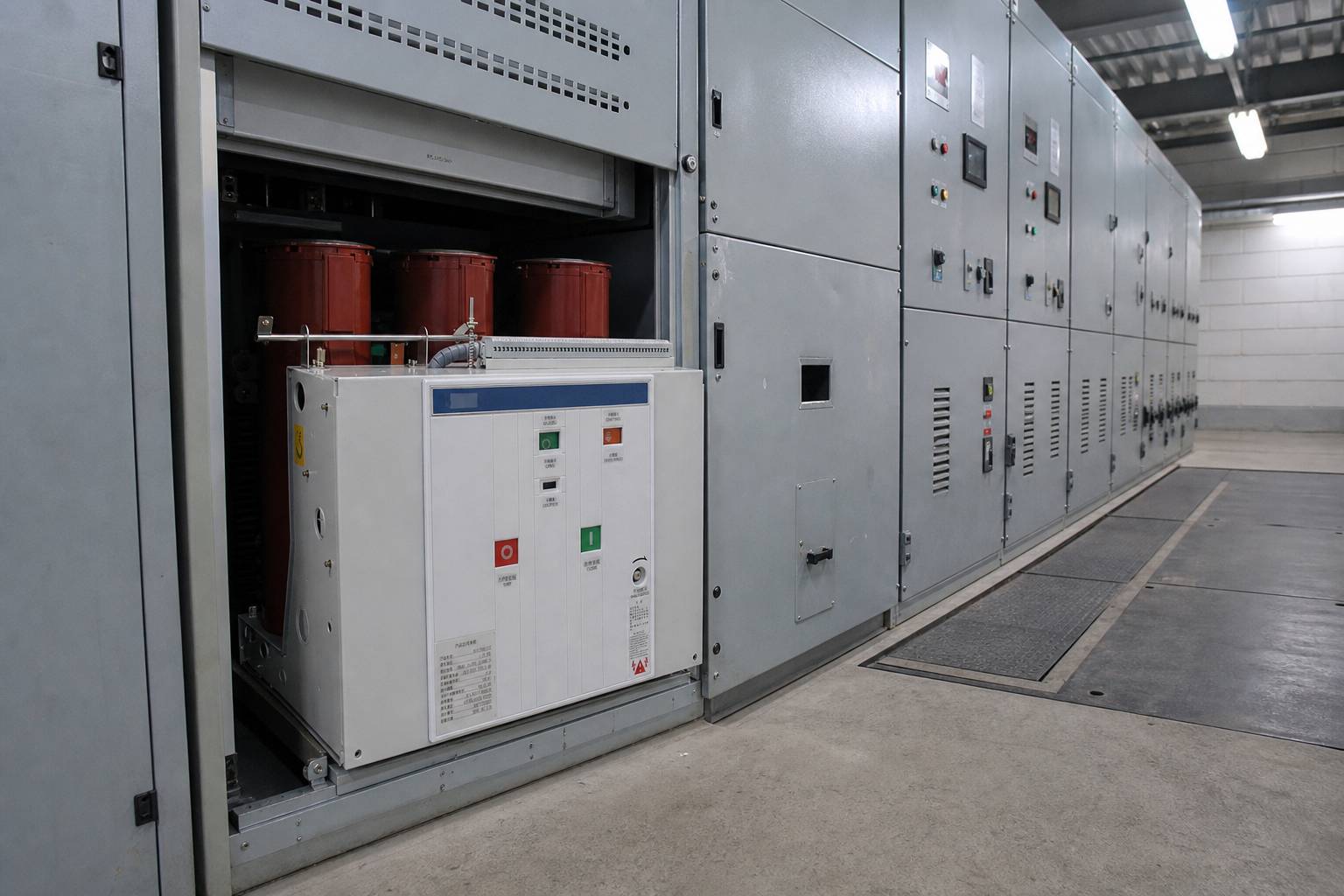
The document only makes sense against a standard, and the governing one for this family is IEC 62271-100, High-voltage switchgear and controlgear – Part 100: Alternating-current circuit-breakers. Its current third edition, published in 2021, applies to three-phase AC circuit breakers designed for indoor or outdoor installation and for operation at 50 Hz and/or 60 Hz on systems having voltages above 1 000 V. That scope sentence is worth quoting in your own document, because it tells the supplier which equipment family you are buying and which type tests apply.
What Must an 11kV Vacuum Circuit Breaker Specification Actually Contain?
A complete document answers ten questions and leaves the supplier no room to choose. Check your draft against this list before it goes to tender:
- Rated voltage, and the rated insulation level the standard ties to it.
- Rated normal current, with the ambient and enclosure conditions it applies to.
- Rated short-circuit breaking current – the vacuum circuit breaker breaking capacity that matters most in fault clearing.
- Rated short-time withstand current, always written with its rated duration.
- Mechanism type, charging method and control voltages.
- Every interlock, named individually rather than described in general terms.
- Enclosure construction, IP rating, and internal arc classification where people may stand near the switchgear.
- Auxiliary contacts, including normally-open and normally-closed counts and the terminal arrangement.
- The type tests and routine tests to be evidenced, each against a named standard.
- The standard editions to be cited, with the year, so that a current edition cannot be swapped for an older one.
If a datasheet can satisfy any of those points with a blank cell, the specification is not finished.
Why Does the Rated Voltage Clause Come First in an 11 kV VCB Specification?
Because rated voltage is a standard value, not a copy of the system voltage on the single-line diagram. For switchgear, the next highest standard value above the maximum operating voltage is taken as the rated voltage, and that value in turn fixes the dielectric requirements. A widely used engineering reference sets out the rule and the medium-voltage insulation levels in a table of primary rated values: 3.6, 7.2, 12, 17.5, 24, 36 and 52 kV, each with its rated short-duration power-frequency withstand voltage and its rated lightning impulse withstand voltage. On a nominal 11 kV system the next standard value above it is 12 kV, and the insulation level follows 12 kV rather than the buyer's preference.
This is where an 11 kV VCB specification is most often muddled. Buyers write "11 kV" in every clause, the supplier quotes a 12 kV rated breaker, and the paperwork no longer matches the tender. State the system voltage for context, then state the required rated voltage as a standard value, and require the supplier to declare the insulation level with it. If the site needs extra withstand because of pollution, altitude or cable-charging duty, say so explicitly instead of assuming the standard value will cover it.
Which Current Ratings Must Be Stated, and Which Are Optional?
Four current parameters carry most of the risk, and each one answers a different question.
Vcb rated current is the continuous current the breaker carries within its temperature limits, and it is meaningless unless the ambient conditions, enclosure type and installation altitude appear in the same clause. A rating quoted for other conditions is not the rating you are buying.
Rated short-circuit breaking current is the fault current the breaker can interrupt, and it belongs next to the rated operating sequence and the recovery voltage conditions under which it was demonstrated. IEC 62271-100 states that its making and breaking test provisions rely on direct testing methods, with synthetic testing handled by a separate document, so a supplier quoting synthetic evidence should be asked to say so. Never accept an unlabelled breaking capacity figure.
Rated short-time withstand current is a withstand rating, not a switching rating, and it is always paired with the rated duration of short circuit. The same reference notes that the peak current and short-time current are withstand variables while the making and breaking currents express switching capacity, and that the standard fixes a relationship between them: a peak-to-short-time ratio of 2.5 for 50 Hz equipment and 2.6 at 60 Hz. That ratio is a useful sanity check. If a datasheet quotes a peak withstand figure that does not follow from the short-time current, one of the two numbers is wrong or belongs to another configuration.
The rated short-circuit making current should be stated separately from the peak withstand current, because the two are demonstrated for different purposes and reviewed by different people.
How Should the VCB Operating Mechanism Be Specified?
Mechanism clauses go wrong when they stop at a word like "spring". A usable clause names the family, then specifies how the stored energy is produced, how commands are given, and what the mechanism reports back:
- Stored-energy spring mechanism, charged by motor or manually, with the charging state visible without opening a door.
- Closing coil, tripping coil and any undervoltage or shunt release, with control voltage and supply source.
- Anti-pumping behaviour, so a held closing command cannot cause repeated closing operations.
- Mechanical position indication and an operation counter a maintenance planner can read.
- Auxiliary switches for remote indication, coordinated with the auxiliary contacts listed elsewhere.
Ask for the mechanism endurance class and the number of operations it corresponds to, and ask which document evidences it. A mechanism clause with no endurance claim cannot be checked at delivery.
Which VCB Interlocks Must Be Written Into the Specification?
Interlocks are safety functions, and they are also the first thing a competitive quotation trims, because a missing interlock stays invisible until an operator tries to do something dangerous. Name each one:
- The breaker cannot be racked or withdrawn unless it is open.
- The breaker cannot be closed unless it is fully in a defined service or test position.
- The earthing switch cannot be closed while the breaker is in service, and vice versa.
- Cable compartment access is blocked while the circuit is live.
- Key interlocks where a sequence must be forced between two items of equipment, for example before busbar earthing.
Interlocks are also a tested function, not a mechanical detail. The current edition of IEC 62271-102 for disconnectors and earthing switches introduced additional withstand requirements for interlocking devices and a dedicated subclause for testing mechanical interlocking devices, and the metal-enclosed assembly standard treats interlock verification as part of type testing. Ask for interlock type test evidence, and ask for the logic to appear as a sequence table in the supplier's document set rather than as prose.
How Do You Specify Enclosure, IP Rating and Auxiliary Contacts?
The assembly around the breaker has its own document. Metal-enclosed switchgear and controlgear for rated voltages above 1 kV and up to and including 52 kV is covered by IEC 62271-200, which deals with prefabricated assemblies for alternating current in indoor and outdoor installations and refers to the circuit breaker standard in its own requirements. Cite it whenever the breaker is supplied inside a panel, because compartmentalisation, pressure relief and internal arc behaviour are specified there.
On ingress protection, the IP code is a two-numeral system: the first numeral grades protection against solid objects on a scale from 0 to 6, the second grades protection against liquids from 0 to 9. The IEC explains the scheme on its own IP ratings page and points to IEC 60529 for the full definitions and test conditions. Write the two numerals you need, say whether they apply to the enclosure or to one compartment, and require verification evidence. Indoor and outdoor installations rarely deserve the same rating.
Auxiliary contacts are easy to under-specify. State how many normally-open and normally-closed contacts remain spare after the internal functions are wired, state the terminal arrangement, and say whether contact state must be proven during routine testing. Then repeat those counts in the mechanism and protection clauses.
Which Tests Must the Supplier Evidence, and Under Which Standards?
A specification should not ask for "test certificates". It should ask for named tests, against named standards, for the exact configuration offered. For a medium-voltage vacuum breaker and its panel the evidence list normally covers dielectric verification, temperature rise, short-circuit making and breaking, mechanical operation and endurance, interlock function, and ingress protection.
Be precise about which of those are type tests and which are routine tests, because the two are not interchangeable: a routine test on the unit you receive does not replace a type test on the design. Ask for the report, the laboratory, the date, the configuration tested and the standard edition used. Then ask what has changed in the design since the test, and what in that change could affect the result. That question resolves a surprising share of approval queries.
How Do You Read a Supplier Datasheet Against 11kV Vacuum Circuit Breaker Specifications?
Read the datasheet the way you wrote the specification: parameter by parameter, in the same order, with the same demand for conditions. Four habits separate a real comparison from a glance at a headline rating.
- Compare conditions, not just figures. A current rating is comparable only when ambient, enclosure and altitude match.
- Treat silence as a deviation. If the specification asks for an interlock and the datasheet never mentions it, you have found a gap, not an acceptance.
- Watch for a change of parameter. A datasheet that answers a breaking capacity question with a making current figure has not answered the question.
- Check the standard edition. A report against an older edition of the common specification needs a written explanation before it enters the approval file.
Where an 11kV vacuum circuit breaker specifications document is silent, the datasheet wins by default, because nothing else defines the requirement. That is exactly how scope gaps appear in a package that looked compliant at quotation stage.
Two Documents, One Parameter: Requirement Versus Claim
The table below is the shape of a review sheet that works for any 11 kV VCB specification. Every row that cannot be filled from the datasheet is a question for the supplier.
| Written in the specification | Written in the datasheet | |
|---|---|---|
| Rated voltage | Standard value with insulation level | Often only the system voltage |
| Rated normal current | Current plus ambient conditions | A figure, conditions unstated |
| Breaking capacity | Rated short-circuit breaking current | May quote making current instead |
| Short-time withstand | Current and duration together | Duration frequently omitted |
| Mechanism | Family, charging, endurance | Coil voltage only |
| Interlocks | Each interlock named | One generic sentence |
| Enclosure | IP rating and arc classification | IP rating alone |
| Tests | Named tests and standards | A list of certificate titles |
Ask for that table back, completed by the supplier, as part of the technical offer, and keep a living deviation list. A package with twenty open questions is easier to close than a package with two that nobody wrote down.
Where the Specification Meets the Rest of the Package
A specification never stands alone. The ratings you write have to survive the way the panel is operated and maintained, which is why it is worth reading the specification alongside the practical guide to vacuum circuit breakers and the testing procedure reference before the document is issued. If the switchboard includes ring main units, the same ratings discipline applies to the ring main unit configurations that share the busbar, and the interlock scheme has to be agreed across the whole assembly rather than per panel.
Nahu Group manufactures 10–35 kV distribution equipment – instrument transformers, metering boxes, load break switches, ring main units, vacuum circuit breakers, surge arresters, drop-out fuses and cable branch boxes – so a breaker offer often arrives together with the surrounding equipment. That is convenient, and it is also a reason to be strict: ask the supplier to identify, for each item, which type test report covers it, which standard edition that report cites, and which configuration was on the test bed. Nothing here is a claim about any particular product; it is a list of questions that any buyer is entitled to ask and that a serious manufacturer will answer in writing.
For 10–35 kV distribution equipment, see the vacuum circuit breaker range, or send the specification to the engineering team and ask which clauses need tightening before the document goes to tender.
Frequently Asked Questions About VCB Specifications
What is the minimum content of an 11kV vacuum circuit breaker specification?
At minimum it must state the rated voltage, the rated normal current, the rated short-circuit breaking current, the rated short-time withstand current together with its duration, the operating mechanism type, the interlock scheme, the enclosure and IP rating, the auxiliary contact arrangement, and the type tests the supplier is required to evidence against named standards.
Should a specification ask for 11 kV or 12 kV rated equipment?
Rated voltage is a standard value rather than a copy of the system voltage. On a nominal 11 kV system the next standard value above it is 12 kV, and the insulation level follows that value, so the specification should name the rated voltage and the insulation level and treat 11 kV as the system condition it has to cover.
How is vcb rated current different from breaking capacity?
Rated current is the continuous current the breaker carries within its temperature limits, while breaking capacity is the short-circuit current it can interrupt. They are separate ratings, and a breaker that carries a large continuous current is not automatically able to interrupt a large fault current.
Why must the duration be written next to the short-time withstand current?
Because a withstand current is only meaningful with the time it must be withstood. The standard treats the current and its duration as one rating, so a specification that lists the current alone leaves the supplier free to declare the shorter duration.
What should the specification say about the vcb operating mechanism?
It should name the mechanism family, such as a stored-energy spring mechanism charged by motor or manually, and then state the closing and tripping coil voltages, which releases are required, whether anti-pumping is needed, and what position indication and operation counting the buyer expects.
Which vcb interlocks have to be listed explicitly?
List the interlock that prevents racking or withdrawing a closed breaker, the one that prevents closing unless the breaker is in a defined service or test position, the earthing switch interlock, the compartment access interlock and any key interlock used for busbar earthing. Interlocks that are not listed are the interlocks that get left out.
Is an IP rating the same as internal arc classification?
No. The IP code grades an enclosure against the ingress of solid objects and liquids, and it is defined in IEC 60529. Internal arc classification describes performance during an internal fault and is demonstrated by a different type test, so a specification should ask for both where the switchgear is accessible to people.
How do you check a supplier datasheet against the specification?
Build a line-by-line table with the specified value in one column and the datasheet value in another, mark every cell that is silent, lower or differently qualified, and require a written statement for each one. An empty cell is a deviation, not an acceptance.
Published September 23, 2026 · Nahu Group (NAHU Electric Technology)