
A vacuum circuit breaker VCB is bought as four sub-assemblies — the vacuum interrupter, the pole insulation, the operating mechanism and the contact-wear indication — and each one needs its own line in the specification. Suppliers quote a model number and a price; what decides whether the breaker survives fifteen years on a feeder is how those four parts were chosen, and whether the enquiry forced the supplier to state them.
This is a construction teardown for the engineer who has to approve a datasheet, witness a routine test or explain why two breakers of one rating behave differently on site. Working principle is covered separately in the vacuum circuit breaker guide.
What Does a Vacuum Circuit Breaker VCB Consist Of at the Pole?
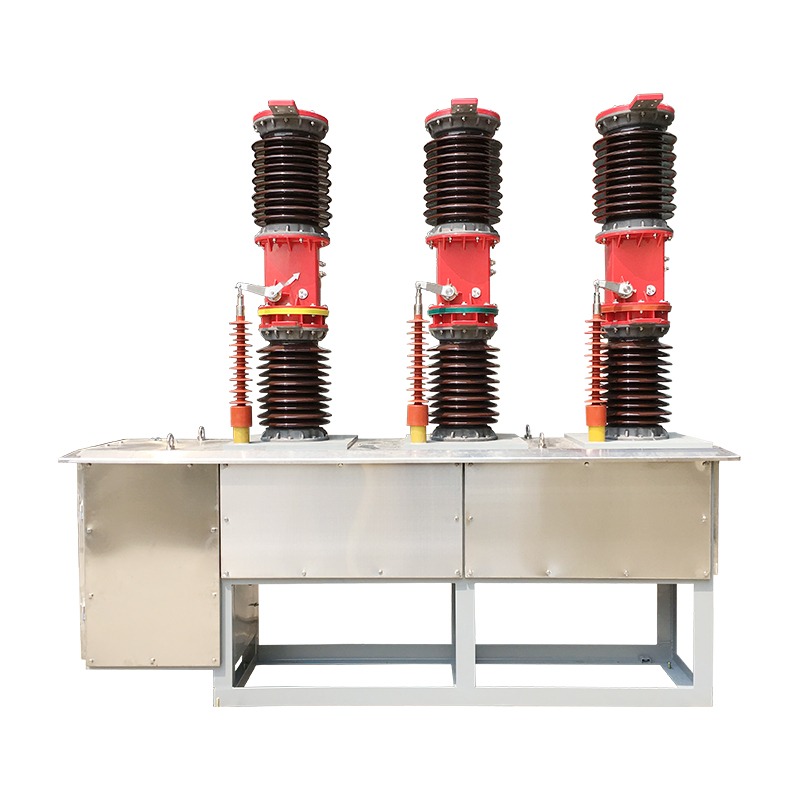
One pole of an outdoor 12 kV breaker reads from top to bottom as: top terminal, upper shedded envelope, vacuum interrupter, lower shedded envelope, bottom terminal, and inside the base a linkage joining the moving contact stem to the mechanism. On many designs the ring current transformer is mounted around the lower envelope, which is why its ratio cannot be changed later without changing the pole.
Three parts are electrical and one is mechanical, and they fail differently: the interrupter when it has spent its electrical endurance, the envelope when pollution and UV have eaten the shed surface, the mechanism when its coils or capacitor supply are wrong for the site. A specification listing only rated voltage and current leaves all three open.
| Sub-assembly | What it decides | What the specification must state |
|---|---|---|
| Vacuum interrupter | Breaking capability, endurance | Rated short-circuit breaking current, standard edition type-tested to, endurance classes |
| Pole insulation | Creepage, arcing distance, pollution and UV behaviour | Material, specific creepage in mm/kV, arcing distance, IP rating |
| Mechanism | Operating times, energy source | Spring or magnetic actuator, control voltage and tolerance, anti-pumping |
| Wear indication | Whether erosion is readable without dismantling | Erosion mark or stroke gauge, counter, the maker's limit |
| Current transformers | Protection, metering, later ratio change | Ratio, class, burden, mounting, split or solid core |
Inside the Vacuum Interrupter: What the Ceramic Envelope Hides
The interrupter is a sealed alumina ceramic cylinder with a fixed contact at one end and a moving contact at the other; the moving stem passes through a stainless bellows that keeps the vacuum while allowing a stroke of a few tens of millimetres. A metal vapour shield keeps arc products off the inner ceramic wall so dielectric strength recovers quickly, and a getter absorbs residual gas over life.
None of this is visible or serviceable, so the only evidence of condition is external. The buying decision therefore rests on the type test report and the declared endurance classes; a breaker without a traceable type test to the current edition of the breaker standard is a different product from one that has it, at an identical nameplate.
Two details are cheap to state and expensive to discover late: the contact material, and whether the interrupter is rated for capacitor-bank or reactor switching, since restrike duty is a separate type test a general-purpose rating does not cover. Add the mechanical endurance class too — a breaker specified for a few thousand operations on a feeder that trips weekly reaches its limit inside the warranty.
The Operating Mechanism: Spring Stored Energy or Magnetic Actuator
A spring mechanism charges a closing spring with a small motor and releases it on command; opening uses a second spring charged during closing. Its weak points are the motor, the limit switch, the coils and the latch. A magnetic actuator holds the closed position with a permanent magnet and drives the contact with a coil pulse from a capacitor bank. It removes the latch and most of the linkage, which suits pole-mounted breakers where access is poor, but moves the reliability question to the capacitor supply and its supervision.
On any vacuum circuit breaker VCB the control supply is a specification item. A mechanism ordered for 110 V DC and installed on a 220 V DC station battery, or an actuator whose capacitor is unsupervised, passes factory tests and fails the first remote operation. Practice varies between utilities, so state the supply, its tolerance and the trip-circuit supervision rather than assuming them.
The Insulation Envelope: Cast Epoxy, Porcelain or Silicone
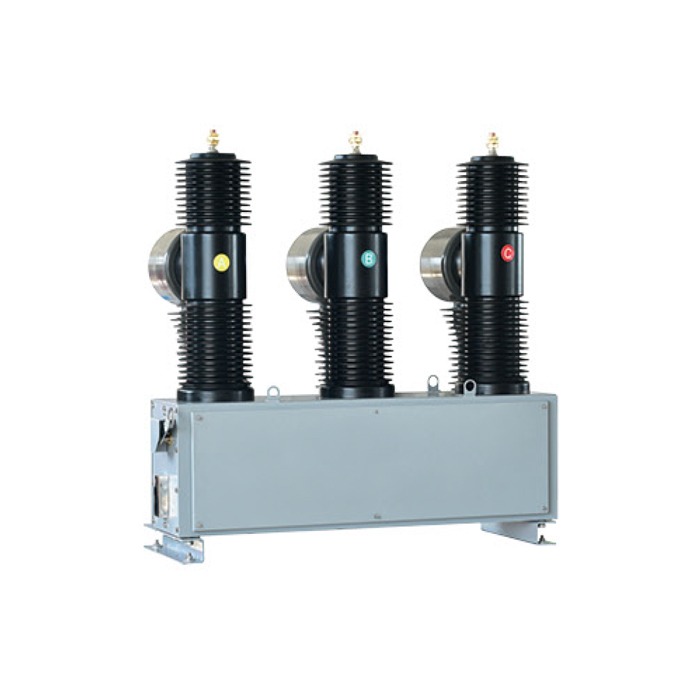
Indoor breakers almost always use cast epoxy poles: the interrupter is potted into an epoxy cylinder with sheds moulded on, giving a compact part with good tracking resistance in a clean switch room. Outdoors, porcelain stays common at 40.5 kV because it is dimensionally stable and well documented; silicone-housed poles are lighter and resist pollution better because the surface stays hydrophobic, which matters where sand abrasion and salt fog erode porcelain.
The number that sizes that envelope is specific creepage, in millimetres per kilovolt of highest system voltage, chosen for the pollution level at the site rather than for the country. A coastal Gulf substation and an inland one three hundred kilometres away are the same voltage and not the same insulator. Ask for the creepage figure and the pollution level it was dimensioned for, and have arcing distance — the straight-line clearance between open contacts — stated separately, because creepage along a shed profile does not substitute for it.
How Contact Wear Is Indicated, and How to Read It
Contact erosion is cumulative and irreversible, so every reputable design gives the crew a way to judge it without opening the vacuum. Four methods are used, none interchangeable, and the datasheet should name the one fitted.
| Method | How it is read | What invalidates the reading |
|---|---|---|
| Erosion mark on the moving stem | A groove or step shows how far the contact has been consumed; compare with the maker's limit | Dirt over the mark; a stem replaced without a new reference |
| Stroke measurement | Travel between reference points measured with a gauge against new and worn values | Linkage adjusted after the last reading; a non-standard gauge |
| Contact resistance | Micro-ohm reading across the closed pole, tracked as a trend rather than pass or fail | Different instruments or contact pressures between readings |
| Counter against electrical endurance | Operations compared with the declared class at the actual interrupted current | Counting every trip as a rated-current interruption, which overstates wear |
The trap is treating the counter as the only indicator on a vacuum circuit breaker VCB. One that has cleared forty faults at eighty percent of rated breaking current has done more damage than one that made two thousand load operations: the counter says how often the device moved, the endurance class and the fault log say how hard it worked. Have the routine test report record the stroke or resistance value as manufactured, so the site crew starts from a baseline instead of a guess.
Which Construction Details Must Be Written Into the Specification
The list below is written as requirements for a vacuum circuit breaker VCB enquiry, so it can be pasted in and answered line by line.
- Rated voltage, normal current, short-circuit breaking and short-time withstand current, with the standard edition type-tested to.
- Mechanical and electrical endurance classes, stated separately.
- Envelope material, specific creepage in mm/kV and the pollution level assumed.
- Mechanism type, control voltage, trip-circuit supervision, anti-pumping, auxiliary contacts wired out.
- Contact-wear indication method and the maker's declared limit; CT ratio, class, burden, mounting and split core.
- Enclosure IP rating, surface finish and corrosion category for the site.
- Documents: type test reports, routine test report with measured values, drawings for approval, maintenance manual in English.
Where Construction Choices Cost Money After Energisation
A thin specification rarely fails at commissioning. It fails two or three years later, once the panel is in service and the spare-parts list is closed.
Mechanism supply mismatch. The wrong control voltage or an unsupervised trip circuit arrives on site and the station cannot operate the breaker remotely. The fix is a coil and wiring change, which on a pole-mounted unit means an outage and a lifted breaker.
Missing anti-pumping. A close command held in during a fault produces repeated close-open cycles on that fault; the damage happens in seconds and no warranty argument covers it.
Unreadable wear indication and a buried CT. If erosion can only be judged by removing and opening the breaker, the maintenance interval becomes a guess. If a solid core is moulded around the envelope, the ratio is fixed for the life of the breaker, and a changed protection study means a new breaker or an external CT that was never in the budget.
Hot, Dusty and Coastal Sites: What Changes in the Construction
Common specifications assume an ambient that many Gulf and South Asian sites exceed for weeks. Above the reference ambient the rating must be derated, and the honest way to handle it is to ask for the temperature-rise test at site ambient or a declared derating curve, not a nameplate measured in a European workshop.
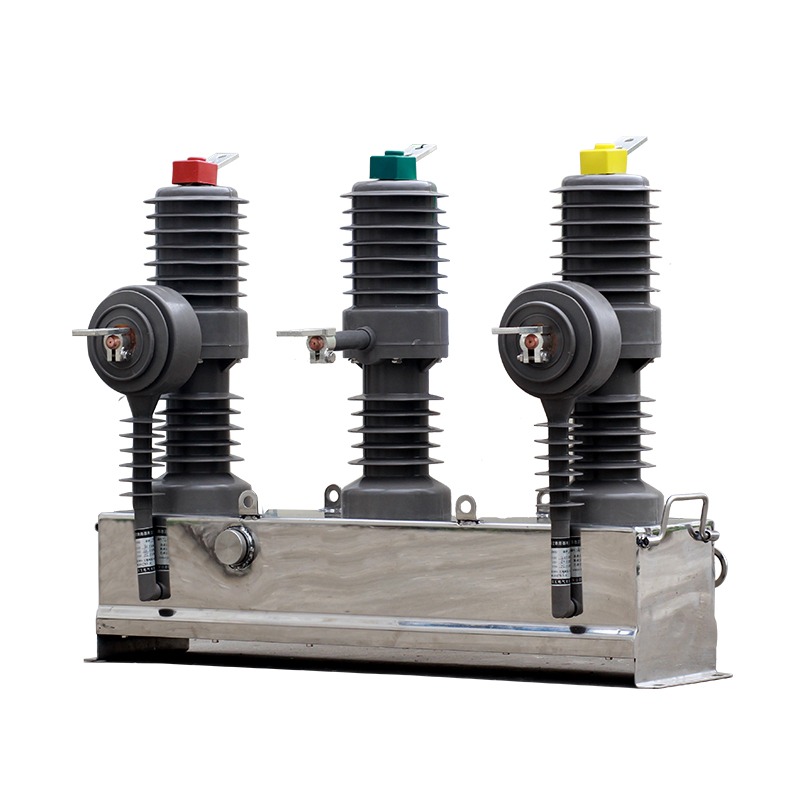
Dust changes the insulation argument: abrasive particles polish porcelain and erode silicone sheds, so shed profile and material hardness matter more than indoors. Coastal humidity adds a second stress, because a contaminated hydrophobic surface behaves differently once wetted. Ask for the pollution level the creepage was dimensioned for, the shed material and the corrosion category of external fasteners, and confirm open-contact arcing distance holds after altitude correction. The 40.5 kV unit below follows the same logic at a higher class.
Frequently Asked Questions About VCB Construction
Can a vacuum interrupter be repaired in the field?
No. It is sealed and evacuated, and opening it destroys the vacuum. Field work covers external checks only: stroke or erosion mark, contact resistance, insulation resistance, mechanical operation. A pole that fails a withstand test is replaced as a unit, so agree the spare-pole policy at order stage.
How often should contact wear be checked?
Tie the interval to duty, not the calendar. A feeder with frequent fault trips is checked after every few short-circuit interruptions; a rarely operated breaker can follow the maker's interval. Record each reading so the trend drives the decision.
Spring mechanism or magnetic actuator for a hot desert site?
Both work and they fail differently. A spring mechanism has more wear parts but is repairable locally. An actuator has fewer parts but depends on a supervised capacitor supply, so where access is difficult it is the better trade only if the DC supply is engineered properly.
Can a permanent-magnet mechanism be retrofitted into an existing panel?
Rarely, never as a drop-in. The actuator changes operating times, the control scheme and often the mounting interface, so a retrofit is a redesign of the truck or pole assembly. Treat it as a new breaker.
What does a maintenance-free claim cover?
Ask for it in writing next to the endurance class and the service conditions assumed. A claim made for 40 degrees and clean air does not transfer to a coastal site at 55 degrees with sand.
Sources and Further Reading
- IEC 62271-100:2021 — High-voltage switchgear and controlgear, Part 100: Alternating-current circuit-breakers — the type-test standard that fixes rated short-circuit breaking current, operating sequences and the mechanical and electrical endurance classes quoted on a datasheet
- IEC 62271-1:2017 — High-voltage switchgear and controlgear, Part 1: Common specifications for alternating current switchgear and controlgear — the shared service conditions, rating definitions and dielectric requirements a breaker inherits from the assembly it sits in
Where Nahu Group Fits
Nahu Group builds indoor and outdoor breakers for 12 kV to 40.5 kV networks, with spring or permanent-magnet mechanisms, built-in current transformers and intelligent protection options. The vacuum circuit breaker range covers the pole-mounted ZW32-12 outdoor breaker and the ZW7-40.5 outdoor breaker, alongside indoor draw-out units such as the ZN63A-12 indoor breaker.
To configure a unit, send the voltage class, normal current, breaking current, mechanism and control voltage, CT ratio and class, mounting arrangement, site ambient, pollution level and the approval documents you need. That is enough to price and draw the breaker. Test records are covered in the testing procedure article, drawing conventions in the note on the VCB symbol on a single-line diagram.
Published Nov 10, 2026 · Nahu Group (NAHU Electric Technology)