
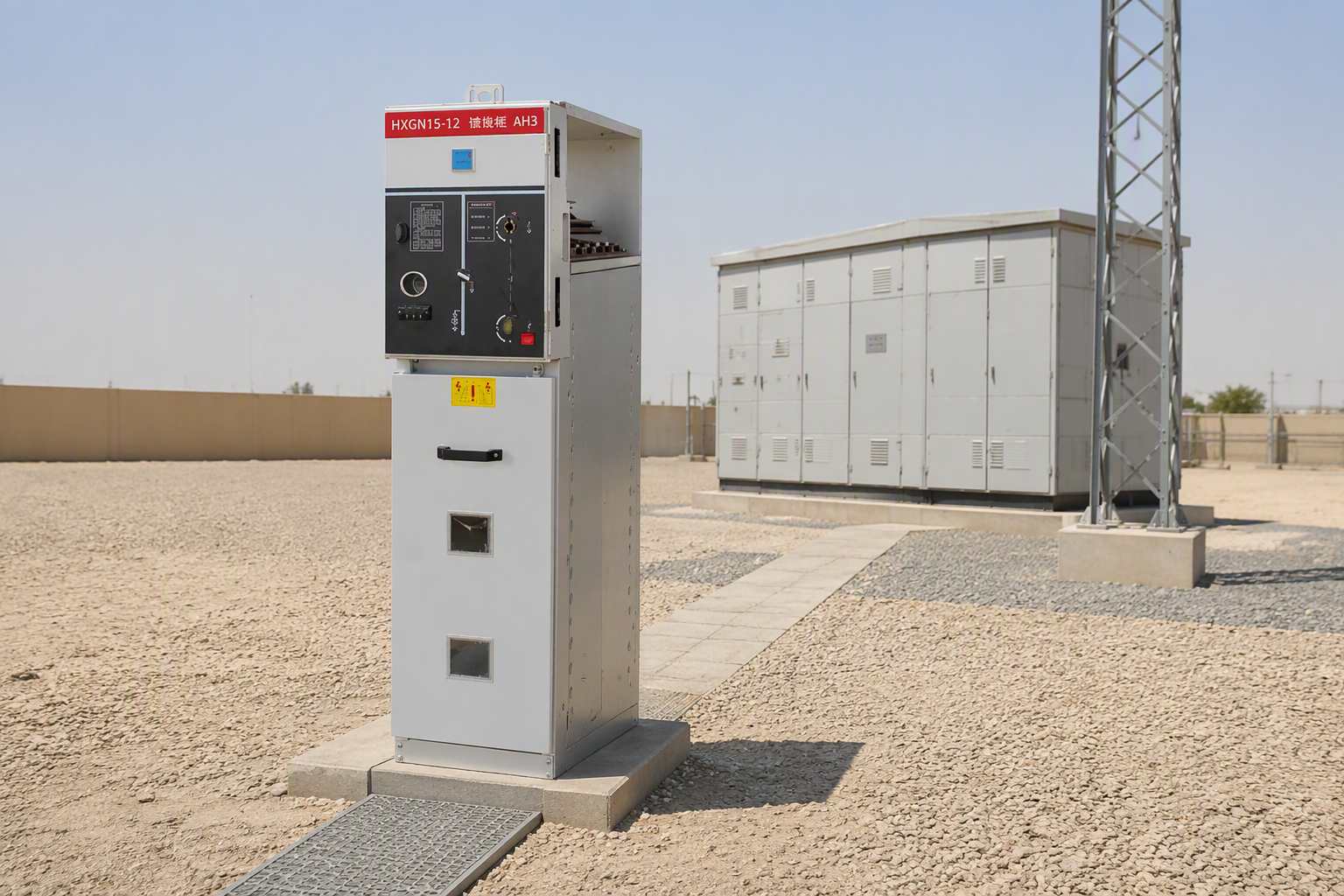
Ring main unit types are described along two independent axes: by the number of switching functions built into the assembly — 2-way, 3-way, 4-way and extensible — and by the insulating and switching medium, which is SF6, vacuum or air. A 3-way unit can be SF6-insulated or vacuum-switched, so the two classifications answer different questions and a procurement specification normally has to fix both.
What Is a Ring Main Unit?
A ring main unit is a factory-assembled switchgear assembly that sits at a distribution substation on a ring-fed network. It carries the switching needed to connect the substation to two ring feeders and to tee off to the local transformer, so that any single cable section can be isolated without interrupting supply to the rest of the ring.
That single requirement — keep the ring alive while one leg is worked on — is what separates a ring main unit from a plain switchboard. The assembly is compact, usually metal-enclosed, and designed for a distribution substation rather than for a bulk power station. If you want the cost side of the same equipment, see what drives ring main unit price.
What Are the Main Ring Main Unit Types?
Buyers in this equipment class tend to use the word "type" loosely, so it helps to separate the two axes explicitly.
Axis one is the number of ways or functions. This counts how many switching functions the assembly provides: the ring cable ways, the transformer tee-off, and any spare or busbar section. It is a statement about circuit topology.
Axis two is the insulating and switching medium. This describes how the live parts are insulated and how the current is interrupted — typically SF6, vacuum, or air at atmospheric pressure, often with solid insulation around the current paths. It is a statement about how the equipment is built.
Because the axes are independent, "which configuration do you need?" cannot be answered by picking one label. A project brief usually fixes the function count from the network diagram and the medium from the site, the utility's policy and the market the equipment is destined for.
How Many Ways Does a Ring Main Unit Need?
The number refers to switching functions in the assembly, not to the number of cables a single function can physically accept.
- 2-way. Two ring cable ways. Used where the substation only has to be inserted into the ring, for example at a cable section that feeds no local transformer.
- 3-way. Two ring cable ways plus a transformer tee-off. This is the common shape of a distribution substation on a ring: the ring passes through and the substation loads it.
- 4-way, or quad. Adds a further tee-off or a busbar section, so two transformers, a second outgoing circuit or a sectionalising point can be served from one assembly.
- Extensible. Not a count but a capability: the assembly is built so that adjacent units can be coupled onto its busbar later, which is what makes a 3-way unit able to become part of a 6-way installation.
The practical check is to read the switching functions off the single-line diagram and count them, rather than accepting a supplier's label. A unit advertised as 3-way may include an earthing function that a different supplier counts separately.
What Is an Extensible Ring Main Unit For?
An extensible ring main unit carries a busbar system that can be extended after installation, so an adjacent unit can be bolted on and coupled without replacing the original assembly. The alternative — a non-extensible, or block, unit — is sealed once built and can only be replaced, not grown.
The choice is a forecast about the load. If reinforcements are likely, if a second transformer may follow, or if the site is a phased development where later stages will need their own tee-offs, an extensible busbar is usually cheaper than a second substation. If the load is fixed and will not grow, the block unit is simpler and needs fewer joints to be made on site.
SF6 vs Vacuum vs Air: Which Ring Main Unit Type?
The medium question has become a procurement question rather than a purely technical one, because the regulatory position on SF6 has changed.
SF6 is an excellent dielectric and arc-quenching medium, which is why SF6 ring main units have been the compact default for decades. It is also a fluorinated greenhouse gas with a very high global warming potential. Regulation (EU) 2024/573 defines electrical switchgear as switching devices and their assemblies used in connection with the generation, transmission, distribution and conversion of electric energy, and it restricts putting such equipment into operation where it uses, or relies on, fluorinated greenhouse gases in the insulating or breaking medium.
The phase-out dates in Article 13(9) of that Regulation are voltage and duty specific, and they are worth reading in the original text before a specification is written:
| Putting into operation prohibited from | |
|---|---|
| Medium voltage switchgear for primary and secondary distribution, up to and including 24 kV | 1 January 2026 |
| Medium voltage switchgear for primary and secondary distribution, above 24 kV up to and including 52 kV | 1 January 2030 |
| High voltage switchgear from 52 kV up to and including 145 kV, up to and including 50 kA short-circuit current, with a global warming potential of 1 or more | 1 January 2028 |
| High voltage switchgear above 145 kV, or more than 50 kA short-circuit current, with a global warming potential of 1 or more | 1 January 2032 |
The same Article carves out a set of derogations. Paragraph 14 disapplies the prohibition where the operator can evidence that the order was placed before 11 March 2024, and paragraphs 11 to 13 allow limited exceptions tied to the outcome of a procurement procedure and to evidence about life-cycle emissions. Paragraph 7 separately prohibits, from 1 January 2035, the use of SF6 for maintenance or servicing of electrical switchgear unless it is reclaimed or recycled, with narrow exceptions.
Two consequences follow for anyone specifying a ring main unit today. First, a 24 kV breakpoint now sits in the middle of the range that distribution projects actually use, so an SF6 unit at 24 kV and an SF6 unit at 36 kV are in different regulatory positions for a European destination. Second, virgin SF6 is being pushed toward reclaimed or recycled gas, which makes the long-term service and gas-handling arrangement part of the purchase decision rather than an afterthought.
Vacuum switching with air or solid insulation avoids the gas question entirely. The trade-off is physical: SF6 allows a very compact enclosure because its dielectric strength is high, so a gas-free design of the same ratings often needs more space, or a different arrangement of the current paths, or a different enclosure philosophy. Whether that is acceptable depends on the substation footprint, the room available, and whether the site is indoors or outdoors.
A third option, SF6-free but still gas-insulated using an alternative fluorinated or fluoronitrile mixture, exists in the market. It is neither "SF6" nor "gas-free" in the ordinary sense, so a specification should name the medium explicitly rather than relying on either label.
Ring Main Unit Types at 11 kV and 33 kV
Both 11 kV and 33 kV sit comfortably inside the scope of the metal-enclosed switchgear assembly standard, which covers alternating current assemblies above 1 kV and up to and including 52 kV. The configuration vocabulary does not change between the two levels, but the numbers attached to it do.
| What it determines | |
|---|---|
| How many switching functions? | Read from the single-line diagram: ring ways, transformer tee-off, spare ways, sectionalising |
| Extensible or block? | Whether the busbar can be coupled to a future adjacent unit without replacing the assembly |
| Which insulating and switching medium? | Footprint, gas handling, end-of-life obligations and market access |
| Indoor or outdoor? | Enclosure, degree of protection and the ambient conditions the specification must state |
| Which switch device per function? | Whether a function is a load break switch, a switch-disconnector or a circuit-breaker |
How Do You Choose the Right Ring Main Unit Type?
Work from the network outward, and fix the physical facts before looking at any catalogue.
- Rated voltage and insulation level. The system voltage and the impulse withstand the utility requires. This single pair of numbers usually decides whether SF6 is even worth considering for a European destination, because the 24 kV line falls inside the range most distribution projects use.
- Continuous current. What the ring has to carry in normal operation, and what it may have to carry in a planned alternative feeding arrangement. The second number is often the larger one.
- Short-circuit withstand. The prospective fault level at the substation, stated as both a short-time withstand current with its duration and a peak withstand current. These values must be chosen before the assembly, not after.
- Functions required. Count the ways from the single-line diagram, including any spare way the utility insists on.
- Growth. Decide explicitly whether an extensible busbar is needed, because that decision cannot be revisited cheaply after installation.
- Location and environment. Indoor or outdoor, ambient temperature range, humidity, altitude, and whether the enclosure must resist flooding or corrosive atmospheres.
- Continuity and arc classification. The loss-of-service continuity category the utility wants, and the internal arc classification with its access type if the specification calls for it.
- Interlocking and earthing. The switching sequence the operators will actually follow, and the earthing arrangement that makes it safe.
Only after those eight items are fixed does the medium and the enclosure choice become a fair comparison between suppliers. If you are also selecting the switching device itself, the load break switch guide covers the device-level decision.
What Should a Ring Main Unit Specification State?
A specification that omits the items below tends to produce quotations that cannot be compared, because each supplier fills the gap differently.
- Rated voltage, rated insulation level and the rated frequency
- Rated normal current of the busbars and of each branch
- Rated short-time withstand current and its duration, plus rated peak withstand current
- Number of ways and the function of each, read from the single-line diagram
- Whether the busbar must be extensible, and the interface dimensions if it is
- The insulating and switching medium, named specifically at the gas-mixture level rather than as a category
- Indoor or outdoor installation, degree of protection, and the ambient conditions
- Loss-of-service continuity category and internal arc classification, with access type, if required
- Interlocking scheme, earthing arrangement and the operating sequence to be maintained
- Cable box type and cable size range for each way
- Protection, metering and control interfaces, including current and voltage transformers if the unit carries them
- The standard edition each requirement is written against, and the test evidence expected with the offer
Naming the standard edition against each clause is the single cheapest way to avoid arguments later, because an assembly built to one edition of a standard is not automatically evidence against another.
Which Standards Apply to Ring Main Units?
Three parts of the IEC 62271 series do most of the work in this equipment class, and they cover different objects.
- The assembly. IEC 62271-200:2021 applies to prefabricated AC metal-enclosed switchgear and controlgear assemblies designed for rated voltages above 1 kV and up to and including 52 kV. Ring main units are assemblies, so this is the part that governs the enclosure, the interlocks and the classification of the complete unit.
- The circuit-breaker function. IEC 62271-100:2021 applies to three-phase AC circuit-breakers for indoor or outdoor installation and for operation at 50 Hz and 60 Hz.
- The switch function. IEC 62271-103:2021 applies to AC switches and switch-disconnectors for rated voltages above 1 kV and up to and including 52 kV.
Which of the latter two is relevant depends on how each way in the assembly switches. A transformer tee-off protected by a circuit-breaker points at IEC 62271-100; a ring way switched by a load break switch points at IEC 62271-103. Both are then assembled under IEC 62271-200, which is why a specification should state the function of every way rather than only the total count.
Frequently Asked Questions About Ring Main Units
What is a ring main unit in simple terms?
A ring main unit is a compact, factory-assembled switchgear unit installed at a distribution substation on a ring-fed network. It contains the switching needed to connect the substation to two ring cables and to tee off to the local transformer, so that one cable section can be isolated without cutting supply to the rest of the ring.
What are the main ring main unit types?
Ring main unit types are classified in two independent ways. The first is the number of switching functions in the assembly, such as 2 way, 3 way, 4 way and extensible. The second is the insulating and switching medium, such as SF6, vacuum or air. The two classifications are independent, so a 3 way unit can be SF6 insulated or vacuum switched.
What does 2 way, 3 way and 4 way mean on an RMU?
The number counts switching functions in the assembly. A 2 way unit normally provides two ring cable ways, a 3 way unit adds a transformer tee off, and a 4 way or quad unit adds another tee off or a busbar section. The count describes circuit functions, not the number of cables one function can accept.
What is the difference between an extensible and a non extensible ring main unit?
An extensible ring main unit has a busbar that can be coupled to an adjacent unit later, so the installation can grow without replacing what is already there. A non extensible or block unit is fixed once built and can only be replaced, not extended.
Is an SF6 ring main unit still allowed?
It depends on the destination and the voltage. Regulation (EU) 2024/573 prohibits putting into operation medium voltage electrical switchgear for primary and secondary distribution that uses or relies on fluorinated greenhouse gases in the insulating or breaking medium, up to and including 24 kV from 1 January 2026 and above 24 kV up to and including 52 kV from 1 January 2030. Other markets set their own requirements. Always confirm the current rule for the specific destination and voltage.
Which ring main unit type is best for an 11 kV network?
There is no single best type at 11 kV. The right choice comes from the network: the number of switching functions on the single line diagram, the continuous and short circuit currents, whether the busbar must be extensible, indoor or outdoor installation, and the medium permitted in the destination market.
Which standards apply to a ring main unit?
IEC 62271-200 covers the metal enclosed assembly itself for rated voltages above 1 kV up to and including 52 kV. IEC 62271-100 covers AC circuit breakers and IEC 62271-103 covers AC switches and switch disconnectors. Which device standard applies to a given way depends on how that way switches.
What should a ring main unit specification include?
At minimum it should state the rated voltage and insulation level, the rated normal current of the busbars and branches, the rated short time withstand current with its duration and the rated peak withstand current, the number of ways and the function of each, whether the busbar is extensible, indoor or outdoor installation, the insulating and switching medium, the interlocks and earthing arrangement, and the test evidence expected with the offer.
Sources and Further Reading
- Regulation (EU) 2024/573 on fluorinated greenhouse gases — consolidated text on EUR-Lex; Article 13(9) carries the switchgear phase-out dates, and Article 2(33) defines electrical switchgear
- IEC 62271-200:2021 — AC metal-enclosed switchgear and controlgear for rated voltages above 1 kV and up to and including 52 kV; the assembly standard for ring main units
- IEC 62271-100:2021 — high-voltage switchgear and controlgear, Part 100: alternating-current circuit-breakers
- IEC 62271-103:2021 — alternating current switches for rated voltages above 1 kV up to and including 52 kV, via the IECEE standard record
This article describes how ring main unit types are classified and how the choice is made. It deliberately quotes no price figures and no numeric ratings, because a defensible number can only be produced against a specific specification and network.
Matching the Assembly to the Network
Nahu Group manufactures 10 to 35 kV distribution equipment, including ring main units, load break switches, vacuum circuit breakers, current and voltage transformers, metering boxes, lightning arresters, drop-out fuses and cable branch boxes. For ring main unit enquiries the useful starting point is the single-line diagram plus the rated voltage and fault level, because those three documents settle most of the classification questions above.
If the project also involves instrument transformers or metering, high-voltage electrical equipment covers how those items are specified alongside switchgear, and the FZN25-12 vacuum load break switch page shows a worked example of one switching device used in this class of assembly. See the product range, or send the engineering team your single-line diagram and the standards your customer references.
Published September 21, 2026 · Nahu Group (NAHU Electric Technology)