
A load break switch (LBS) is the standard switching device in medium-voltage distribution: it connects and disconnects feeders under load, safely interrupting the normal operating current of the circuit. You will find it in ring main units (RMUs), distribution substations, and industrial incoming panels from 12 kV up to 24 kV.
The key distinction engineers must understand: a load break switch is designed to switch load current — not to clear fault current. That job belongs to the fuse or circuit breaker behind it. Get this right and the switchgear is safe and economical; get it wrong and the consequences are severe.
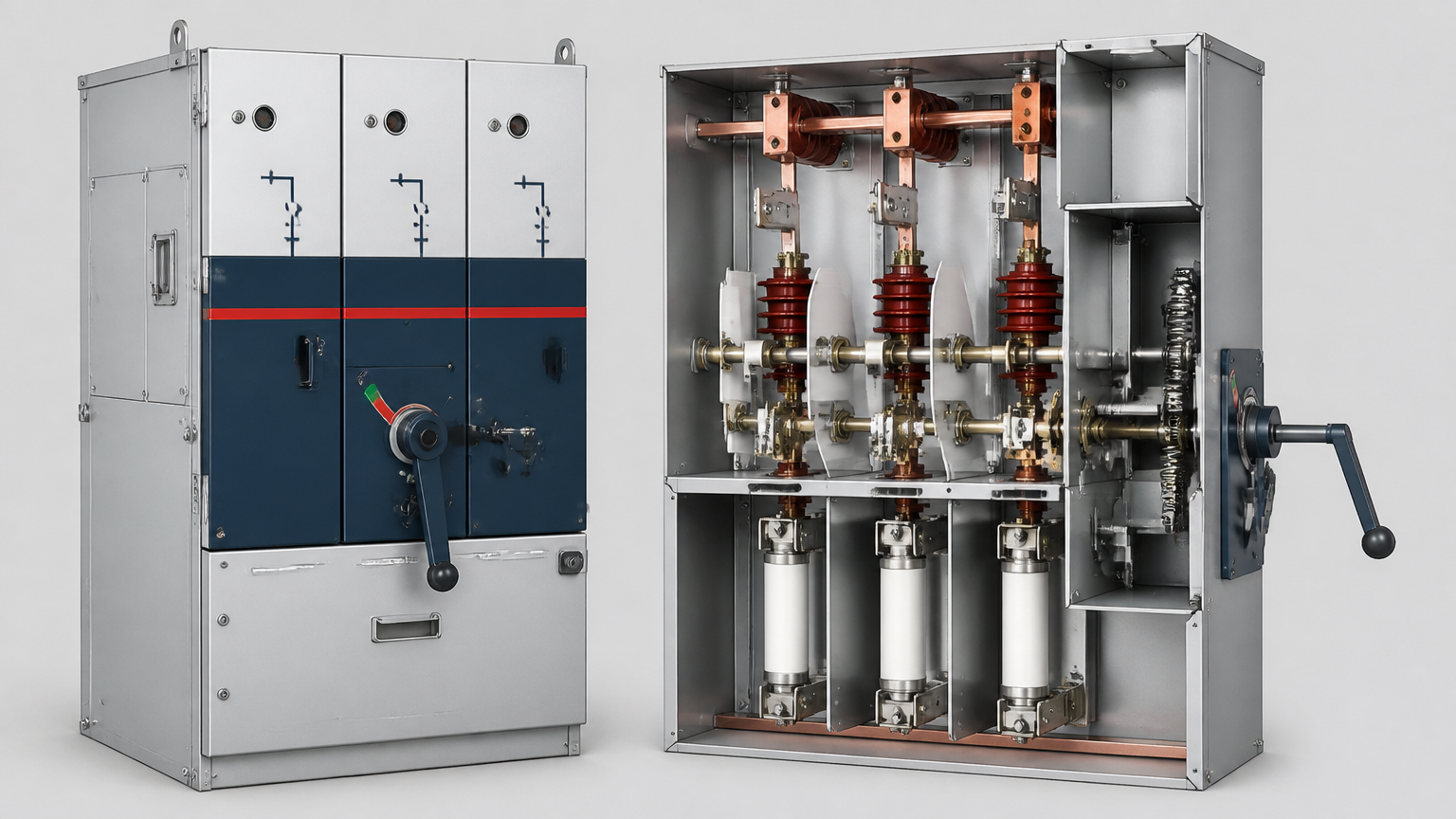
What Is a Load Break Switch?
A load break switch is a three-position switching device (closed / open / earthed) that can make and break the rated normal current of a circuit, including transformer magnetising current and cable-charging current. It is a cross between an isolator and a circuit breaker: it interrupts current, but only up to its rated switching capacity — typically the full-load current of the feeder, not fault current.
Because distribution feeders spend almost all their life carrying normal load, an LBS combined with fuses (fuse-switch combination) covers the vast majority of switching duties at a fraction of the cost of a circuit breaker bay.
How a Load Break Switch Works
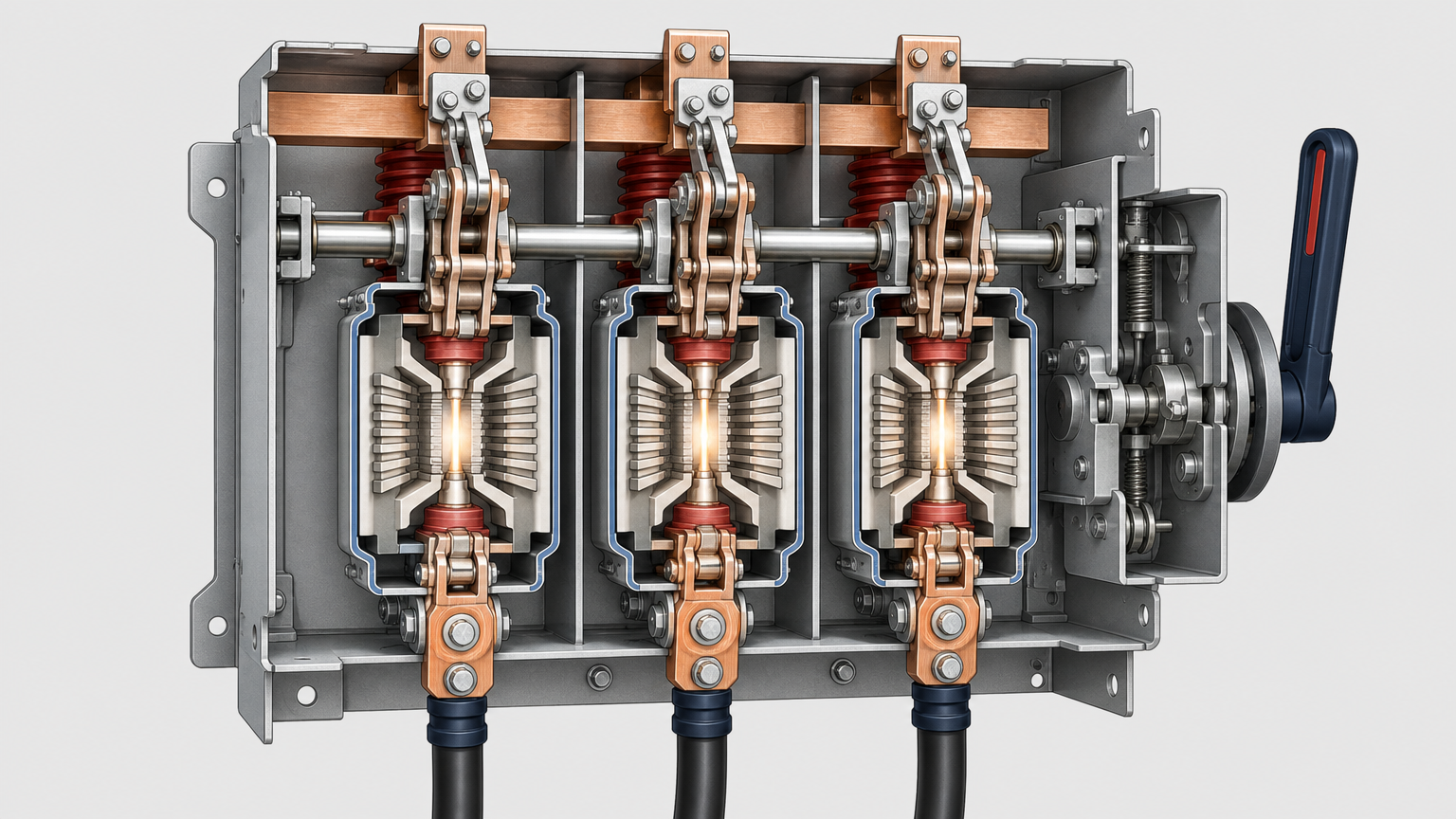
Opening a switch under load creates an arc. The load break switch must extinguish that arc quickly and safely, which is what separates it from a simple disconnector. Three arc-quenching technologies dominate:
- Compressed-air (puffer) switching — a blast of compressed air blows the arc out; simple and proven, widely used in RMUs
- Vacuum switching — contacts part inside a sealed vacuum interrupter; the arc dies at current zero with no gas handling and very long electrical life
- SF6 switching — gas-quenched contacts in a sealed tank; excellent performance but with the environmental and handling burdens of SF6
In every case the mechanism must be fast and snappy — slow contact travel sustains the arc longer and erodes the contacts. Most LBS designs use a spring-operated mechanism that gives a rapid, positive break independent of operator speed.
Load Break Switch vs Circuit Breaker vs Isolator
These three devices are often confused, but their duties are distinct:
- Isolator — no load switching at all; only provides a visible disconnection point on an already-dead circuit
- Load break switch — switches normal load current and small charging currents, but cannot interrupt fault current
- Circuit breaker — switches load AND interrupts fault current automatically, with protection relays
In a fuse-switch combination, the LBS handles routine switching while the fuses detect and clear faults, giving circuit-breaker-like protection at lower cost — the most common arrangement in ring main units.
Where Load Break Switches Are Used
The classic application is the ring main unit: a compact metal-enclosed switchgear cubicle with two load break switches for the incoming ring feeders and a fuse-switch for the transformer outgoing feeder. RMUs power distribution transformers across urban networks, commercial buildings and industrial sites. LBS also appears in:
- Distribution substations and pole-mounted switchgear
- Industrial incoming and outgoing feeders
- Cable distribution cabinets and network sectionalising points
Wherever a feeder must be switched locally, reliably and economically, the load break switch is the workhorse.
How to Choose a Load Break Switch
Match the LBS to the circuit duty:
- Rated voltage — 12 kV or 24 kV class, matching the system voltage
- Rated normal current — equal to or above the feeder's maximum continuous load (typical ratings 400 A, 630 A, 1250 A)
- Rated short-time withstand current — the fault current the switch must survive in the closed position (commonly 20 kA/3 s, 25 kA/1 s)
- Switching capability — verify the rated load-breaking and cable-charging currents cover your switching duty
- Fuse compatibility — for fuse-switch combinations, the switch must coordinate with the fuse rating and operate the trip mechanism on fuse blow
- Earthing position — an integrated three-position switch (closed/open/earthed) simplifies safety procedures
- Standards — specify to IEC 62271-103 for load break switches
Maintenance and Safety
Load break switches are low-maintenance, but the mechanism deserves attention: verify operating force and contact alignment at each inspection, and confirm the position indicator reflects reality. For fuse-switch units, always check fuse condition after any fault operation — a blown fuse means the switch should not be closed again until the fault is found and cleared. The integrated earthing position should be used whenever work is carried out on the downstream circuit.
Q&A
Question: Can a load break switch interrupt a short-circuit?
Short answer: No. An LBS is rated to switch normal load current only; fault current must be cleared by the series fuse or an upstream circuit breaker. Closing an LBS onto a fault is dangerous.
Question: What is the difference between a load break switch and a disconnector?
Short answer: A disconnector (isolator) cannot break current at all and is only operated on a dead circuit; a load break switch is designed to make and break rated load current.
Question: Why are load break switches used in ring main units?
Short answer: They let operators reconfigure the ring and isolate transformer bays at load current, economically and safely, with fuses providing fault protection — the standard RMU architecture.
Question: Which arc-quenching technology should I choose?
Short answer: Vacuum and compressed-air designs avoid SF6 entirely, have long mechanical life, and are the most future-proof choice for new RMU projects; vacuum adds the longest electrical endurance.
Nahu Group (NAHU Electric) manufactures compressed-air and vacuum load break switches for 12–24 kV ring main units and distribution networks, with fuse protection options. For ratings, type tests and panel integration support, see our load break switch range, or contact our engineering team.
Published August 12, 2026 · Nahu Group (NAHU Electric Technology)