
The load break switch is the workhorse switching device of the medium-voltage ring main unit (RMU). Its job is precise: make and break the currents that normal network operation demands — full rated load current, closed-loop transfer current, and the small charging currents of unloaded transformers and cables. It is deliberately not built to break fault current; in an RMU bay that duty belongs to the backup fuse or to a circuit breaker. Nahu Group's FZN25-12 vacuum load break switch covers exactly this switching duty for 12 kV ring networks, transformer substations and industrial equipment.
This article looks at the FZN25-12 and its fuse-combination partner, the FZRN25-12: what each one can and cannot switch, how vacuum arc extinction differs from compressed-air designs, the ratings you should verify, and how the device is operated and interlocked. For the wider picture of load break switch technology across 12–24 kV networks, see our load break switch guide — here we focus on the vacuum type and its place in the bay.
What a load break switch does in a ring main unit
A ring main unit sits at the head of a distribution feeder and typically contains three switching functions: two ring or cable bays that can loop power through the unit, and one transformer bay that steps down to the LV network. The load break switch is the common switching element in all three positions, and its duty list is defined by what happens during routine, planned operation:
- Breaking rated load current: The switch must open a healthy circuit carrying its full rated current, for example when a feeder is de-energized for maintenance.
- Closed-loop transfer: During a ring transfer, two sources are briefly paralleled through the switch. The current that circulates between the two supplies — the closed-loop current — must be interrupted cleanly when the ring is opened again.
- Unloaded transformer switching: Connecting or disconnecting a transformer with no load on its secondary means making and breaking its magnetizing inrush and its no-load current, not its full load.
- Cable charging current: An open-ended cable behaves like a capacitor, and the switch must be able to break the small charging current it draws from the system.
What the load break switch must not be asked to do is interrupt a short circuit. Fault breaking is the fuse's or the breaker's job, and RMU schemes are arranged so that the fuse or breaker clears the fault while the switch handles the healthy-load duties above. Getting this boundary right is the most important part of specifying an RMU switching device.
Vacuum arc extinction versus compressed-air switching
Whenever a switch parts its contacts while current is flowing, an arc forms across the gap, and the switching technology is really about how that arc is extinguished. In a compressed-air load break switch, the arc burns in air and is driven and stretched by a blast of compressed air or by a puffing mechanism until the gap recovers enough dielectric strength to hold. In a vacuum load break switch, the contacts live inside a sealed vacuum interrupter: the arc is drawn in metal vapor that condenses and disappears within microseconds of a current zero, and the vacuum gap recovers its insulation almost instantly.
The practical result of vacuum extinction is a short, tightly controlled arc, very little contact erosion, and no dependence on external air pressure. Because the switching energy is contained inside a small vacuum bottle, the mechanism can be compact. The FZN25 and FZRN25 series use a transmission structure in which the arc-extinguishing chamber only bears high pressure at the moment of closing and opening, which keeps the whole appliance small in size and light in weight while allowing the isolation gap and the arc-extinguishing chamber gap to operate in a single motion.
FZN25-12 switch-only and FZRN25-12 fuse-combination appliances
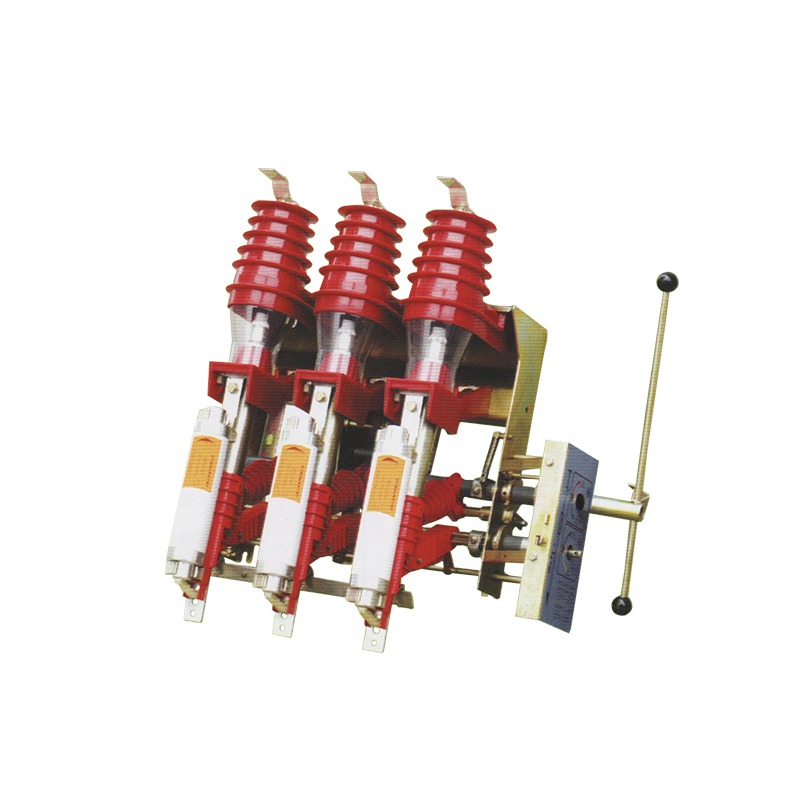
The FZN25-12/FZRN25-12 family covers two configurations for 12 kV duty. The FZN25 and FZRN25 series vacuum load switches and combined electrical appliances are suitable for load control and short-circuit protection in three-phase AC 50 Hz ring networks or terminal power supplies and industrial electrical equipment. The load switches connect and disconnect loads, closed-loop current, and unloaded transformer and cable charging current; the combined electrical appliances can additionally interrupt any current up to the rated short-circuit current. Both versions employ direct-acting isolation contacts linked with a vacuum arc-extinguishing chamber, so a single operating stroke produces the isolation break and the arc-chamber break together.
The switch-only unit is the FZN25-12D/T630-20, a standalone load break switch for bays where protection is provided separately. The combined appliance is the FZRN25-12D/T125-31.5, which pairs the switch with high-voltage fuses in one unit for the classic RMU transformer bay. Full specifications, outline drawings and installation dimensions are on the FZN25-12/FZRN25-12 vacuum load switch product page.
Understanding the fuse-combination logic explains why the combined appliance can claim full short-circuit capability while a plain load break switch cannot. In the FZRN25-12 configuration, the fuse is the fast element: when a short circuit occurs, the fuse element melts and interrupts the fault current. As the fuse operates, its striker triggers the switch mechanism, which then opens all three phases. The load switch therefore performs the three-phase disconnection after the fuse has done the fault breaking, and the circuit is left with a visible, safe three-phase gap instead of a single-phase fuse operation that could leave a motor or a transformer running on two phases.
Ratings, duty and mechanical life
When you compare offers for a vacuum load break switch, the nameplate ratings define what the device can actually do in your network. For the FZN25-12D/T630-20 switch unit, the published ratings are a rated voltage of 12 kV, a rated frequency of 50 Hz and a rated current of 630 A. For the FZRN25-12D/T125-31.5 fuse-combination appliance, the switch side is coordinated for fuse-combination duty up to 125 A, with short-circuit breaking of 31.5 kA provided through the SDLAJ-12 and SFLAJ-12 fuses.
Equally important is how long the device will last in service. The FZN25 and FZRN25 series carry a mechanical life of 10,000 operations, which is the figure used for maintenance planning in utilities and industrial plants that operate RMUs frequently. Combined with the low-contact-erosion characteristic of vacuum switching, that mechanical endurance is what makes the load break switch a low-maintenance component between scheduled overhauls.
Manual and electric operation with grounding-switch interlocking
A load break switch in an RMU has to be operable by a field operator as well as by the automation system. Manual operation uses a lever or operating handle on the front of the unit, with position indication showing open, closed and earthed states; electric operation is available with a motor mechanism so the switch can be operated locally from a panel or remotely by the distribution automation system, which matters for loop restoration and load transfer schemes.
Safety depends on interlocking between the switch and its grounding switch. On the FZN25 and FZRN25, a grounding valve sits between the stationary contact and the conductive cylinder of the moving contact and is linked to the grounding switch. The interlock ensures the outgoing cable or transformer terminals cannot be earthed while the load break switch is closed, and the switch cannot be closed while the earth is applied — protecting both personnel and the equipment during maintenance. This linked grounding arrangement is what makes the switch safe to work on after it has been opened.
Where it fits: isolating switch vs vacuum circuit breaker
The load break switch occupies a deliberate middle position in the switching hierarchy, and it helps to place it against the two devices it is most often confused with. An isolating switch (disconnector) provides a visible isolation point and is rated for negligible current breaking — it must never be operated on load. At the other end, a vacuum circuit breaker is designed to break fault current and is used where protection duties, frequent automatic operation or high short-circuit levels rule out a fuse-based scheme. The load break switch sits between them: it can switch normal load currents routinely, but it relies on a fuse or breaker for fault clearing. For more detail on the adjacent devices, see our isolating switch guide and vacuum circuit breaker guide.
In practice the choice for a 12 kV transformer bay is usually between a fuse-combination unit like the FZRN25-12 and a vacuum circuit breaker. The fuse-combination is the economical, compact standard for RMUs where fault levels sit within fuse capability; the breaker is chosen when the protection philosophy, auto-reclosing needs or coordination requirements point that way. Either way, the plain load break switch remains the right device for the ring and cable bays, where routine load and closed-loop switching — not fault breaking — is the daily task.
If you are specifying a 12 kV ring main unit, transformer substation or industrial feeder, review the ratings above against your system voltage, load current and earthing arrangement. Nahu Group (NAHU Electric Technology) manufactures the FZN25-12/FZRN25-12 under an ISO 9001 quality system with type-tested designs, has supplied switchgear since 2008 to customers in 40+ countries, and supports a product range spanning 3–40.5 kV. Browse the full load break switches range, or send your single-line diagram to our engineering team for a configuration check.
Published September 2, 2026 · Nahu Group (NAHU Electric Technology)