
There is no single 11 kV ring main unit price. An RMU is assembled to a project specification, so two units described as "11 kV, 630 A" can land far apart once switching technology, enclosure rating, protection and metering fitment, cable boxes and test scope are fixed. The only meaningful ring main unit price list is the one a supplier builds against your own specification — which is why comparing headline quotes without reading the line items usually leads to the wrong award. The voltage class is written both ways in practice — an 11kV ring main unit and an 11 kV RMU are the same equipment, and both spellings appear in the same enquiry.
This guide is written for utility asset engineers, EPC procurement leads and panel builders buying ring main units for distribution networks. It breaks the cost structure down driver by driver, explains how to read an itemised quotation, and sets out what an RFQ should contain so the quotes you receive are genuinely comparable.
Why is there no standard ring main unit price?
A ring main unit is not a catalogue appliance. It is an assembly of switching devices, busbars, cable compartments, an enclosure and — increasingly — protection, control and metering. Two units sharing the same headline voltage and current rating can differ in almost every one of those layers. The unit price therefore moves with the specification, not with the voltage class.
That follows from how the equipment is standardised. IEC 62271-200 sets requirements for AC metal-enclosed switchgear and controlgear for rated voltages above 1 kV and up to and including 52 kV, which is the frame most RMU specifications sit inside. The standard fixes the safety and performance envelope; it does not fix which optional features a given project buys. Choosing the options is what creates the price.
What actually drives ring main unit cost?
Seven factors account for most of the variation between two quotes for nominally the same RMU.
1. Switching technology: SF6, vacuum or air
The interrupting medium is usually the single largest technical cost lever. SF6 switchgear has historically been the most compact and the cheapest to build at medium voltage, which is why it dominates traditional RMUs. Vacuum interrupters cost more per pole but remove the gas entirely, and SF6-free designs — vacuum switching with solid or air insulation — carry a premium that buyers increasingly accept for environmental and end-of-life reasons. Air-insulated designs sit between the two depending on the current and fault rating.
The switching devices themselves are covered by their own standards: IEC 62271-103 applies to alternating current switches for rated voltages above 1 kV up to and including 52 kV, which is the family a load break switch or switch-disconnector inside an RMU belongs to. Ask which standard each switching device is type tested to — the answer changes both the cost and the evidence package.
2. Busbar and cable compartment configuration
A two-function unit (one incoming, one outgoing) is the cheapest configuration. Adding functions — a third or fourth way, a busbar section, an integrated earthing switch, a metering or riser compartment — adds copper, insulation, a separate gas or vacuum compartment and additional interlocks. Extensible designs, which let a network be extended later without replacing the unit, cost more up front than a fixed pattern but avoid a much larger rebuild cost downstream.
3. Enclosure construction and ingress protection
Indoor cubicle versus outdoor kiosk is a large step. An outdoor enclosure adds weatherproofing, a higher ingress protection rating, anti-condensation provision, a sun and dust-resistant finish, and often a concrete or steel base. Material choices — sheet steel, stainless steel, galvanised construction, or concrete for roadside installations — move the number further. Inner arc classification, internal arc withstand and loss of service continuity categories under IEC 62271-200 are specified per project and must be demonstrated by testing, not asserted.
4. Protection, control and metering fitment
This is where a "cheap" RMU becomes expensive. Bare switching has no protection. Adding current transformers and voltage transformers for measurement or protection, protection relays, fault passage indicators, trip coils, auxiliary power supplies, remote terminal units or communication gateways each adds hardware and — more importantly — engineering, wiring, testing and documentation time. A protection and metering package can constitute a significant share of the delivered price, and it is the part most often under-specified in a first enquiry.
5. Cable boxes and terminations
Cable connection method is a frequent hidden difference between quotes. A unit quoted for a bolted palm may not include the separable connectors, screened cable terminations, cable glands, earthing eyes or surge protection your network actually uses. Specify the cable type, cross-section, conductor material and termination system explicitly, or suppliers will quote the cheapest interpretation and the gap appears at installation.
6. Test and certification scope
Routine tests on the delivered unit are one cost; type tests on the design are another. If your specification references IEC 62271-200 with a particular internal arc classification, loss of service continuity category or ingress protection rating, the supplier must be able to produce the corresponding type test evidence. Buying a design that has already been type tested is far cheaper than funding a new type test programme for a bespoke arrangement. Decide early whether you need witnessed testing or a third-party inspection release, because both add cost and schedule.
7. Quantity, tooling and logistics
Unit cost falls with repetition: jigs, wiring looms, drawings and test procedures are amortised across the order. A one-off custom arrangement carries the full engineering load on a single unit. Beyond the factory, enclosure size and weight drive freight, and an outdoor kiosk or concrete-housed unit costs considerably more to move than a compact indoor cubicle. Delivery terms matter too — an ex-works price and a delivered-duty-paid price are not comparable numbers.
Which cost driver changes the price most?
The table below ranks the drivers by how much they typically move a delivered price. It shows direction and relative influence, not absolute figures — a specific price only exists once a specification exists.
| What changes | Typical influence on price | |
|---|---|---|
| Protection and metering package | CTs, VTs, relays, indicators, RTU, wiring and test time | High |
| Switching technology | SF6, vacuum, SF6-free, air insulation | High |
| Enclosure and installation type | Indoor cubicle, outdoor kiosk, concrete housing, IP and arc categories | High |
| Number of functions | 2-way, 3-way, 4-way, extensible versus fixed pattern | Medium to high |
| Cable interface | Termination system, glands, screened connectors, surge protection | Medium |
| Test and inspection scope | Routine only, type test evidence, witnessed tests, third-party release | Medium |
| Quantity and logistics | Order size, amortised tooling, freight, delivery terms | Low to medium |
How do you read an 11 kV ring main unit quotation?
An itemised quotation is a specification in disguise. Read it looking for what is not there as much as what is.
- Standards column. Which standard is each switching device and the enclosure assembly type tested to, and to which edition? A quote that names no standard is not yet a technical offer.
- Ratings. Rated voltage, rated normal current, rated short-time withstand current and its duration, and peak withstand current. These four numbers define the unit.
- Classification. Internal arc classification, loss of service continuity category and ingress protection rating — stated explicitly, not implied by a drawing.
- Scope boundary. Where does the supply end? At the cable box? At the relay terminals? Is auxiliary power supply included? Is installation supervision included?
- Documentation. Routine test certificates, GA drawings, wiring diagrams, operation and maintenance manuals, and the language they are delivered in.
- Commercial terms. Incoterm, validity, lead time by stage, warranty period, spare parts provision and whether the price is firm or subject to adjustment.
What should an RMU RFQ contain?
The quality of the quotes you receive is decided by the RFQ. Include all of the following and the offers become comparable:
- Network data: system voltage, system earthing arrangement, prospective short-circuit current at the point of installation.
- Required configuration: number of functions, whether extensible, busbar arrangement, incoming and outgoing duties.
- Installation environment: indoor or outdoor, ambient temperature range, humidity, altitude, dust or corrosive atmosphere, and the required IP and arc categories.
- Cable details: type, conductor material, cross-section, number of cores, termination system.
- Protection and metering requirements: CT and VT ratios, accuracy classes and burdens, relay functions, communication protocol, auxiliary supply.
- Testing and documentation: whether type test reports must be supplied, whether witnessed testing or third-party inspection is required, and the document language.
- Commercial: quantity, delivery point and Incoterm, required delivery date, warranty expectations, and any local market access requirement.
A useful internal check: if two suppliers could read your RFQ and legitimately quote different configurations, the RFQ is not yet specific enough.
What does an RMU cost over its working life?
Purchase price is only the first number. Across a distribution network's asset life, the costs that accumulate are spares holding, operator and maintenance training, periodic inspection and servicing, the cost of an unplanned outage caused by a failure, and — for gas-insulated designs — gas handling and end-of-life obligations. A unit that is harder to service or whose spares become unavailable will cost more than a slightly dearer unit that stays supportable. Ask for the recommended spare parts list and the service interval in the same enquiry as the price.
What are the most common mistakes when comparing RMU prices?
- Comparing different scopes. The lowest quote often omits the protection package, the terminations or the documentation the project assumes are included.
- Ignoring the classification. Two units inside the same standard can sit in different internal arc and loss of service continuity categories, which is not a cosmetic difference.
- Treating the delivery term as neutral. Ex-works and delivered-duty-paid quotes cannot be ranked side by side without adding freight, insurance, duty and clearing cost.
- Buying an untested bespoke design to save unit cost. The saving is usually smaller than the cost of the type test programme, and it lands on the critical path.
- Forgetting the spares and training line. They are almost never in the first quote and almost always needed in the first year.
Frequently asked questions about ring main unit pricing
Is there a published price list for 11 kV ring main units?
Not one that is meaningful. Because each RMU is configured to a project specification, published figures describe a configuration, not a product. A price becomes comparable only when the standard, ratings, classification, protection scope, cable interface and delivery term are fixed on both sides.
What information do I need before I can get a firm RMU quotation?
System voltage, prospective short-circuit current, required number of functions and whether the unit must be extensible, indoor or outdoor installation, cable type and termination system, protection and metering requirements including CT and VT ratios and classes, auxiliary supply, and the testing and documentation scope.
Does switching technology really change the price?
Yes, it is one of the largest technical levers. SF6-insulated switchgear has traditionally been the most compact and lowest cost at medium voltage, while vacuum and SF6-free designs carry a premium in exchange for removing the gas. The gap narrows as production volumes of SF6-free designs grow.
Why is the protection package such a large part of the cost?
Because it is engineering, not just hardware. Current and voltage transformers, relays, indicators, trip coils, auxiliary supply and communications all require selection, wiring design, factory testing and documentation. It is also the part most often omitted from an initial enquiry, which is why the first quote can look deceptively low.
Should I buy an untested bespoke arrangement to save money?
Usually not. If your specification calls for an internal arc classification, a loss of service continuity category or a specific ingress protection rating, the design has to be type tested and the evidence supplied. Funding a new type test programme for a bespoke arrangement normally costs more than the unit-level saving and puts the project schedule at risk.
Does order quantity change the unit price?
Yes. Engineering, drawings, wiring looms and test procedures are largely fixed costs, so they amortise across the order. A single bespoke unit carries the full engineering load, while a repeat order against an existing design carries very little.
What ongoing costs should I plan for?
Spare parts, operator and maintenance training, periodic inspection and servicing, and — for gas-insulated designs — gas handling and end-of-life obligations. Ask for the recommended spare parts list and service interval at the same time as the price.
Specifying RMUs for a distribution network
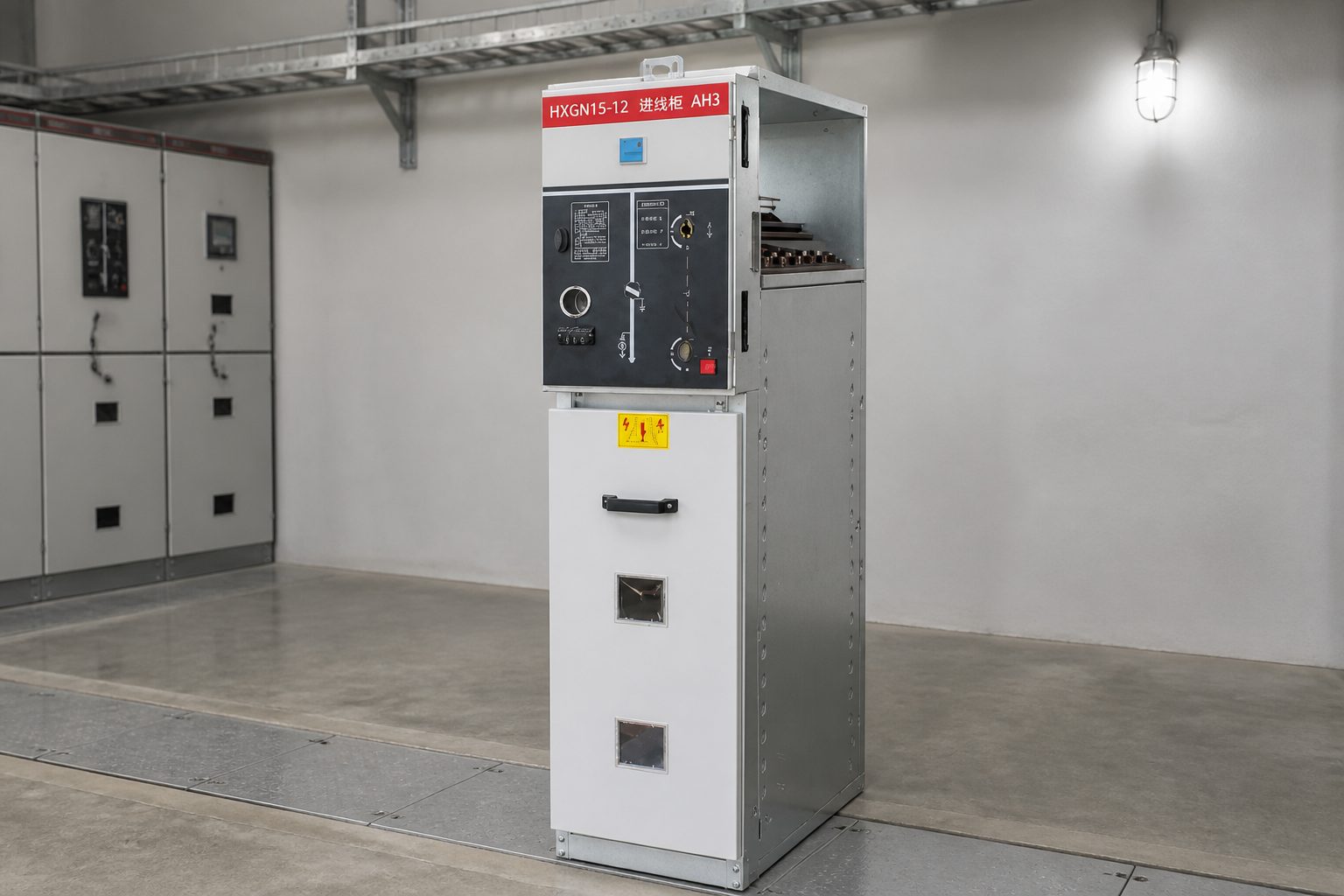
Nahu Group manufactures medium-voltage distribution equipment for 10-35 kV networks, including metal-enclosed ring network switchgear, load break switches, instrument transformers and metering equipment, supplied to utilities, EPC contractors and panel builders. When you send a specification with the data listed above, our engineering team can return an itemised offer that names the standards applied, the classification of the assembly, the scope boundary and the documentation set — so it can be compared line by line with any other offer. See the HXGN15-12 ring network switchgear for the RMU range, or read our guides to vacuum load break switches and load break switch selection, and to isolating switches and earthing.
Sources and further reading
- IEC 62271-200:2021, AC metal-enclosed switchgear and controlgear for rated voltages above 1 kV and up to and including 52 kV — IECEE standard record
- IEC 62271-103, Alternating current switches for rated voltages above 1 kV up to and including 52 kV — IECEE standard record and IEC Webstore
- Amendment EN IEC 62271-200:2021/A1:2024 — standards record
This article explains how ring main unit cost is structured. It deliberately contains no price figures, because a defensible number can only be produced against a specific specification.