
The short answer for a 12 kV branch line
"Air break" names the arc-quenching medium; "load break" names a duty. So a gas-producing air switch can be a genuine load break switch — the FKN12A-12D declares a 630 A active-load breaking rating — while a plain air-break isolating switch has no load-breaking rating at all and must be opened dead. Neither design clears a short circuit on its own, and that fuse requirement, not the medium, is what most 12 kV specifications get wrong.
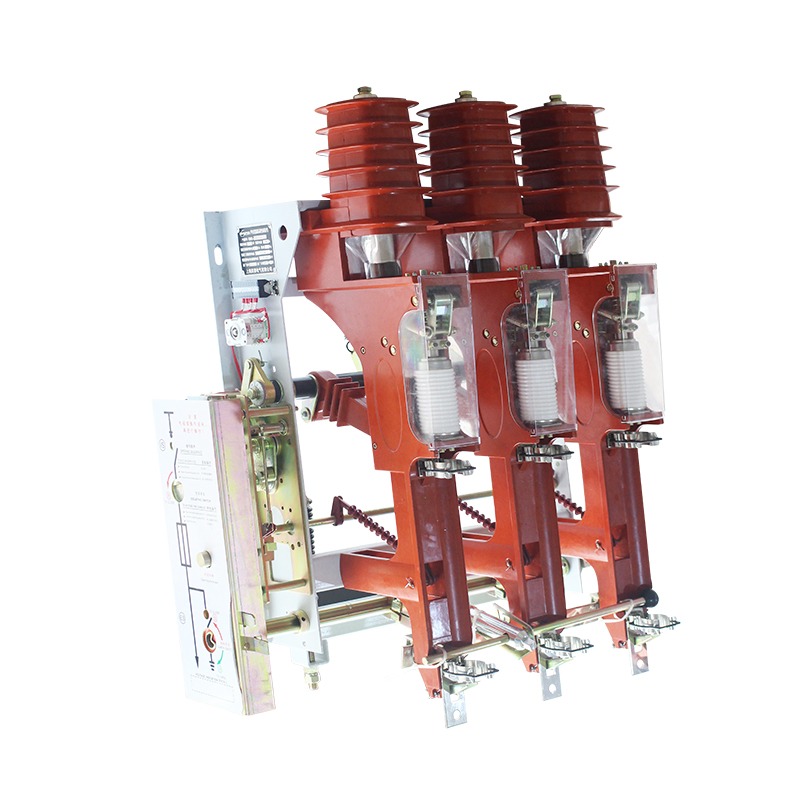
The phrase covers three products. The first is an air-break isolating switch, for putting a visible gap in a section already dead. The second is a gas-producing load-break switch — the FKN12A-12D on the 12 kV load break switch, 630 A, 20 kA short-time withstand for 4 s. The third is a vacuum load-break switch such as the FZN25-12D: the same 630 A and the same 20 kA, but a sealed interrupter and 10,000 mechanical operations against 2,000. If the enquiry does not name the duty, the quotation comes back for whichever of the three is cheapest to build.
How each design quenches the arc it makes
The air unit interrupts in open air. Each pole carries a gas-producing nozzle — the pale cylinders visible inside the clear chambers on the FKN12A-12D — and the arc's own heat vaporises the nozzle material, releasing a blast of gas that pushes the arc across the gap as the blade withdraws. The break stays visible through the chamber, which is why the design survives where an operator still walks up to the pole. The same feature sets the maintenance expectation: the nozzle is consumed a little on every interruption, and 2,000 operations is what that buys.
A vacuum interrupter does the same work inside a sealed bottle. The contacts part in vacuum, there is no gas to generate and no chamber to inspect, which is where the 10,000 operations declared for the FZN25-12D come from. SF6 designs sit alongside both, quenching with an electronegative gas instead of a blast, and are the usual choice inside sealed ring main units where enclosure size matters more than a visible break.
What each one is allowed to break
A specification has to pin this down, because "12 kV, 630 A" is a carrying rating all three devices can print on a plate. The breaking duties separate them, and the published values are specific enough to quote in a tender table.
| Duty | Air-break isolating switch | FKN12A-12D gas-producing load switch | FZN25-12D vacuum load switch |
|---|---|---|---|
| Rated normal current | Carrying only | 630 A | 630 A |
| Active load breaking current | Not declared | 630 A | 630 A |
| Closed-loop breaking current | Not declared | 630 A | 630 A |
| 5% active load breaking current | Not declared | 31.5 A | Not stated on the page |
| Cable charging breaking current | Not declared | 10 A | 10 A |
| Breaking no-load transformer capacity | Not declared | 1,250 kVA | 1,250 kVA |
| Rated short-time withstand | Depends on model | 20 kA for 4 s | 20 kA for 4 s |
| Rated peak making current | Not declared as a switching duty | 50 kA | 50 kA |
| Short-circuit breaking | None — upstream device | Fuse only, in the FKRN variant | Fuse only, in the FZRN variant |
| Mechanical life | Not stated on the page | 2,000 operations | 10,000 operations |
Two lines carry more weight than the rest. The 31.5 A figure at 5% active load is a small inductive current, not a fault: it is what a lightly loaded branch looks like when someone opens the switch at night, and a device with no declared value for it can restrike into a flashover. Closed-loop breaking at 630 A is the other — the duty that lets a switch transfer load around a loop, and the first number to disappear when an isolating switch is substituted to win on price. What a disconnect switch may break is set out in the load-current limits of a disconnect switch.
Why the fuse decides the comparison
Neither the air switch nor the vacuum switch breaks fault current; on a transformer circuit the fuse does, which is why the combination variants exist. The FKRN12A-12D pairs the same 630 A frame with a 150 A fuse rated to break 31.5 kA, and the FZRN25-12D pairs the vacuum switch with a 125 A fuse at the same 31.5 kA. Buying the switch and adding a fuse later is not the same product: the combination is a tested assembly whose fuse striker trips the switch.
Two numbers decide whether that assembly behaves. Rated transfer current — 1,200 A on the FKRN12A-12D, 2,000 A on the FZRN25-12D — is the level at which the fuse hands interruption over to the switch, and the higher figure is more forgiving where fault levels are stiff and the fuse clears fast. Striker energy is the second: 1 + 0.5 J on the FKRN12A-12D against 2–5 J on the FZRN25-12D, which names SDLAJ-12 and SFLAJ-12 fuse types. A fuse with the wrong striker energy either fails to trip the switch or damages the mechanism, and neither shows up until the first fault. Specify fuse type, striker energy and transfer current together.
FKN12A-12D against FZN25-12D, line by line
Both are 12 kV, 50 Hz, 630 A devices from the same range, so this comparison isolates the design differences rather than the ratings. Values below are from the published parameters of the FKN12A-12D air load switch and the FZN25-12D vacuum load switch.
| Parameter | FKN12A-12D (air, gas-producing) | FZN25-12D (vacuum) |
|---|---|---|
| Rated voltage / frequency | 12 kV, 50 Hz | 12 kV, 50 Hz |
| Rated normal current | 630 A | 630 A |
| Power frequency withstand, 1 min, to earth and between phases | 42 kV | 42 kV |
| Power frequency withstand, isolation break | 48 kV | 48 kV, with 30 kV across the interrupter gap |
| Lightning impulse withstand | 75 kV to earth, 85 kV across the isolation break | 75 kV to earth, 85 kV across the isolation break |
| Rated short-time withstand | 20 kA for 4 s; earthing switch 20 kA for 2 s | 20 kA for 4 s; earthing switch 20 kA for 2 s |
| Rated peak making current | 50 kA | 50 kA |
| Breaking duties | 630 A active load, 630 A closed loop, 31.5 A at 5% load, 10 A cable charging, 1,250 kVA no-load transformer | 630 A active load, 630 A closed loop, 10 A cable charging, 1,250 kVA no-load transformer |
| Mechanical life | 2,000 operations | 10,000 operations |
| Auxiliary supply | Not stated on the page | 220 V or 110 V, AC or DC |
| Installation geometry | Phase pitch 210 ± 2 mm, opening distance at least 175 mm, interphase air gap at least 125 mm | Not stated on the page |
| Ambient range | -25 °C to +40 °C, altitude up to 1,000 m | Not stated on the page |
The geometry row matters more than it looks. An air switch needs a 210 mm phase pitch and at least 175 mm of travel because the arc has to be stretched in open air; a vacuum bottle needs almost none of it. A cubicle drawn around a compact vacuum or SF6 block will not accept the air frame without a new internal layout, and that is a drawing change, not a substitution.
Where the switch is actually mounted
The same 12 kV function is packaged three ways, and the enclosure often decides the purchase before the interrupter does. Inside a unit-type metal-enclosed ring main unit such as the HXGN15-12 ring network switchgear — 12 kV, 50 Hz, IP3X, ambient -25 °C to +40 °C, altitude up to 2,000 m, built to IEC 62271-200 and GB3906 — the switch is one compartment in a bolted sheet-steel assembly with mechanical interlocks. On an overhead branch the same duty sits on a pole frame carrying switch, fuses and cable terminations, operated from the ground with an insulated rod. What changes is inspection access, earthing and the cable box.
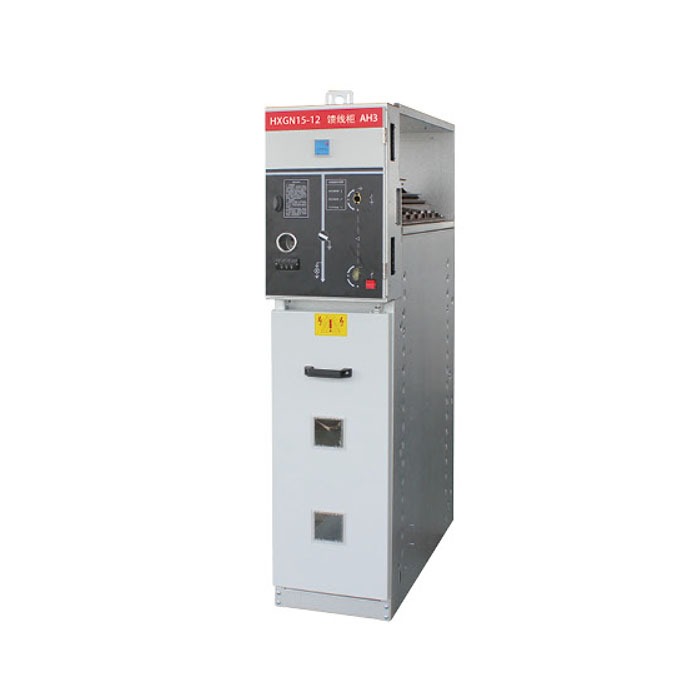
A ring main unit can be specified around an SF6 switch or a vacuum breaker, and the HXGN15-12 page states both options. What it cannot do is accept an air load switch on a drawing made for a compact block: the 210 mm phase pitch has to be designed in from the start, with the 175 mm opening distance and a chamber that stays visible. Where a project fixes the cubicle first and the switch second, that drawing check is worth more than any parameter on the datasheet.
Two arrangements for a 12 kV rural branch
A rural 12 kV branch feeding a distribution transformer is where this comparison is usually settled, and it resolves into two workable arrangements rather than one winner. The air switch-fuse combination suits it because the duty is small, the fault level modest and the operator wants to see the break from the ground. The vacuum combination suits the same branch when it is switched often or the cubicle has to be small. Both clear transformer faults with the fuse; neither replaces a recloser. The same trade-off is worked through in cable branch box versus ring main unit.
| Question | Pole-mounted air switch-fuse | Cubicle vacuum switch-fuse |
|---|---|---|
| What clears a transformer fault | The fuse, with the striker tripping the switch | The fuse, with the striker tripping the switch |
| Realistic switching frequency | Occasional: planned outages, branch isolation | Frequent: weekly loop transfer sits inside the 10,000-operation life |
| Visible break for the operator | Yes, through the chamber, at the pole | Through the cubicle window or position indicator only |
| Remote operation and automation | Manual by rod; motor operation is unusual | Motor-operated versions exist, with auxiliary contacts for telemetry |
| Footprint | A crossarm and a pole | A foundation, a cubicle and a cable trench |
| Main cost driver | Switch and fuse set, plus pole work | Cubicle, foundation, cable terminations, plus switchgear |
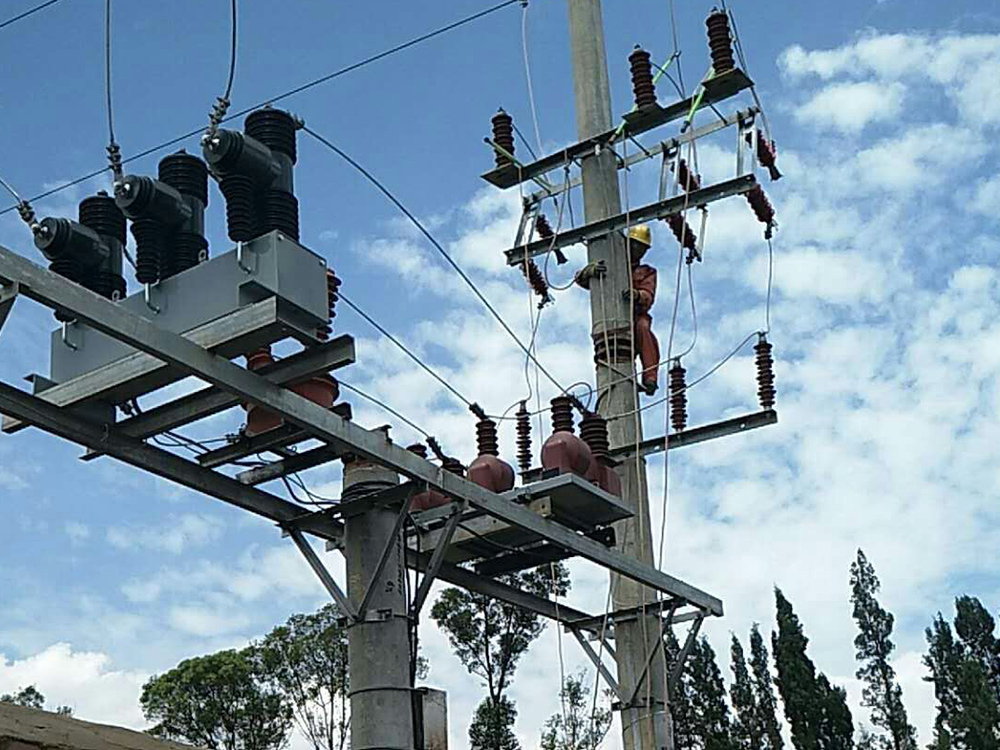
On the pole the arrangement reads as a stack: switch or interrupters on the upper crossarm, fuses or isolators below, jumpers dropping to the transformer. The photograph above is a live 12 kV pole frame of that type, with the switchgear bolted to a galvanised crossarm and a linesman working the pole steps — the practical reason the air design keeps its market, since everything likely to need replacement is reachable from a bucket.
What goes wrong when the wrong unit arrives
The expensive failures here are not wrong voltages but units that look right and cannot do the duty they were bought for.
- An isolating switch ordered as a load-break switch. The plate says 12 kV and 630 A, so it passes goods-in. On site it is opened under load once, restrikes, and the fault is blamed on the operator rather than the purchase order. Replacing it means a new switch, a new fuse assembly and a second outage.
- A combination assembled from unmatched parts. A fuse with the wrong striker energy beside a mechanism expecting 2–5 J will not trip reliably. The failure is latent and appears at the first fault, when the transformer is already damaged.
- An air frame ordered into a cubicle drawn for a compact block. The 210 mm phase pitch and 175 mm opening distance have to exist in the enclosure. Finding out at assembly means re-cut partitions, a new drawing approval and a delayed energisation.
- A life figure assumed rather than read. A branch switched twice a week is fine on 2,000 operations; a loop transferred twice a day is not, and the spare-nozzle kit that follows an air switch is a procurement line most buyers meet in year two.
Each is a few characters on a datasheet and a commercial event on site: rework, a rejected inspection, a postponed energisation, or a spare-part mismatch that keeps a feeder locked out while a nozzle kit is imported.
What to write into the RFQ
The enquiry only works if it separates carrying from breaking. Put these to a supplier as requirements, not questions.
- Rated voltage, frequency and normal current, plus the fault level and its duration at the point of installation.
- Every breaking duty the scheme uses: active load, closed loop, cable charging, no-load transformer capacity in kVA, and the small inductive current if the branch runs lightly loaded.
- Whether a fuse is required, and if so its rated current, short-circuit breaking current, striker energy and the assembly's rated transfer current.
- Short-time withstand current with its duration, and rated peak making current, stated separately.
- Insulation level across the isolation break as well as to earth, since the break value is what proves the visible gap.
- Mechanical life in operations, and whether a spare arc-quenching nozzle set is on the spares list.
- Where the switch goes into a cubicle: phase pitch, opening distance, IP rating, ambient and altitude.
- Documents: type test reports to IEC 62271-103 and IEC 62271-1, routine test report for the serial numbers supplied, and an outline drawing for approval before manufacture.
A supplier who answers all eight lines has told you which device they are quoting. A reply returning only voltage, current and price has not answered the question.
Frequently Asked Questions
Is an air break switch the same as a load break switch?
Not automatically. Air break describes the medium; load break describes a rated duty. A gas-producing air switch such as the FKN12A-12D is a load break switch with a declared 630 A active-load breaking rating, while a plain air-break isolating switch has no load-breaking rating and must be opened only after the circuit is isolated.
Can either type clear a short circuit on its own?
No. Both the air and the vacuum load switch are switching devices, not protective devices. Short-circuit clearing comes from the fuse in the combination variant — 31.5 kA on both the FKRN12A-12D and the FZRN25-12D — or from an upstream breaker. Specifying the switch without the fuse leaves the transformer unprotected.
Why is the vacuum version rated for 10,000 operations and the air version for 2,000?
Because the air switch consumes its nozzle on every interruption: the arc vaporises part of the gas-producing insert, so the chamber is a wear item. A vacuum interrupter parts its contacts in a sealed bottle with nothing to erode, which is why the FZN25-12D declares 10,000 operations against 2,000.
Which one belongs on a pole-mounted rural branch?
The air switch-fuse combination is the usual answer where the branch is switched occasionally and the operator wants a visible break from the ground. Move to the vacuum combination when the branch is switched often, when the loop transfers load, or when the enclosure has to be compact enough to rule out a 210 mm phase pitch.
What does rated transfer current mean on a switch-fuse combination?
It is the current level at which the fuse takes over the interruption from the switch. The FKRN12A-12D declares 1,200 A and the FZRN25-12D 2,000 A. It matters on stiff networks where the fuse clears quickly; without it, a combination cannot be checked against the fault level at the installation point.
Does the air switch need more space inside a cubicle?
Yes. The FKN12A-12D is published with a 210 ± 2 mm phase pitch, an opening distance of at least 175 mm and an interphase air gap of at least 125 mm, because the arc is stretched in open air. A cubicle drawn around a compact vacuum or SF6 block will not take it without a new internal layout.
Sources and Further Reading
- IEC 62271-103:2021 — Alternating current switches for rated voltages above 1 kV and up to and including 52 kV — the type-test standard for load-break and load-break/isolating switches, including the closed-loop and cable-charging duties quoted above
- IEC 62271-1:2017 — Common specifications for high-voltage switchgear and controlgear — service conditions, ratings and the dielectric and mechanical test requirements shared by every device in this comparison
- Load break switch: what it is, how it works and how to choose — the wider selection guide, including where a load break switch sits against a circuit breaker and an isolator
Published Nov 20, 2026 · Nahu Group (NAHU Electric Technology)