
A type test report is the document that proves a switchgear design has passed the tests defined by its product standard — on a representative sample, in an accredited laboratory, to a named edition of that standard. It is not a certificate of quality and it is not a per-unit record. It describes one frozen configuration, the tests applied to it, and the results obtained, so a buyer can judge whether the equipment offered is the equipment that was proven.
For medium-voltage switchgear the report is read against IEC 62271-200, the metal-enclosed assembly standard, together with IEC 62271-1 for common specifications and the device standard for each switching device inside the enclosure. That layering is why two reports can both look official and still describe different things.
This guide explains what the document contains, how it differs from the routine test record supplied with each unit, what to check before accepting one, and where the document stops being useful. It is written for the person who has to sign off a switchgear submittal, not for the laboratory that produced it.
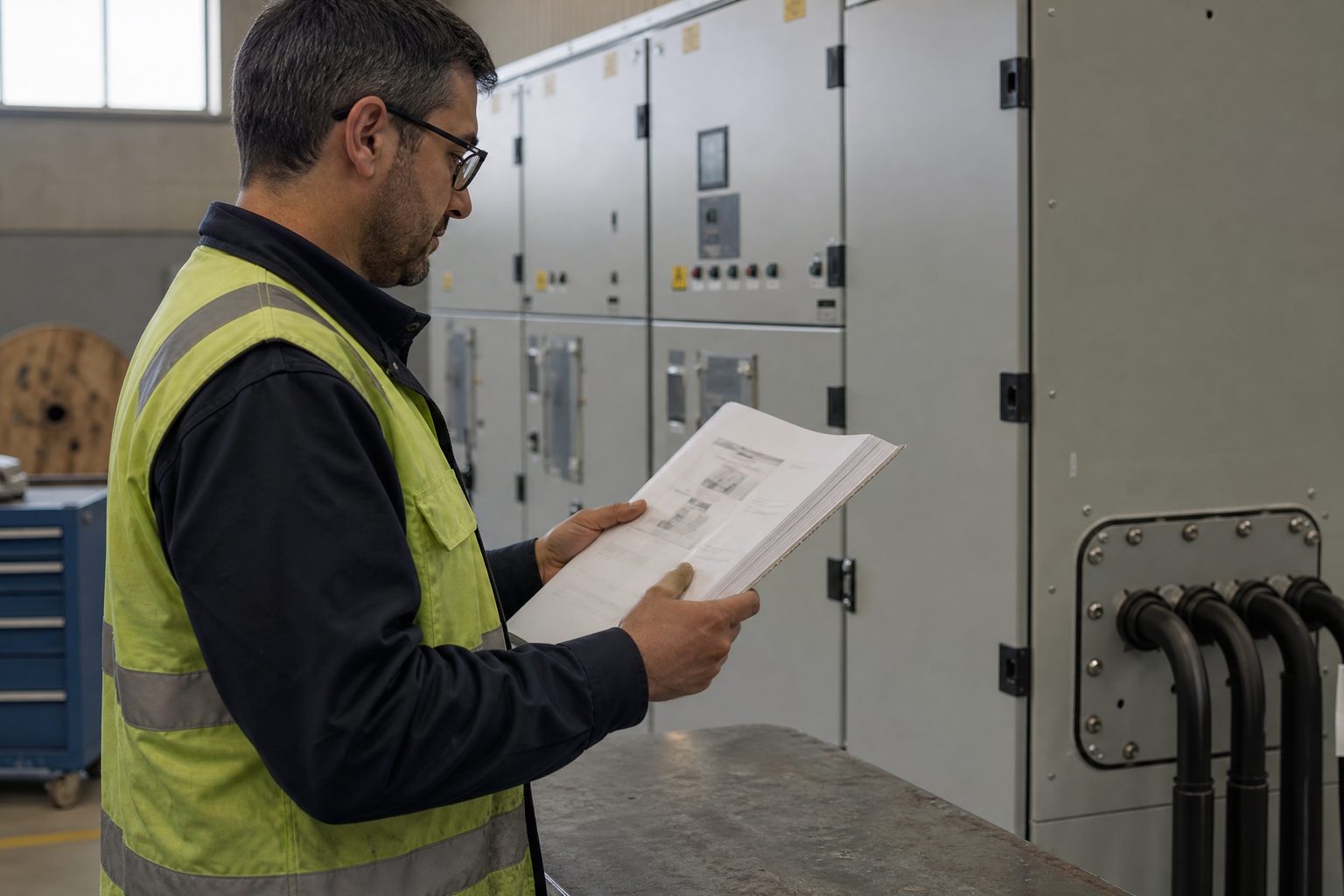
What Is a Type Test Report in Switchgear?
A type test is performed once on a design, not on every unit sold. Its purpose is to demonstrate that the design meets the ratings and behaviour claimed for it: dielectric withstand, short-time and peak current withstand, making and breaking capability, temperature rise, mechanical endurance, tightness and, where the standard requires it, internal arc performance.
The report is the record of that campaign. In a well-formed document it carries the laboratory's identity and accreditation, the report number and date, the standard and edition applied, a description of the tested configuration detailed enough to match a quotation, the measured results against the required values, and the test setup with photographs or drawings.
Three words in that list do most of the work: representative, edition and configuration. A report on a different frame size, a different short-circuit rating or a different internal arc class is evidence for that variant, not for the one in your purchase order. IEC TR 62271-307 exists precisely because extending type test validity to variants is a judgement call rather than an automatic right, and buyers who ignore it discover the gap at approval stage.
Type Test Report vs Routine Test Report: What Is the Difference?
Both documents arrive in the same submittal package, and confusing them is the most common review error. The distinction is simple: one proves a design, the other records a unit.
| Type-test report | Routine test report | |
|---|---|---|
| What it proves | The design meets the ratings and classifications claimed, on a representative sample | The individual unit leaving the factory is sound and matches the design |
| How often it is done | Once per design, or per variant when validity is extended | On every unit manufactured |
| Who performs it | An independent, accredited high-power laboratory in most procurement regimes | The manufacturer's own test bay |
| Typical content | Dielectric, short-time and peak withstand, making and breaking, temperature rise, mechanical operation, internal arc where applicable | Dielectric test on main circuits, measurement of main-circuit resistance, tightness, mechanical operation, wiring and visual checks |
| What it cannot tell you | Whether the unit in front of you was built correctly | Whether the design itself is capable of the fault level on your network |
| Where it appears in a contract | Technical submittal, before award | Factory acceptance test and shipping release |
The two documents are complementary and neither substitutes for the other. A supplier who offers only a routine test record has not shown that the design can interrupt the fault current your network can deliver. A supplier who offers only type-test evidence has not shown that the particular cubicle was assembled and wired correctly.
The per-unit half of that pairing is covered in more detail in our guide to the vacuum circuit breaker testing procedure, which walks through the checks a breaker sees before dispatch and again on site.
Which Standards Does the Report Cite?
A report is only meaningful against a named edition, and the editions have moved. Three layers usually appear.
- IEC 62271-1 — the common specifications for high-voltage switchgear and controlgear. It supplies shared definitions, ratings and the general test framework that the part standards build on.
- IEC 62271-200 — AC metal-enclosed switchgear and controlgear for rated voltages above 1 kV and up to and including 52 kV. Edition 3.0 was published in 2021, with Amendment 1 following in 2024, and it classifies assemblies by internal arc (IAC), loss of service continuity (LSC) and partition class (PM or PI).
- The device standard — IEC 62271-100 for circuit-breakers, IEC 62271-103 for switches, IEC 62271-105 for switch-fuse combinations. These define the tests that qualify the interrupter itself.
IEC 62271-100:2021 is explicit about what belongs in which bucket. Its type test programme covers dielectric tests, short-time and peak withstand, making and breaking procedures with transient recovery voltage considerations, and the associated measurement of arcing times. Its routine tests are a shorter list: dielectric checks, resistance measurement, tightness, mechanical operation and visual inspection. That split is the conceptual key to reading any switchgear test package.
Edition drift matters commercially. A report to an older edition of the assembly standard may be technically honest and still fail a specification that names the current text. The same applies to national adoptions: GB/T 3906-2020 in China is a modified adoption of IEC 62271-200:2011, so a report to GB/T 3906-2020 demonstrates conformity with a standard built on the previous edition, not with the 2021 text.
What Should a Type Test Report for MV Switchgear Contain?
The checklist below is the one worth applying line by line. Each item answers a question a reviewer will eventually ask, and a missing item is cheaper to resolve before the purchase order than after it.
- The laboratory and its accreditation. The report should name the testing organisation and the accreditation under which it operates. High-power testing is a small world: the Short-circuit Testing Liaison group listed eleven member organisations in its June 2025 directory, among them CESI, KEMA, KERI, CPRI, VEIKI and ZKU, all outside China. Knowing where a Chinese manufacturer's type tests were actually run is a normal procurement question, not an accusation.
- Report number and date. Both are needed to cross-check with the laboratory and to judge whether the evidence predates a design change.
- The standard and its edition. "Tested to IEC 62271-200" is not enough. The edition, and any amendment consolidated into it, decide which requirements were actually applied.
- The exact tested configuration. Rated voltage, rated normal current, short-time withstand current with its duration, peak withstand current, the internal arc class with current and duration, the insulating medium, and the arrangement of functional units.
- The results against the required values. A report that lists only "pass" without measured values and tolerances is a summary, not evidence.
- The test arrangement. Drawings or photographs of the assembly as tested, including the position of partitions, shutters, venting and cable compartments.
- The classification declared. IAC, LSC and partition class are each declared on the basis of type tests, so the report is where those three claims are verified rather than assumed.
- The variant basis. If the offered equipment differs from the tested sample, the report should reference how validity was extended, for example through IEC TR 62271-307.
How Do You Verify the Report Is Genuine?
Verification is mostly cross-referencing, and it takes less time than reading the report itself. Five checks catch nearly everything.
- Check the laboratory exists and does this class of testing. A high-power laboratory that performs short-circuit making and breaking tests is a specific kind of facility. If the named organisation is not in that business, the document needs explaining.
- Check the report number and date independently. Most laboratories will confirm a report reference on request. This one step defeats most fabricated or borrowed documents.
- Match the configuration to the quotation. Model designation, frame size, rated current, short-circuit level, arc class and medium should correspond item by item. A report for a 630 A panel does not qualify a 1250 A panel.
- Check the date against the design history. A report dated before the product existed, or after the model was revised, is a warning sign rather than proof.
- Read the results section, not the cover. The cover is a summary. The results tables show whether the tested values sit close to the requirement or comfortably above it, which tells you something about design margin.
A practical habit: ask for the complete report rather than the certificate page, and ask which laboratory will confirm it. Suppliers with genuine evidence answer both questions without hesitation.
What Does the Report Not Cover?
Knowing the boundaries prevents the more expensive kind of misunderstanding, where a valid report is treated as a guarantee it was never meant to give.
- Your site conditions. Ambient temperature, altitude, humidity, pollution level and seismic duty may all require derating or additional evidence. The report describes the conditions tested, which are the standard reference conditions unless stated otherwise.
- The relay, the meter and the control scheme. Protection and metering devices carry their own standards and their own evidence. A switchgear type test says nothing about whether the protection settings coordinate.
- Installation quality. Cable termination, earthing, torque values and interlock adjustment are site work. No factory document covers them.
- Later modifications. A changed barrier, an added compartment, a different venting arrangement or a substituted interrupter can invalidate the basis of the original evidence.
- Per-unit workmanship. That is the routine test's job, and it is why the routine records are requested separately at factory acceptance.
How Does the Report Fit Into a Factory Acceptance Test?
The factory acceptance test is where the two documents meet. Before shipment, the buyer or their representative witnesses the routine tests on the actual units: dielectric checks on main circuits, main-circuit resistance measurement, tightness verification, mechanical operation of each device, and the wiring and visual inspection that confirms the assembly matches the drawings.
The type test report supplies the reference values for that exercise. If the design was type-tested with a main-circuit resistance of a given order, a routine measurement far outside that band is a signal worth investigating before the unit is packed. Used this way, the report stops being a document filed for compliance and becomes a working baseline.
Where the contract provides for witnessed testing, agree the scope in writing: which tests will be witnessed, which records will be signed, who signs them, and what happens if a result falls outside tolerance. Disagreements at that stage are almost always about scope that was never fixed, not about equipment that failed.
For instrument transformers inside the same assembly, the equivalent pre-dispatch evidence is described in our note on primary injection testing of a current transformer, and the wider assembly context is set out in the metal-enclosed switchgear guide.
Which Documents Should a Buyer Request Together?
The report on its own leaves gaps. The package below covers the design, the unit and the installation, and each item answers a different question.
| What it establishes | When to ask for it | |
|---|---|---|
| Type-test report | The design meets the ratings and classifications claimed, to a named standard edition | With the technical offer, before award |
| Routine test records | Each unit was tested and matches the design | At factory acceptance, before shipment |
| Internal arc classification statement | Which sides are protected, at what current and duration | With the technical offer, if the specification cites IAC |
| Drawings and single-line diagram | The arrangement matches the network design and the interlocking concept | For approval, before manufacture |
| Installation and maintenance instructions | The site work and the service regime the design assumes | Before shipment, in the destination language |
Why Type Test Evidence Matters More on MV Switchgear
At medium voltage the consequences of an under-rated design are not gradual. A panel that cannot interrupt the available fault current does not simply wear faster; it fails at the moment it is asked to perform the one function it exists for. The same logic applies to internal arc performance, where the classification describes what happens to the operator side of the enclosure when an arc occurs inside it.
This is also where the gap between a catalogue and a report becomes commercially important. Catalogue ratings are declarations. Test reports are the evidence behind declarations, and the difference surfaces when a utility, an EPC contractor or an insurer asks for the file.
Nahu Group manufactures medium-voltage distribution equipment — metal-enclosed switchgear, ring main units, vacuum circuit breakers, load break switches, instrument transformers and metering boxes — for networks in the 10–35 kV range. For project submittals, the engineering team can confirm which standard editions and which tested configurations correspond to a given enquiry, so the documentation request matches the equipment actually being quoted.
Frequently Asked Questions
What is a type test report in simple terms?
A type test report is the record of tests performed once on a representative sample of a design, to show that the design meets the ratings claimed for it. It names the laboratory, the standard and edition applied, the tested configuration and the measured results. It is evidence about a design, not about an individual unit.
Is a type test the same as a certificate?
No. A report records what was tested and what was measured. A certificate is a short statement that a conformity assessment has been completed. Procurement documents often ask for both, but the report is the substantive evidence, and a certificate without a report behind it is difficult to evaluate.
How long is the report valid?
There is no universal expiry date. Validity depends on whether the design is unchanged, whether the standard edition cited is still accepted by the buyer, and whether the report covers the exact configuration offered. A report does not automatically transfer to a modified design or a different rating.
Can one report cover several switchgear ratings?
Sometimes, but only through a documented extension of validity. IEC TR 62271-307 addresses how type test results may be extended to variants. Without that basis, a report on one rating should not be read as evidence for a higher current, a higher short-circuit level or a different arc classification.
Which standard applies to metal-enclosed MV switchgear?
IEC 62271-200 covers AC metal-enclosed switchgear and controlgear rated above 1 kV and up to and including 52 kV. It is read together with IEC 62271-1 for common specifications and with the device standards for the circuit-breakers, switches or switch-fuse combinations inside the assembly.
Does the report prove the unit I receive is correct?
No. The type test proves the design. The unit is covered by routine tests performed at the factory on every assembly, and by the factory acceptance test if the contract provides for witnessing. Ask for the routine records together with the type test evidence.
Why does the standard edition matter so much?
Because requirements change between editions, and a specification usually names one. IEC 62271-200 edition 3.0 was published in 2021 with Amendment 1 in 2024, and national adoptions may still be based on the 2011 text. A report to an older edition may be genuine and still not satisfy a tender that cites the current one.
What should I check first in a report I have just received?
Start with the tested configuration: rated voltage, rated current, short-time withstand current and duration, internal arc class and insulating medium. Compare that list against the quotation. If the configuration does not match, the rest of the document describes a different product and the review can stop there.
Sources and Further Reading
- IEC 62271-100:2021 — AC circuit-breakers — scope, type test and routine test content
- Sinospect — MV switchgear from China: a buyer's guide — standard editions, type-test report contents, STL laboratory list
- Intertek — IEC 62271-200 edition 3.0:2021 white paper — what changed in the 2021 edition
- IEC Webstore — IEC 62271-200:2021 with Amendment 1:2024
Read as a chain, the evidence is straightforward: a design proven to a named edition, a unit proven to match that design, and a site installation that preserves both. Most approval problems come from a break in that chain rather than from a failed test, and the type test report is the link buyers most often accept without opening.
For 10–35 kV switchgear, ring main units and instrument transformers, Nahu Group can confirm the tested configurations and standard editions relevant to a project before the submittal is written. See the switchgear range, or talk to the engineering team about the documentation your customer requires.
Published October 18, 2026 · Nahu Group (NAHU Electric Technology)