
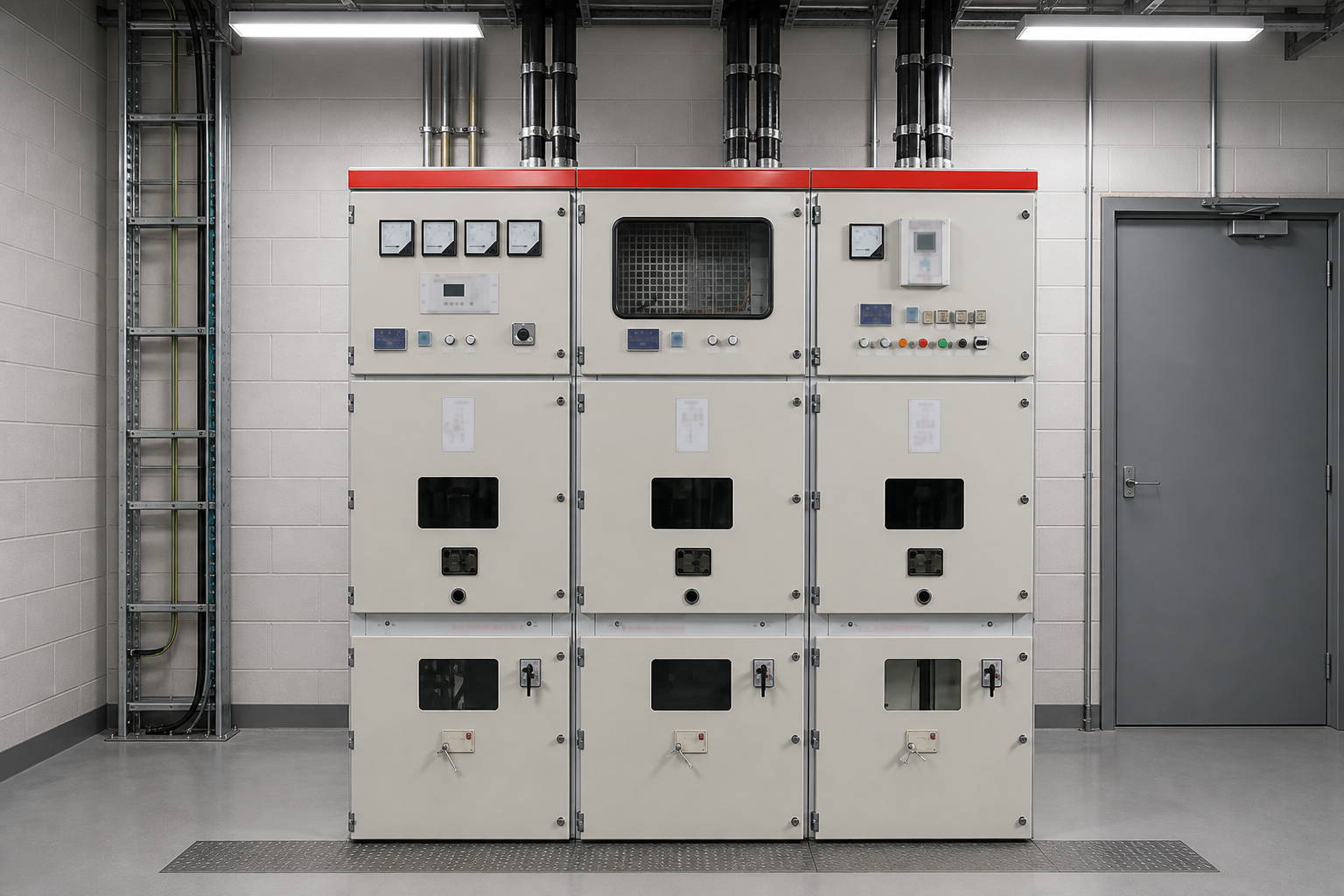
Metal-enclosed switchgear is switchgear whose switching devices, busbars and cable connections are all mounted inside a grounded metal enclosure that forms part of the assembly, so the cabinet itself — not the apparatus alone — is the barrier between live parts and the person operating it. The term covers the enclosure, the compartments inside it, the interlocks that police the operating sequence, and the pressure-relief paths that direct an internal arc away from the operator.
This is the layer of a 10–35 kV project where the decision is made by a committee: a utility engineer, an EPC contractor and a procurement officer reading the same tender package. This guide stays with the enclosure and the assembly — the three cabinet families Nahu Group builds, how ring network switchgear and armored withdrawable designs differ, and the specification clauses that decide whether what arrives on site matches the single-line diagram.
The devices inside a cabinet are covered elsewhere on this blog: read the load break switch guide or the vacuum circuit breaker guide if that is the level you need. Nothing here re-teaches a load break switch, a vacuum circuit breaker or a ring main unit on its own.
Specifying a distribution cabinet for a project?
Send the single-line diagram, the system voltage and the fault level. Nahu Group will confirm which cabinet family fits, which published ratings apply, and what documentation accompanies the offer.
What Is a Metal-Enclosed Switchgear Cabinet?
A metal-enclosed switchgear cabinet is a factory-assembled unit in which the primary circuits sit inside a grounded metal enclosure. The term is defined by the enclosure, not by what is switched inside it: the assembly must provide a grounded metal barrier around the primary circuits, but it does not promise that every function is separated from every other function by its own barrier. That extra segregation is where much of the price difference between two apparently similar cabinets lives.
The enclosure also carries everything that is not switching: the busbar tying the cabinets together, the cable termination space, the earthing switch, the instrument transformers, the voltage detection, the surge arresters and the low-voltage compartment are all part of the same assembly. A buyer who specifies only the switching device has specified perhaps a third of what is being bought.
The international standard written around this equipment is IEC 62271-200, whose scope covers prefabricated AC metal-enclosed switchgear and controlgear assemblies for rated voltages above 1 kV and up to and including 52 kV, for indoor and outdoor installation, with air-insulated and fluid-filled compartments. Whether the units offered to you carry type-test evidence against the edition your project references is a question for the supplier, not an assumption to make.
How Is a Cabinet Compartmented, Barriered and Ventilated?
The compartment layout is the most informative item on a general arrangement drawing, because it answers a practical question: what can be worked on while the rest of the assembly stays live? A medium-voltage cabinet normally divides into four zones — the busbar compartment across the top, the device compartment holding the load switch or circuit breaker, the cable compartment receiving the cables, earthing switch, instrument transformers and terminations, and the low-voltage compartment holding relays, meters, terminal blocks and the electrical half of the interlock logic.
The HXGN15-12 sets the arrangement out explicitly in its published datasheet: a busbar compartment at the top linking to the adjacent switch cabinet; the load switch as an independent unit filled with SF6; a cable room using about 75% of its space for cable connections, fuses, earthing switches and CT/PT installation; a small compartment holding the operating mechanism and mechanism interlocks together with position indicators, auxiliary contacts, trip coils and live indicators; and an optional relay box at the top. The cabinet is 2 mm aluminium-zinc coated sheet, or cold-rolled sheet with powder coating, riveted together.
Pressure relief is the part buyers overlook most often. An internal arc raises pressure inside a compartment in milliseconds, so the assembly has to send that pressure somewhere controlled: the HXGN15-12 has two pressure-relief ports at the rear, one for the cable compartment and one for the load switch and busbar compartment, while the KYN28A-12(Z) publishes a pressure-relief passage on every compartment. Check where the ports discharge, and that a trench cover, a wall or the operator's standing position is not in the way.
Metal-Enclosed, Metal-Clad and Armored Withdrawable: What Is the Difference?
These three words are used loosely in tenders, and they describe progressively stricter construction rather than three brands of the same thing.
- Metal-enclosed — the primary circuits are inside a grounded metal enclosure. Several functions may share one enclosure, and the enclosure is the barrier to the operator.
- Metal-clad or compartmented — each function sits in its own grounded metal compartment, with barriers between the busbar, device and cable zones, so an arc in one compartment is far less likely to propagate into the next.
- Armored withdrawable — the device is carried on a withdrawable element rather than bolted in place. It travels between a working position, where the primary contacts are engaged, and a testing position, where they are not, and shutters or barriers close over the fixed contacts as it is drawn out so a live busbar is not left exposed.
More segregation is not automatically better. It buys safer maintenance and faster restoration after a fault, and it costs footprint, weight and money. A compact distribution substation on a ring network usually does not need it; a primary substation where a breaker will be withdrawn for routine testing usually does.
When a specification asks for metal-clad switchgear, or for a particular degree of internal separation, the useful answer is a declared classification rather than a description of barriers. IEC 62271-200 classifies assemblies by loss of service continuity — how much of the board can stay energised while a compartment is opened — and a declared classification is something that can be checked against the drawing.
Ring Network Switchgear and Armored Switchgear: Two Families, Two Jobs
The two high-voltage cabinet families a distribution buyer meets most often solve different problems, and confusing them is an expensive way to start a project.
Ring network switchgear: compact, ring-fed, close to the load
Ring network switchgear — the ring main unit class of equipment — is a compact assembly for a distribution substation on a ring-fed network. It is designed so that one cable section can be isolated without cutting supply to the rest of the ring, which is why the ring is built in the first place.
Nahu Group's HXGN15-12 is a unit-type AC metal-enclosed ring network switchgear. Its published parameters are a rated voltage of 12 kV, a rated frequency of 50 Hz, a main bus rated current of 630 A with a maximum rated fuse current of 125 A, a rated short-time withstand current of 20 kA for 3 s on both the main circuit and the earthing circuit, a rated peak withstand current of 50 kA, a rated short-circuit making current of 50 kA, and a load switch rated for 100 full-capacity breaking operations. The load switch is an independent SF6-filled unit, and an SF6 or vacuum circuit breaker can be placed below a load switch where the single-line diagram needs one. For how the ways and functions are counted on this type of unit, see ring main unit types and configurations.
Armored withdrawable switchgear: higher ratings, serviceable breakers
Armored withdrawable switchgear is the assembly for substations where the circuit breaker must be replaceable and the ratings are higher. Nahu Group's KYN28A-12(Z) is published at rated voltages of 3.6, 7.2 and 12 kV and a rated frequency of 50 Hz, with circuit breaker and switchgear rated currents of 630, 1250, 1600, 2000, 2500 and 3150 A, a rated short-time withstand current at 4 s of 20, 25, 31.5 and 40 kA, a rated peak withstand current of 50, 63, 80 and 100 kA, and a rated short-circuit breaking current of 20, 25, 31.5 and 40 kA.
Structurally it is an all-metal modular assembly in aluminium-zinc coated steel sheet, CNC-machined, fastened with rivet nuts and high-strength bolts, and the cable compartment accepts up to nine single-core cables. In tenders the same assembly may be called an MV switchgear cabinet, a distribution cabinet, a panel or a board; what matters is the ratings, the compartment and interlock arrangement, the cable interface and the declared service conditions behind the label.
GGD, HXGN15 and KYN28A: How Do the Three Cabinet Families Compare?
| GGD low voltage switchgear | HXGN15-12 | KYN28A-12(Z) | |
|---|---|---|---|
| Assembly type | AC low-voltage distribution cabinet | Unit-type AC metal-enclosed ring network switchgear | Armored withdrawable AC metal-enclosed switchgear |
| Rated voltage | 380 V (GGD1 published data) | 12 kV | 3.6 / 7.2 / 12 kV |
| Rated current | 1000 A / 600(630) A / 400 A | Main bus 630 A; maximum rated fuse current 125 A | 630 / 1250 / 1600 / 2000 / 2500 / 3150 A |
| Rated short-time withstand current | 15 kA for 1 s | 20 kA for 3 s (main circuit and earthing circuit) | 20 / 25 / 31.5 / 40 kA for 4 s |
| Rated peak withstand current | 30 kA | 50 kA | 50 / 63 / 80 / 100 kA |
| Rated short-circuit breaking current | 15 kA | Not published for the assembly; short-circuit making current 50 kA | 20 / 25 / 31.5 / 40 kA |
| Switching and insulating arrangement | Air-insulated low-voltage cabinet range | Independent SF6-filled load switch unit; optional SF6 or vacuum circuit breaker below a load switch | Withdrawable handcart with working and testing positions |
| Interlocks and relief | Indoor fixed assembly | Mechanism interlocks with position indicators; two pressure-relief ports at the rear | Mechanical and electrical interlocks meeting the five protections; pressure-relief passage in every compartment |
| Maximum ambient air temperature | +40 °C | +40 °C | +40 °C |
| Minimum ambient air temperature | −5 °C | −25 °C | −15 °C |
| Altitude | Not above 2000 m | Not above 2000 m | Not above 1000 m |
| Relative humidity | Not above 50% at +40 °C; 90% at +20 °C | Daily average not above 95%; monthly average not above 90% | Daily average not above 95% with water vapour pressure not above 2.2 kPa; monthly average not above 90% with water vapour pressure not above 1.8 kPa |
| Other published condition | Indoor installation; inclination not more than 5 degrees from vertical | Indoor distribution room installation | Earthquake intensity not above magnitude 8; usage conditions stated with reference to GB 3906 |
Read the table for duties rather than as a league table: the 4 s duration on the KYN28A and the 1 s duration on the GGD1 are different duties, not the same duty with different numbers, and those details belong in the specification, where a supplier can be held to them.
What Service Conditions Decide the Cabinet You Can Use?
Published ratings are quoted inside an envelope of service conditions, and the last rows of the comparison table above show where the three families part company.
Two consequences follow. The temperature floors and the altitude ceilings are genuinely different: a ring network cabinet declared to −25 °C, an armored cabinet declared to −15 °C and a low-voltage cabinet declared to −5 °C are not interchangeable on one site, and the 1000 m ceiling on the armored family matters on upland networks. Working outside a published envelope does not make equipment unsuitable, but it moves the discussion into design review, where the supplier has to confirm what changes in writing.
How Does a Buyer Specify Metal-Enclosed Switchgear?
A specification has one job: to make a wrong offer impossible. Most disputes in this equipment category trace back to a tender that left a required value implicit, and a supplier who filled the gap with the cheapest compliant interpretation. These are the clauses that carry real consequences.
- System voltage and insulation level. State the nominal system voltage and the insulation level expected, not only the highest nominal voltage of the family.
- Rated normal current. Give the busbar current and the current of each branch separately; a busbar rating is not a branch rating.
- Short-time withstand current with its duration, and the peak withstand current. A current without a duration is half a requirement, and the peak value is quoted separately because it sizes the busbar supports.
- Circuits: number and function. Note every incoming, outgoing, tee-off and bus section, and state whether the busbar must be extensible so the board can grow.
- Switching and insulating medium. Name the medium required for each switching function, including any market restriction that applies to it.
- Compartments, interlocks and relief. Require a declared classification for internal separation or loss of service continuity, the interlock scheme, and the relief arrangement.
- Cable interface and instrument transformers. State the number, type and cross-section of cables per compartment and the termination type, together with the ratios, burdens and accuracy classes of the current and voltage transformers.
- Service conditions and evidence. Give measured ambient maximum and minimum, altitude, humidity and seismic requirements, and name the type-test report, drawings and routine test records you expect with the offer.
One clause is worth adding on its own line: the standard edition the equipment is to be verified against. IEC 61439-2:2020 defines the specific requirements for low-voltage power switchgear and controlgear assemblies, for assemblies whose rated voltage does not exceed 1000 V AC, for indoor and outdoor applications, stationary or movable, with or without enclosures. Naming the edition in the tender removes the commonest source of argument at approval stage.
What Should You Ask a Supplier For?
The equipment in this category looks similar from the outside, and the difference between two offers is almost always in the paperwork. Ask for the type-test report that covers the configuration being quoted rather than a statement that a family has been tested, the general arrangement and interlock drawings, the declared service conditions in writing, and the standard editions the evidence was produced against — a report against a superseded edition may not satisfy the approving engineer.
Nahu Group manufactures the GGD low-voltage cabinet and the HXGN15 and KYN28A high-voltage families described here, together with the complementary apparatus that goes inside them — current transformers, voltage transformers, metering boxes, load break switches, vacuum circuit breakers, lightning arresters, drop-out fuses and cable accessories — across a 10–35 kV catalogue range. The engineering team can confirm which configuration applies to a specific enquiry.
Frequently Asked Questions About Metal-Enclosed Switchgear
What is a metal-enclosed switchgear cabinet?
A metal-enclosed switchgear cabinet is an assembly in which the primary switching devices, busbars and cable connections are mounted inside a grounded metal enclosure that forms part of the equipment. The enclosure, not the individual apparatus alone, provides the barrier between live parts and the operator, and it is the assembly as a whole that is specified, verified and delivered.
What is the difference between metal-enclosed, metal-clad and armored switchgear?
Metal-enclosed is the general term for switchgear inside a grounded metal enclosure, and several functions may share one enclosure. Metal-clad or compartmented construction gives each function its own grounded metal compartment. Armored withdrawable construction carries the device on a withdrawable element that moves between a working position and a testing position, with shutters or barriers closing over the fixed contacts as it is drawn out.
What is ring network switchgear?
Ring network switchgear, often called a ring main unit, is a compact assembly used at a distribution substation on a ring-fed network, so that one cable section can be isolated without cutting supply to the rest of the ring. Nahu Group's HXGN15-12 is a unit-type AC metal-enclosed ring network switchgear at 12 kV with an independent SF6-filled load switch unit and a top busbar compartment that links to the adjacent switch cabinet.
What is armored withdrawable switchgear?
Armored withdrawable switchgear is a metal-enclosed assembly in which the circuit breaker is carried on a withdrawable handcart that moves between a working position and a testing position. Nahu Group's KYN28A-12(Z) is built this way, with mechanical and electrical interlocks meeting the five protections requirement and a pressure-relief passage in every compartment.
What are the five protections on a withdrawable switchgear cabinet?
The five protections is the name given to the interlock scheme that governs the operating sequence of a withdrawable circuit breaker, so that the handcart cannot be moved while the breaker is closed, the breaker cannot be closed unless the handcart is in a correct position, and the earthing and secondary connections follow the right order. Nahu Group's KYN28A-12(Z) is published as having mechanical and electrical interlocks meeting this requirement; the exact logic should be confirmed against the interlock scheme drawing for your order.
What is the difference between GGD low voltage switchgear and a high-voltage cabinet?
GGD low voltage switchgear is an AC low-voltage distribution cabinet, published for GGD1 at 380 V with rated currents of 1000 A, 600(630) A and 400 A, a rated short-circuit breaking current of 15 kA and a rated short-time withstand current of 15 kA for 1 s. It is installed indoors in power plants, substations, factories and mines. The HXGN15-12 and KYN28A-12(Z) cabinets are high-voltage assemblies, at 12 kV and at 3.6, 7.2 or 12 kV respectively.
How do you specify a metal-enclosed switchgear cabinet?
The specification should fix the system voltage and insulation level, the rated normal current of the busbar and of each branch, the short-time withstand current with its duration, the peak withstand current, the number and function of every circuit, the switching and insulating medium, the compartment and interlock arrangement, the cable interface, the metering and protection requirements, the measured service conditions of the site, and the test evidence expected with the offer.
What evidence should you ask a supplier for?
Ask for the type-test report covering the configuration being quoted rather than a general catalogue claim, the general arrangement and interlock drawings, the declared service conditions in writing, the routine test records supplied with the units, and a statement of the standard editions the evidence was produced against. A report for a different configuration or a superseded edition may not support the approval the project needs.
Sources and Further Reading
- IEC 62271-200:2021 — AC metal-enclosed switchgear and controlgear for rated voltages above 1 kV and up to and including 52 kV — the assembly-level standard for the cabinets discussed here, covering prefabricated metal-enclosed assemblies for indoor and outdoor installation
- IEC 61439-2:2020 — Low-voltage switchgear and controlgear assemblies, Part 2: Power switchgear and controlgear assemblies — the specific requirements for low-voltage power assemblies such as the GGD family
- IEC 62271-1:2017 — High-voltage switchgear and controlgear, Part 1: Common specifications for alternating current switchgear and controlgear — the common specifications that the ratings and service conditions of high-voltage assemblies are built on
A metal-enclosed switchgear cabinet is bought at the level of the assembly, and the assembly is where the risk sits. The ratings say what the equipment can carry and interrupt, the compartments, interlocks and relief paths say what it will do to the people around it, and the service conditions say whether it was designed for the room it is going into. Fix all three on the drawings before manufacture. Nahu Group builds GGD low-voltage cabinets and the HXGN15 and KYN28A high-voltage families for 10–35 kV distribution, with published datasheet ratings for each: see the high-voltage distribution cabinet range, or send the engineering team the single-line diagram and site conditions and ask which configuration fits.
Published September 28, 2026 · Nahu Group (NAHU Electric Technology)