
The breakdown voltage of transformer oil is the voltage at which a sample of the oil, stressed by a steadily increasing alternating field, stops insulating and lets a flashover pass between the electrodes. It is measured on oil drawn from the equipment and tested in a dedicated oil test set, and it is reported as a single value in kilovolts for that sample. A high value means the liquid withstood the stress; a low value means something in the oil gave the flashover an easy path to start from.
Two different jobs bring engineers to this measurement. At delivery it is used for acceptance testing of unused insulating liquids, to confirm that a batch meets the specification it was ordered against. In service it is used to establish the condition of a sample taken during monitoring and maintenance of equipment, which is how commissioning and QA teams use it on oil-filled instrument transformers, metering units and similar apparatus.
This article covers the test itself: what it proves, how a sample has to be taken for the number to mean anything, why a single reading is a weak basis for a decision, and where the pass-or-fail judgement comes from. It deliberately quotes no acceptance figure, and that is not an oversight.
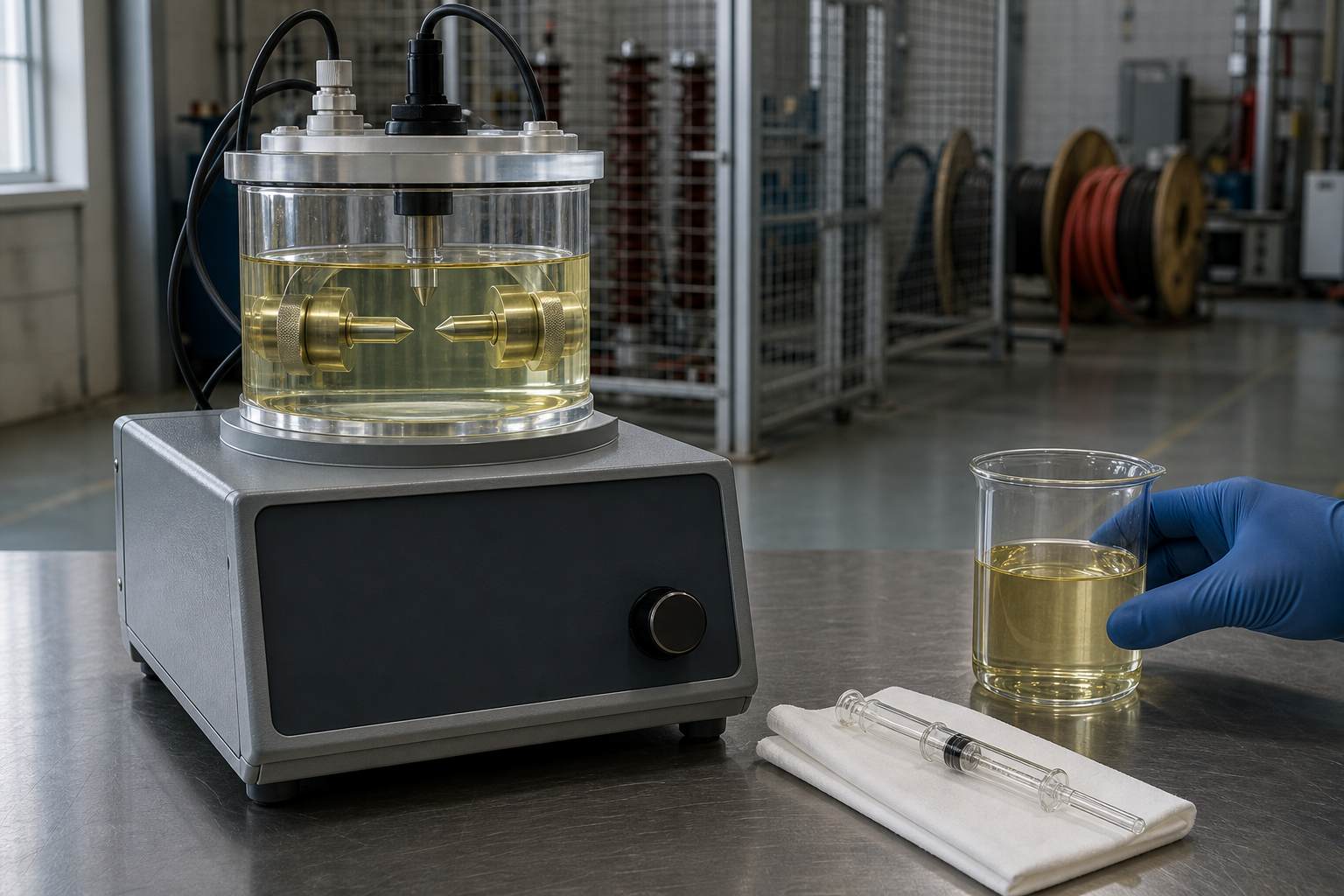
What Does the Breakdown Voltage of Transformer Oil Actually Prove?
The test answers one narrow question: how much electric stress this liquid can take before it breaks down. Everything practical about the breakdown voltage of transformer oil follows from how narrow that question is.
- It is a property of the liquid, not of the equipment. The measurement describes the oil in the test vessel on the day it was tested, not the winding insulation, the bushings or the core.
- It is very sensitive to free water and solid contamination. Separated moisture, fibres, dust and metallic particles all lower the value sharply, because they give the discharge somewhere to begin.
- It is an indicator, not a diagnosis. A low result shows that the oil has been contaminated; it does not say with what, or where the contamination entered.
- It is one test among several. Acidity, interfacial tension, dissipation factor and dissolved gas analysis answer different questions about the same sample.
That is why commissioning teams treat the breakdown voltage of transformer oil as a screening check rather than a verdict: it is quick, it needs only a small volume of oil, and it catches the gross contamination that matters most before energisation.
Which Standards Define the Test, and Which One Contains the Limit?
Four documents shape the way the breakdown voltage of transformer oil is measured and judged, and they do not all do the same job.
- IEC 60156:2025 is the test method. Edition 4.0, published on 31 January 2025, is titled Insulating liquids — Determination of the breakdown voltage at power frequency — Test method. It describes the test in which an increasing AC electrical field is applied to the oil sample until breakdown occurs. It applies to insulating liquids of nominal viscosity up to 350 mm²/s at 40 °C, and it is appropriate both for acceptance testing of unused liquids at delivery and for establishing the condition of samples taken during monitoring and maintenance of equipment.
- IEC 60422:2024 is the supervision and maintenance guidance. Edition 5.0, published on 18 July 2024, gives the monitoring guidance and procedures required for the use and maintenance of mineral insulating oils in transformers and other electrical equipment, including strategic spares. It applies to oils originally supplied conforming to IEC 60296 and helps the operator evaluate the oil's condition and keep it serviceable. It also notes explicitly that condition monitoring of the equipment itself, for example by dissolved gas analysis, is outside its scope.
- IEC 60296:2020 is the specification for the fluid itself. Edition 5.0, published on 26 June 2020, sets out specifications and test methods for unused and recycled mineral insulating oils in the delivered state, for transformers, switchgear and similar equipment where the oil provides insulation and heat transfer. It defines Type A and Type B groups on the basis of performance, and does not apply to oils used as an impregnating medium in cables or capacitors.
- IEEE C57.106-2015 is the parallel guide, covering acceptance and maintenance of insulating mineral oil in electrical equipment, with recommendations on oil tests and evaluation procedures and on reconditioning and reclaiming for oil used in transformers, reactors, load tap changers and voltage regulators.
Now the point that matters most here: the test-method standard does not contain an acceptance limit. A laboratory report that names IEC 60156 says how the measurement was made, not what the oil had to achieve. The value the oil has to reach comes from the supervision and maintenance guidance and depends on the equipment class and voltage level the project specifies. Judging the breakdown voltage of transformer oil is therefore a project decision taken from the applicable guidance, not a figure to be copied from a web page.
| The test method standard | The supervision and maintenance guidance | |
|---|---|---|
| What it contains | How the measurement is made: the apparatus, the handling of the sample, and the way the increasing field is applied until breakdown occurs | How the operator monitors, evaluates and keeps mineral insulating oil serviceable in equipment |
| The question it answers | Was this measurement carried out to the recognised method? | What should we do about the condition of this oil? |
| Acceptance value | None — the method standard defines the test, not a limit | Recommendations on tests and evaluation procedures; the figure the oil must reach is set for the equipment class and voltage level the project specifies |
| Oil within scope | Insulating liquids within the method's stated viscosity range, for acceptance of unused liquids at delivery and for condition monitoring of samples | Oils originally supplied to the unused-oil specification, in transformers, switchgear and other apparatus where sampling is reasonably practicable, including strategic spares |
| Where it stops | Reports a measurement; it does not judge the equipment | Notes explicitly that condition monitoring of the equipment itself, such as dissolved gas analysis, is outside its scope |
How Should a Sample Be Taken for a Breakdown Voltage Test?
Most disappointing results are created before the oil reaches the test vessel. The value is only as good as the sample, and the discipline is straightforward once the purpose is understood: capture a small volume of oil that represents the bulk, without letting it change on the way to the laboratory. For the breakdown voltage of transformer oil, that discipline decides whether the number means anything at all.
- Choose the sampling point deliberately. A proper sampling valve that draws from the body of oil is the default. A low drain point where water and sediment settle, or a dead-end fitting that has held stagnant oil for months, will describe the fitting rather than the liquid.
- Flush before you fill. Run oil through the valve and discard it, so that the container receives oil from the equipment rather than from the tap.
- Use a clean, dry container and seal it immediately. A vessel that has held water, or that has been rinsed and left damp, contaminates the sample at the moment it is taken.
- Limit contact with air and with light. Moisture is very willing to move between humid air and oil, and prolonged exposure to strong light changes the oil as well. Fill, close, and keep it closed.
- Take it under the right conditions and label it properly. Sample when the oil is at its normal working condition as far as is practical, and record the equipment identifier, the sampling point, the date and the oil temperature. Without those facts a result cannot be compared with anything later.
- Test promptly, and always from the same point. A sample can drift between the valve and the test vessel, so delay works against you. Consistency of point and method is what makes one result comparable with the next.
On oil-filled instrument transformers and metering units, which hold a modest volume of oil, this discipline matters more than it does on a large power transformer. There is less bulk oil to dilute a local problem, so a sample drawn from the wrong place shows up quickly in the breakdown voltage of transformer oil taken from that unit.
Why Is a Single Reading of the Breakdown Voltage of Transformer Oil Not the Whole Story?
The measurement is a scattered one. Run repeated tests on the same oil and you will not get the same number every time; you get a spread. That scatter is normal, and it has a practical consequence: one figure cannot be read as a precise statement about the oil.
A single figure also mixes two things you want to keep apart — the condition of the oil and the quality of the sampling. A fall may be real, or it may be a container that was not dry, an extraction that pulled in air, or a delay before testing. A trend built from successive samples at the same point separates the two: a sampling fault tends to appear as a single outlier, while a genuine change shows itself as a direction.
| One sample, one reading | Repeat samples from the same point | |
|---|---|---|
| What it shows | The breakdown voltage of transformer oil in that vessel at that moment | Whether the oil is stable, improving or degrading over time |
| Sensitivity to sampling | High — a damp container or a rushed extraction can move the result on its own | Lower — a sampling error tends to stand out against the pattern |
| Use in a decision | Raises a question; rarely settles one | Supports a maintenance decision and a comparison with the commissioning baseline |
| Usual failure mode | Reading a single value as a verdict | Comparing samples taken under different conditions without recording the difference |
There is a second boundary to hold. The oil and the equipment are different questions, and IEC 60422 draws the line explicitly by placing condition monitoring of the equipment itself, for example by dissolved gas analysis, outside its scope. A reassuring value is not evidence that the apparatus is healthy, and it should never be presented as such.
How Is a Breakdown Voltage Result Judged?
Not against a universal number, and not by the laboratory that performed the measurement. The judgement follows a route that is worth spelling out, because it is the part most often skipped in a specification.
- Start from the supervision and maintenance guidance. IEC 60422 is written around monitoring, evaluation procedures and keeping the oil serviceable, rather than around one cut-off figure for every application. That is a deliberate structure, not a gap.
- Fix the figure for the equipment and the voltage level. What the breakdown voltage of transformer oil has to reach depends on the equipment class and voltage level that the project specifies, along with the type and criticality of the unit and whether the oil is new or in service, so the same oil in two applications can be judged against two different expectations.
- Compare against the unit's own history. The commissioning baseline and the trend from previous samples carry more information than an absolute figure read in isolation. A value that looks acceptable in the abstract but sits clearly below where this unit has been running is worth investigating.
- Read it with the rest of the programme, and treat a poor result as a trigger. Breakdown voltage sits alongside moisture, acidity and dissipation factor on the same sample, and alongside dissolved gas analysis for the equipment. The normal first response to a poor value is a confirmatory sample drawn with extra care, before any conclusion is drawn.
The practical lesson for anyone writing a specification is to put the required value in the document yourself, on the basis of the guidance and the project's own equipment class and voltage level, and to state the sampling method and the conditions under which it applies. A specification that says only "breakdown voltage test to IEC 60156" has asked for a measurement without saying what it has to show.
What Can Make a Breakdown Voltage Result Misleading?
A result for the breakdown voltage of transformer oil is simple to obtain and easy to invalidate. The following causes recur on commissioning and maintenance work.
- A sample taken from the wrong place. Oil from a low drain point or a stagnant branch describes the sediment, not the bulk liquid.
- Container contamination. Residues of moisture or cleaning fluid in a supposedly clean vessel pull the result down, and the effect is easily large enough to change the conclusion.
- Delay between sampling and testing. The longer a sample sits, the more opportunity it has to change, particularly if it is warm and the container is only partly full.
- Comparing results that are not comparable. A change of apparatus or handling routine, a different sampling point, or a different oil temperature introduces a difference that belongs to the method rather than to the oil, so the comparison has to be stated rather than assumed.
- Misreading the pattern. Treating a single outlier as a trend creates unnecessary work; treating a genuine downward drift as scatter misses the warning the test is designed to give.
How Does the Test Fit Into a Maintenance Programme?
In practice the breakdown voltage of transformer oil earns its place as a routine checkpoint rather than an event. The interval is set by the supervision and maintenance guidance together with the criticality of the unit, its class and voltage level, and how much oil it holds. New equipment is sampled to establish a baseline while the oil is in its delivered condition; in-service equipment is then re-sampled on a routine interval and whenever the oil has been exposed, topped up or treated.
Records are as important as measurements. A result with no record of the sampling point, the conditions and the previous values cannot be compared with anything, and comparison is most of the value. Where a value is confirmed low or shows a sustained fall, the guidance covers the response: investigate the source of the contamination, and evaluate the oil for reconditioning or reclaiming so that it can be returned to a serviceable condition instead of being replaced by default.
Nahu Group manufactures current transformers, voltage transformers and metering equipment for 10–35 kV distribution networks, including oil-filled designs where oil sampling and condition checks are part of normal operation. Where a specific oil test programme has to be agreed at the commissioning stage, the engineering team can work through the sampling points, the intervals and the documentation with the buyer.
Frequently Asked Questions About the Breakdown Voltage Test
What is the breakdown voltage of transformer oil?
The breakdown voltage of transformer oil is the voltage at which the oil, stressed by an increasing alternating field, stops insulating and lets a flashover pass between the electrodes. It is measured on a sample drawn from the equipment and tested in an oil test set, and it is reported as a single value for that sample.
What does the breakdown voltage test actually prove?
It proves how much electric stress one sample of the liquid could withstand before breakdown. A high value shows that the oil is still doing its insulating job in the gap that was tested; a low value shows that moisture, fibres or particles have given the flashover an easy path to start from. It is an indicator of contamination, not a diagnosis of what the contaminant is.
Is there a passing value I can quote in a specification?
Not from the test method. IEC 60156 defines how the measurement is made and contains no acceptance limit. The value the oil has to reach comes from the supervision and maintenance guidance, and it depends on the equipment class and voltage level that the project specifies, so the figure belongs in your own specification rather than in a supplier's web page.
How should a sample be taken for the test?
From a point that carries representative oil, usually a proper sampling valve, after the valve has been flushed and the first oil discarded. Use a clean, dry, sealed container, keep it out of strong light, limit contact with air, label it with the equipment and the sampling conditions, and get it to the laboratory promptly. Consistency matters as much as technique, because results are only comparable when they come from the same point.
Why is one result not enough?
Because a single figure carries both the condition of the oil and the quality of the sampling, and it cannot tell the two apart. The measurement is also scattered, so repeat tests on the same oil produce a spread of values. The trend from successive samples at the same point tells you whether the breakdown voltage of transformer oil is stable, improving or degrading.
Does a good breakdown voltage mean the oil is fine?
No. The test only reflects the ability of the liquid to withstand electric stress. It says nothing about dissolved gas, oxidation or acidity, and IEC 60422 makes that boundary explicit by placing condition monitoring of the equipment itself, for example dissolved gas analysis, outside its scope. Use the result together with the other tests in the programme.
How often should the test be repeated?
The interval is set by the supervision and maintenance guidance together with the criticality of the equipment and its class and voltage level. New equipment is usually sampled to establish a baseline, and in-service equipment is then re-sampled on a routine interval and whenever the oil has been exposed, topped up or treated.
What happens if the result is low or falling?
The usual first step is a confirmatory sample, because a single low value is often a sampling artefact. If it is confirmed, the oil is investigated for the source of the contamination, and the guidance covers the options, which include reconditioning and reclaiming the oil. The decision is taken with the other test results and with the condition of the equipment, not on one figure alone.
Sources and Further Reading
- IEC 60156:2025 — Insulating liquids — Determination of the breakdown voltage at power frequency — Test method, Edition 4.0, published 31 January 2025: the method in which an increasing AC field is applied to a sample until breakdown occurs, applicable to liquids of nominal viscosity up to 350 mm²/s at 40 °C, and used both for acceptance testing at delivery and for establishing condition in monitoring and maintenance.
- IEC 60422:2024 — Mineral insulating oils in electrical equipment — Supervision and maintenance guidance, Edition 5.0, published 18 July 2024: monitoring procedures for keeping oil serviceable, evaluation procedures, and recommendations on reconditioning and reclaiming; dissolved gas analysis and other condition monitoring of the equipment itself are outside its scope.
- IEC 60296:2020 — Fluids for electrotechnical applications — Mineral insulating oils for electrical equipment, Edition 5.0, published 26 June 2020: specifications and test methods for unused and recycled mineral insulating oils in the delivered state, with Type A and Type B groups defined by performance.
- IEEE C57.106-2015 — IEEE Guide for Acceptance and Maintenance of Insulating Mineral Oil in Electrical Equipment: recommendations on oil tests and evaluation procedures and on reconditioning and reclaiming, for mineral oil in transformers, reactors, load tap changers and voltage regulators.
Read together, these documents make a clean division of labour: the test method says how to measure, the oil specification says what a delivered fluid should be, the maintenance guidance says how to monitor and evaluate it in service, and the project says what value your equipment class and voltage level has to see.
The breakdown voltage of transformer oil is worth respecting for what it is: a fast, sensitive check on the insulation strength of a sample, and a poor substitute for a complete judgement on the oil or on the equipment. Take the sample with care, test it promptly, compare it with the same unit's history, and put the acceptance figure in the specification yourself. For related reading, see the different types of transformers used on distribution networks, the guide to high-voltage metering boxes, and how to approach voltage transformer selection for a project.
Nahu Group (NAHU Electric Technology) manufactures current transformers, voltage transformers, metering boxes and 10–35 kV distribution equipment for utilities and EPC contractors. When oil condition checks form part of your commissioning scope, read the current transformer supplier checklist before you issue the enquiry, or contact the engineering team with the equipment class and voltage level you are working to.
Published September 24, 2026 · Nahu Group (NAHU Electric Technology)