
Choosing current transformer suppliers in UAE projects is an evidence exercise, not a price comparison. A supplier is worth shortlisting when it can show an accredited type test report to IEC 61869 for the exact rating you are buying, open its own factory to audit, quote a lead time broken down by stage, and hand over the routine test certificates and drawings that a utility or EPC acceptance process requires. Everything else — catalogue quality, response speed, the size of the discount — is secondary.
This guide is written for the three buyers who actually sign off instrument transformers in the Gulf market: utility asset and protection engineers, EPC procurement leads, and panel builders assembling medium-voltage switchgear. It sets out how to read the evidence a supplier sends you, what that evidence does and does not prove, how to confirm you are dealing with a factory rather than a reseller, how to run a sample evaluation, and which risk signals should stop a purchase. The checklist is deliberately supplier-neutral, because the same tests fail and the same approvals stall regardless of whose nameplate is on the unit.
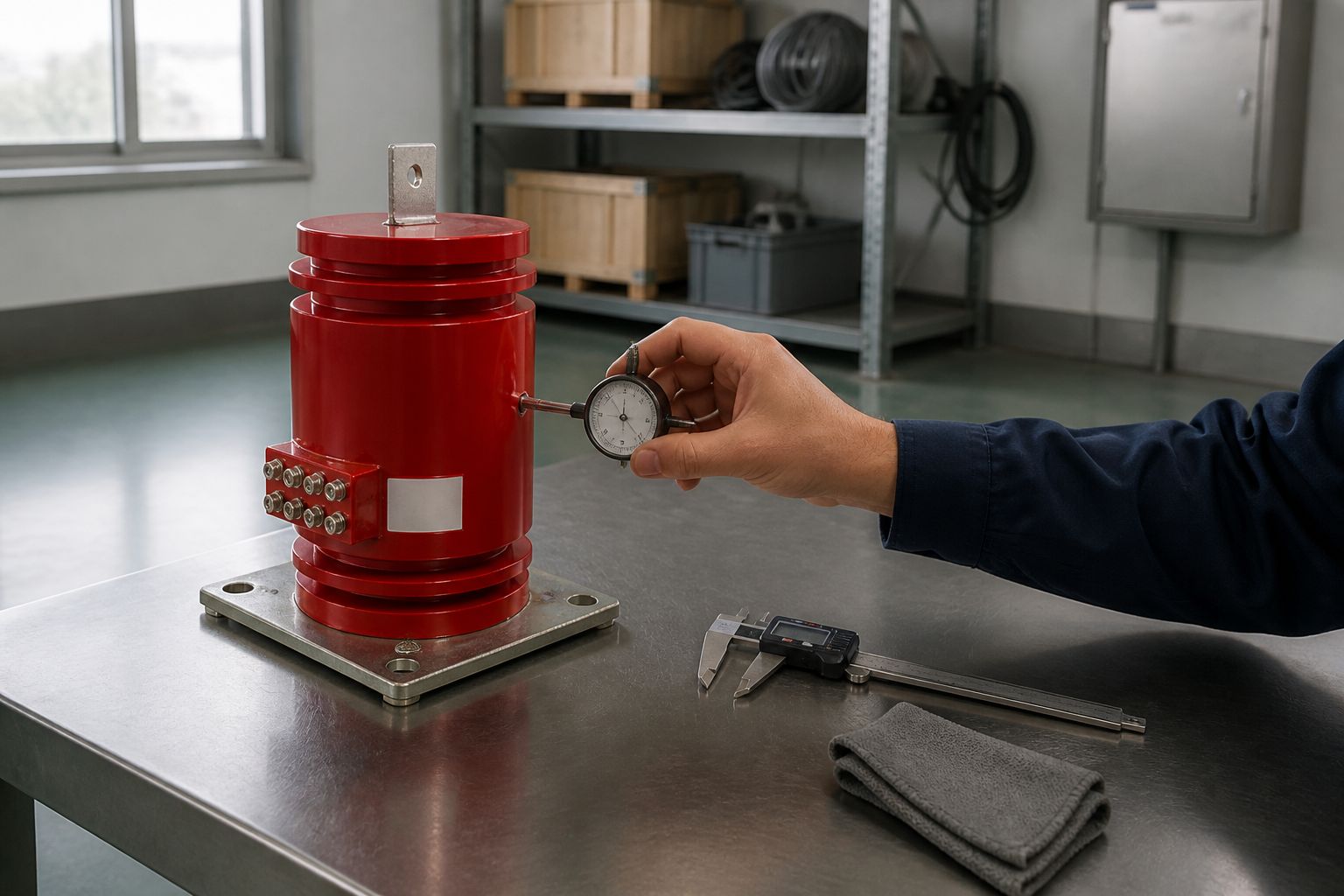
What Separates Real Current Transformer Suppliers in UAE Projects from Traders?
A trading company is not automatically a bad counterparty. On small, urgent, one-off orders a good trader can be faster and easier to deal with. The problem is a trader priced as a manufacturer. When the quotation implies a factory, the audit is refused, and the type test report belongs to somebody else, the buyer carries a risk that was never disclosed.
The distinction shows up in four places, and none of them is the price:
- Ownership of the design. A manufacturer can explain why a core size, a winding arrangement or a cast-resin formulation was chosen for your application, and what changes if you move from a 10 kV indoor unit to a 35 kV outdoor one. A trader forwards a datasheet.
- Ownership of the evidence. The type test report names the applicant. If that name is not the company quoting you, ask what legal or engineering relationship connects them.
- Ownership of the process. Winding, casting or encapsulation, curing, assembly and testing are all in-house activities for a real instrument-transformer factory. A trader cannot show any of them.
- Ownership of the problem. When a unit fails a site acceptance test, a manufacturer can investigate the design and the batch records. A trader can only relay messages.
What Should You Verify Before a Supplier Reaches Your Shortlist?
Shortlisting is cheap; disqualifying a supplier after award is not. Six checks settle most of the question before you invite a price:
- A type test report for the rating you want. Not for the family, and not for a neighbouring ratio. The rated primary current, the rated secondary current, the accuracy class, the rated output or burden, the insulation level and the construction (indoor or outdoor, resin-cast or oil-immersed) should match your specification line by line.
- The laboratory behind the report. Confirm the laboratory is accredited for that test scope, and that its accreditation is accepted under the ILAC mutual recognition arrangement, so the report travels with your project instead of being questioned at the border.
- A named factory address that is not the same as the office. Ask for the production site, and check that the address on the report, the address on the certificate and the address you are invited to visit are the same place.
- A quality certificate you can verify. A management-system certificate can be checked against the issuing certification body and against the IAF's international database. A certificate that validates for a different legal entity, a different site or an expired scope is not evidence of anything.
- A test equipment list with calibration traceability. Ask which set is used for ratio and polarity, which one for insulation, and how the reference standards behind them are calibrated.
- A reference list with a contactable end user. Substation references are more useful than a count of countries served, because they let you ask how the supplier behaved during commissioning.
How Do You Actually Read an IEC 61869 Type Test Report?
The IEC 61869 series is the international standard family for instrument transformers. Part 1 carries the general requirements, and Part 2 adds the requirements specific to current transformers. Both are published by the IEC and both are maintained by the same technical committee, TC 38.
Two details from the published editions are worth knowing before you open a report, because they explain why two suppliers can both be "compliant" and still not be equivalent:
- Part 1 is a product-family standard that covers general requirements only. The IEC states that the product standard for each type of instrument transformer is composed of Part 1 plus the relevant specific product standard. A report that cites only Part 1 has not been assessed against the current-transformer-specific requirements.
- Part 1 and Part 2 are not on the same revision cycle. IEC 61869-1:2023 is the second edition, published in June 2023, and it cancels and replaces both the 2007 first edition and IEC 61869-6:2016. IEC 61869-2 is still the 2012 first edition, and the IEC lists a second edition as under development. That is why a report may pair a recent Part 1 with an older Part 2, and why you should always ask which edition of each part was applied.
Which edition did the laboratory actually test against?
Open the report's first two pages and look for the standards list. You want the part number and the year of each edition. A report against an edition your customer's specification no longer accepts is a document that will not clear approval, however good the equipment is. If the supplier cannot tell you which edition their current report uses, that is itself the answer.
It is also worth asking whether a test report form recognised by an international certification body was used. For current transformers, the IECEE publishes a specific test report form for IEC 61869-2, and its use makes the report easier for a third-party reviewer or a utility approver to read.
Type test, routine test or special test — what is the difference?
The IEC revised how some tests are classified when it published the second edition of Part 1, and it added a clause on commissioning tests, so the categories matter more now than they did a decade ago. In practice, buyers should treat them as three different questions.
| What it is | What it proves to you | Typical current transformer examples | |
|---|---|---|---|
| Type test | A design qualification carried out once on a representative unit | That the design can meet the standard at the ratings tested | Dielectric withstand and impulse, partial discharge, temperature rise, short-time thermal and dynamic current, accuracy verification |
| Routine test | A test performed on every unit produced | That the individual transformer you receive matches the qualified design | Primary and secondary insulation, winding resistance, ratio and polarity, secondary loop resistance, excitation or accuracy check |
| Special test | A test agreed between buyer and manufacturer for a particular project | That an application-specific requirement has been met | Tests tied to a pollution class, a seismic requirement, or an unusual burden and accuracy combination |
| Commissioning test | Site checks after installation and before energisation | That the installed unit and its wiring are correct on site | Ratio, polarity, secondary circuit wiring, burden measurement, insulation of the secondary loop |
The commercial consequence is straightforward. A type test report lets a supplier into the tender. Routine test certificates are what let the equipment be energised. Suppliers who quote a project price and then cannot produce per-serial-number routine test documentation have sold you a design approval, not a delivery.
What Does IEC 61869 Evidence Not Prove?
This is the part buyers get wrong most often, and it costs money in both directions.
- It does not cover ratings that were not tested. Accuracy and insulation behaviour are established at the values in the report. A 200/5 unit in a tested class does not validate a 400/5 unit at a different rated output, even when the bodies look identical.
- It does not survive a design change. A new core supplier, a changed secondary winding arrangement, a different resin formulation or altered secondary terminal geometry all sit outside the tested configuration until they are re-assessed.
- It does not cover the whole assembly. A current transformer tested on its own says nothing about the metering box, the cable box or the switchgear it is later installed in.
- It is not a market-access certificate. Standards compliance and permission to place goods on a national market are two separate tracks. In the UAE the second track runs through the Emirates Conformity Assessment Scheme, administered by the Ministry of Industry and Advanced Technology, and whether your product category falls under it depends on the current regulated products list.
- It does not guarantee production consistency. Only the routine test regime, the calibration system and the traceability of batch records do that.
Manufacturer or Trading Company: How Do You Tell the Difference?
Questions, not accusations, are the fastest route. Ask each one of a manufacturer and of a trader and compare the answers.
| Manufacturer | Trading company | |
|---|---|---|
| What the applicant on the type test report is called | The same legal entity that signs your contract | Another company, with an explanation that may or may not hold up |
| Response to a factory visit | Invites you in, offers dates, names the site contact | Redirects to an office, a showroom or a third party |
| Answer to "where is this made, and on which line?" | A specific plant, line and process step | A country, or a partner they cannot name |
| Behaviour on a non-standard rating | Explains the design change and its consequences | Says yes immediately, without engineering detail |
| Routine test documentation | Issued per serial number from an in-house test bay | Promised, generic, or substituted by a type report |
| Handling of a failure | Batch records, root-cause work, design correction | Commercial negotiation only |
| Spares and repeat orders | Same design, same tooling, same test data over time | Whatever the current source happens to offer |
How Do You Verify Factory Capability When You Cannot Visit Yet?
Most first enquiries start long before an audit is practical. Remote verification is imperfect, but it filters effectively if you ask for specific, checkable material rather than general reassurance.
- A live video walkthrough with landmarks. Ask the person filming to pass from the material store, through winding, into casting or encapsulation, through curing and assembly, and into the test bay without cutting the recording. Edited montages prove nothing; a continuous route through the plant is much harder to stage.
- In-process photographs tied to your order. Winding of your core, your casting batch, your unit on the test bench, with the work order visible. Ask for them at defined milestones, not at the end.
- Calibration certificates. Ask for current calibration records of the instrument transformer test set, and confirm the reference standards behind it are traceable.
- The quality plan for your order. A documented inspection and test plan showing which characteristics are checked, by whom, at which stage, and against which acceptance criterion.
- A third-party inspection option. If the order value justifies it, agree in the contract that pre-shipment inspection may be carried out by a named inspection body, at the factory, with the routine test repeated in front of the inspector.
How Should You Run a Sample or Pre-Production Evaluation?
A sample is only useful if it is a production-representative unit and if you test it the way the site will. Three points decide whether the exercise produces information or just reassurance.
- Insist the sample comes off the same tooling as the order. A hand-made sample from the engineering department tells you what the design can do, not what the line will deliver. Ask which work order it came from.
- Test the sample against your own specification, not the supplier's datasheet. Have the ratio, polarity, burden and accuracy verified by an independent laboratory, and compare the measured excitation characteristics with the values promised. Then repeat the check on the first unit of the production batch and compare the two.
- Inspect the things a datasheet never shows. Casting defects, voids or sink marks, the finish of the secondary terminal block, thread quality on the mounting plate, corrosion protection on steel parts, the legibility and durability of the nameplate, and how the unit is packed for transport.
Document the acceptance criteria before the sample ships. A pre-production evaluation without written criteria turns into an argument about opinions. This is also the stage at which to raise the questions covered in our guide to current transformers for new installations and retrofitting, because retrofits add space and connection constraints that a sample will expose immediately.
What Lead Time and Spares Commitments Should Be in Writing?
Instrument transformers are not a catalogue item for most medium-voltage projects, so a single "lead time" figure hides the sequence that actually governs delivery. Ask for the schedule split into four stages, each with its own duration:
- Engineering and drawing approval — outline drawings, nameplate data, secondary terminal arrangement, and your own comments cycle
- Sample or pre-production approval where the rating, the burden or the accuracy class is non-standard
- Production — material, winding, casting and curing, assembly. Ask whether the quoted period assumes the cores and the resin are in stock or have to be ordered
- Testing and documentation — routine tests per unit, packing, and issue of the certificate package
Two clauses worth adding. First, state explicitly when the lead-time clock starts: at purchase order, or at approved drawings. Suppliers who quote from order and then wait weeks for approval comments are not being dishonest, but the project schedule will not survive the difference. Second, fix the spares position in writing — spare secondary terminal covers, gaskets, mounting hardware, and the nameplate and drawing set you will need for future maintenance. Ask how long the design and its tooling will remain available for repeat orders, so that a spare purchased three years later actually fits.
What Documentation Should a Supplier Provide With the Shipment?
The documentation package is part of the product. If it is missing, the equipment cannot be energised and accepted, regardless of how well it measures. A complete package for a medium-voltage current transformer normally contains:
- Routine test certificates traceable to the serial numbers of the units supplied
- The type test report, or a controlled extract naming the tested ratings and construction
- Approved outline, mounting and nameplate drawings matching the delivered configuration
- Installation, operation and maintenance instructions, including secondary earthing and safety warnings
- The quality plan or inspection and test plan used for the order
- Material and calibration certificates where the specification requires them
- Packing, storage and transport instructions, and any transport restraint advice for the insulation
Ask for the package in editable form as well as PDF where your document control system requires it, and agree the language. A maintenance instruction that only exists in a language the site technicians do not read is a commissioning delay waiting to happen.
Which Risk Signals Suggest a Trader Rather Than a Manufacturer?
Individually these are questions. Together they describe a pattern, and the pattern is what matters.
- The company name has a year in it but no plant. A trade name incorporating a founding year, or a "group" structure, says nothing about production. What is the actual factory entity?
- The website shows products but no process. No winding, casting, curing or test-bay images tied to real work orders, and a contact page that resolves to a serviced office or a virtual address.
- Certificates that do not validate. A management-system certificate in a name that differs from the quoting entity, a scope that does not include instrument transformer manufacture, an expired validity date, or a number that cannot be found in the IAF's certification database.
- Type test reports with a different applicant. Legitimate supply chains exist, but you are entitled to a written explanation of the relationship, and to know which laboratory, which edition and which ratings the report actually covers.
- Resistance to detail. Vague answers on the laboratory, evasive answers on factory location, refusal of a video walkthrough, silence on the test-equipment calibration.
- A price far below the field with no explanation of the difference. Ask what was removed. Sometimes the answer is a lower manufacturing cost that the supplier can defend; sometimes it is a routine test regime, an insulation margin or a documentation package that was quietly deleted.
- Communication that changes character after the order is placed. A supply chain you can inspect stays inspectable after award. If technical contact disappears once the deposit clears, expect the same behaviour when something goes wrong.
How Do UAE Market Requirements Shape the Choice?
For a UAE project, the IEC 61869 report is the technical foundation of your approval file, and the conformity question sits on top of it. The Emirates Conformity Assessment Scheme is the UAE's product conformity framework, delivered through the Ministry of Industry and Advanced Technology, and it applies to product categories on the current regulated products list rather than to everything electrical. Because the list and the technical requirements attached to each category are set by regulation and do change, confirm the requirement for your specific product and destination rather than assuming from a previous project.
Two practical consequences for supplier selection. First, ask candidates whether they have already supplied into the same UAE scheme for a comparable product, and ask to see how that file was assembled — the paperwork path is usually the slowest part of the project, not the manufacturing. Second, check the accreditation chain behind every report you are handed. Laboratories accredited under the ILAC mutual recognition arrangement are accepted by their peers across economies, which is exactly why a report from a recognised laboratory survives scrutiny at approval stage while a report from an unknown one does not.
Nahu Group manufactures current transformers, voltage transformers and metering equipment for 10–35 kV distribution networks from its factory in Zhejiang, China, and supplies utility, EPC and panel-builder projects in the Middle East and Central Asia. Because this article is about how to evaluate any supplier, we have deliberately kept the checklist above generic — the questions we expect from a well-prepared buyer are the same ones we are asked in audits, and we would rather you asked them of everyone in your tender list. A representative indoor unit in the range is the LA-10 indoor current transformer, and the wider selection is on the current transformer product page.
A Shortlist Checklist You Can Send to Suppliers
Copy these five lines into your enquiry. The suppliers who answer them well are the ones worth a factory visit; the ones who answer vaguely have told you something useful.
- Type test report number, issuing laboratory and its accreditation, the standard parts and editions applied, and the exact ratings tested — stated in writing
- Legal entity name of the factory, the full production address, and the applicant name that appears on the type test report
- Routine test list, a sample certificate for one serial number, and the calibration status of the test equipment used
- Lead time split into engineering, approval, production and testing stages, with the event that starts the clock
- Documentation package contents and language, spares and tooling availability, a contactable Gulf reference project, and willingness to accept pre-shipment inspection at the factory
If you are still working out which rating to specify before you approach suppliers, our guide to choosing a current transformer ratio covers the selection step, and the medium-voltage current transformer guide explains the constructions you will be comparing. Getting those decisions settled first makes every supplier answer comparable.
Frequently Asked Questions About Choosing a Current Transformer Supplier
What should I check first when shortlisting current transformer suppliers in UAE?
Start with the type test report. Ask for a report issued by an accredited laboratory to IEC 61869 for the exact rating, accuracy class and construction you are buying, not a general catalogue claim. If the report names a different rating or a different design, treat it as unverified until the supplier explains the difference in writing.
What is the difference between a type test and a routine test on a current transformer?
A type test proves that a design meets the standard, and it is performed once on a representative unit. A routine test is performed on every unit that ships, and it is your evidence that the individual transformer you receive matches the tested design. Buying from a supplier who can produce both is the practical difference between a design approval and a delivery you can accept.
Does an IEC 61869 test report guarantee the shipped units will pass?
No. A type test report describes the design and the configuration that was tested on a given date. It does not cover a later change to the core, the winding, the insulation system or the secondary terminals. Ask what has changed since the report was issued, and require routine test certificates for the actual serial numbers delivered.
How can I tell a manufacturer from a trading company?
Ask for the production flow, not the catalogue. A manufacturer can describe and show its own winding, casting, curing and testing areas, its test equipment and its calibration records. A trader can usually produce a price and a brochure but not a process, and it will resist a factory visit or an unannounced audit.
How long should a current transformer supplier take to deliver?
A realistic quotation separates engineering approval, sample or pre-production approval, production and testing. Standard indoor 10 kV units usually move faster than outdoor 35 kV or non-standard ratings, and the approval cycle is often the longest step. Ask for the lead time broken down by stage, in writing, and check whether the clock starts at order or at drawing approval.
What documents should arrive with a current transformer shipment?
Expect routine test certificates traceable to the serial numbers, the outline and nameplate drawings, the installation and maintenance instructions, and any packing or transport instructions for the insulation. For project work, add the type test report, the quality plan and the material certificates. Missing paperwork is a delivery problem even when the hardware is correct.
Are IEC 61869 reports enough for the UAE market?
They are the technical foundation, not the whole requirement. The UAE runs the Emirates Conformity Assessment Scheme through the Ministry of Industry and Advanced Technology, and whether your product category falls under it depends on the current regulated products list. Confirm the requirement for your specific product and destination before shipping.
Is a cheaper quotation a sign of a worse supplier?
Not automatically, but the reason for the difference matters. Ask what was removed: the routine tests, the calibration of the test equipment, the insulation class, the secondary terminal material, the documentation. A quotation is only comparable when the technical scope, the test list and the documentation package are identical.
Sources and Further Reading
- IEC 61869-1:2023 — Instrument transformers, Part 1: General requirements — second edition, published June 2023; product-family scope, the merger with IEC 61869-6, and the revised classification of tests
- IEC 61869-2:2012 — Instrument transformers, Part 2: Additional requirements for current transformers — first edition, published September 2012; scope, applicable frequency range, and the second edition listed as under development
- ILAC Mutual Recognition Arrangement and signatories — how testing laboratories accredited to ISO/IEC 17025 are recognised across economies
- IAF CertSearch — the international database for validating an accredited management-system certificate, its scope and its status
- UAE Ministry of Industry and Advanced Technology — conformity certificates for regulated products — the official application route for a UAE certificate of conformity for products subject to technical regulations
Supplier selection on instrument transformers comes down to evidence you can verify. A type test report with a named laboratory and a named edition, routine test certificates per serial number, a factory you can walk through, a schedule split into stages, and a document package that arrives with the goods are all checkable facts. Price is the only item in the comparison that cannot be checked against anything, which is why it should be the last thing you weigh rather than the first.
For 10–35 kV current transformers, voltage transformers and metering equipment, Nahu Group works with utility, EPC and panel-builder buyers on the evidence package their project approval requires. Send your specification line and the standard editions your customer references, and the engineering team will confirm which tested configurations apply. Start from the current transformer range, or talk to the engineering team.
Published September 19, 2026 · Nahu Group (NAHU Electric Technology)