
Switchgear corrosion protection is the coated-steel specification that decides how long an enclosure survives its site, and it is written against ISO 12944 — the international standard for protecting steel structures with protective paint systems. The specification has two axes: the corrosivity category of the environment (C1 to C5, plus CX) and the durability the owner wants from the coating, expressed as a maintenance interval rather than a warranty. Get both axes right and the enclosure is repainted once in a generation. Get them wrong and the first rust blooms inside three years.
The subject matters disproportionately in the Gulf, where coastal humidity, salt-laden air and sustained high temperatures attack painted steel harder than most European specification templates assume. It also matters because the standard is frequently misapplied: buyers ask for "C5 coating" on a component it cannot protect, or accept a paint colour and a dry film thickness figure with no test evidence behind either.
This guide sets out what the standard covers, how to choose the category for a real site, where corrosion actually begins on a switchgear enclosure, and the clauses that make the requirement verifiable instead of aspirational.
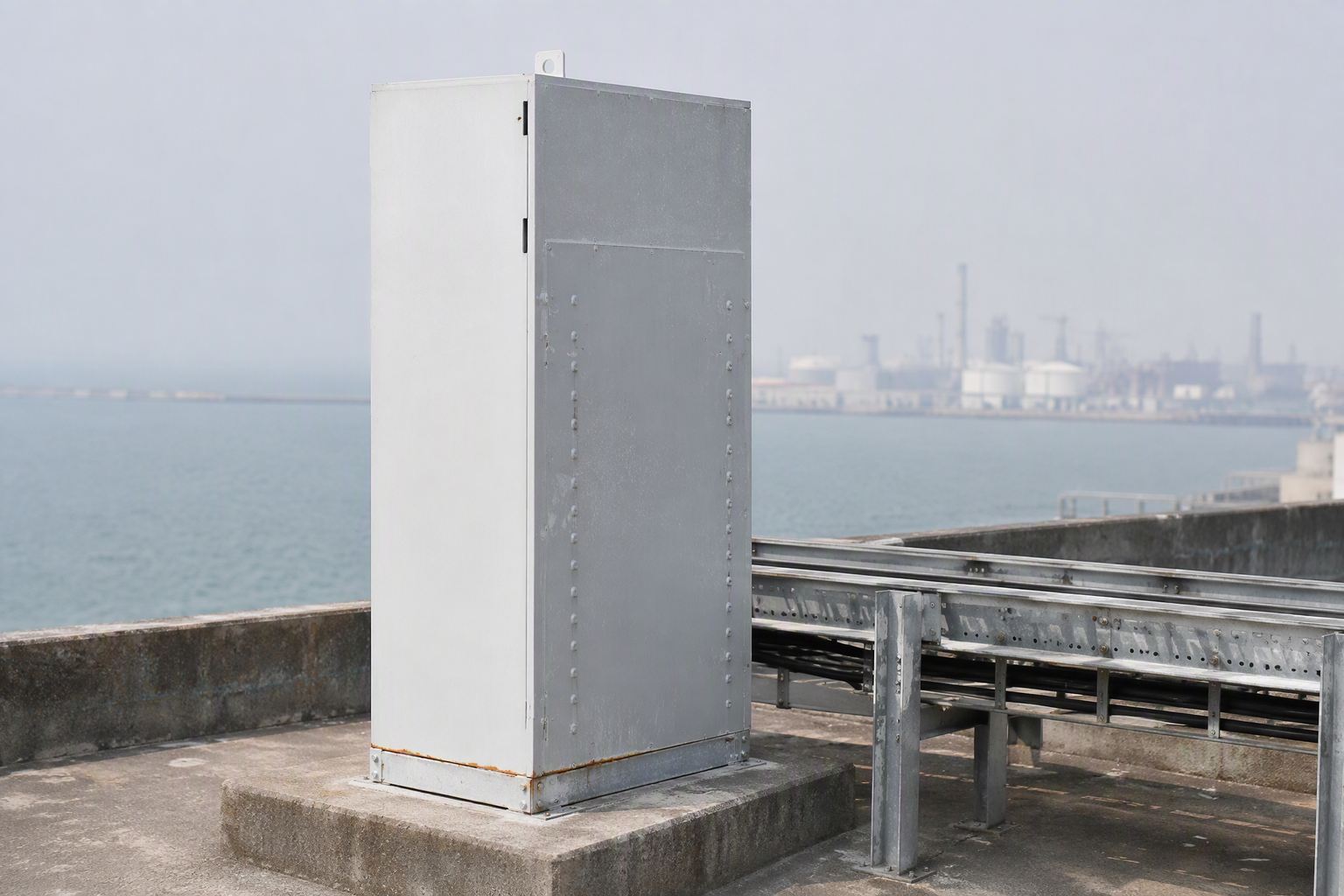
What Does Switchgear Corrosion Protection Actually Mean?
An indoor metal-enclosed switchgear assembly is a welded or bolted steel structure carrying sheet panels, doors, partitions, a base frame and a cable entry plate. Every one of those surfaces is exposed to atmosphere, and most of them are painted. "Corrosion protection" is the specification of how that paint system is built, how the steel beneath it is prepared, and how long the result is expected to last before major maintenance.
Three separate things are often conflated under the phrase, and separating them is the first step towards a specification that works:
- The coating system — the number of coats, their chemistry, and the dry film thickness of each. This is what ISO 12944-5 addresses.
- The surface preparation — how clean and how rough the steel is before the first coat. A good system on a badly prepared surface fails early, and the standard treats preparation as normative, not advisory.
- The environment — the corrosivity of the air around the enclosure, which sets how much protection is needed in the first place.
A fourth factor sits outside the paint specification but inside the outcome: design. Drainage, edge radii, welded joints and access for painting all decide whether a coating can be applied at full thickness where it is needed.
What Is ISO 12944, and What Does It Cover?
ISO 12944 is the international standard for corrosion protection of steel structures by protective paint systems. It is published in parts, each covering one aspect of the problem: the general introduction and durability definitions, the classification of environments, design considerations, surface types and preparation, protective paint systems, laboratory performance test methods, execution and supervision of paint work, specification development, and a part dedicated to offshore and related structures. The current revision dates from 2018 and was updated in 2019, and it introduced the CX category for extreme environments.
Its scope is stated precisely, and the boundary is the single most useful thing a buyer can know about it. The standard applies to carbon or low-alloy structural steel and to steel enclosure and cabinet bodies, with the paint curing at ambient temperature, on steel of a stated minimum thickness. It does not apply to the electrical components inside the enclosure — terminal blocks, miniature circuit breakers, contactors, busbar connections or any current-carrying part. Those are protected by plating, material selection and sealed housings, and are specified against entirely different standards.
This is not pedantry. Writing "ISO 12944 C5 coating" into a clause that covers terminals and internal apparatus produces a requirement that cannot be met and should not be met: hundreds of micrometres of epoxy on a current-carrying terminal would destroy contact resistance and insulation coordination. The correct clause separates the enclosure body, which is painted to ISO 12944, from the apparatus inside, which is specified by IP rating, plating thickness and material grade.
Which Corrosivity Category Applies to My Site?
ISO 12944-2 classifies atmospheric environments into six categories, from C1 (very low, heated and air-conditioned interiors) through C2, C3 and C4 to C5 (very high) and CX (extreme). Immersed conditions are classified separately as Im1 to Im4, covering fresh water, sea or brackish water, soil, and sea or brackish water with cathodic protection.
The categories are not defined by a single measurement. They are derived from the ISO 9223 classification of atmospheric corrosivity, which considers temperature, relative humidity, the time of wetness — the hours when relative humidity exceeds 80 per cent at above freezing — and the corrosive agents present, principally sulphur dioxide and chloride salts. In practice the category is assigned by professional judgement against the standard's descriptions of environments, supported by local experience, rather than by placing coupons on site for a year.
Two consequences follow for a switchgear buyer. First, the category is a property of the location, not of the equipment, so it belongs in the project specification written by the party who knows the site. Second, the same enclosure can sit in two different categories depending on where it is placed: a unit inside a ventilated substation building is not exposed to the same atmosphere as the same unit on an outdoor plinth fifty metres from the sea.
How Do the Categories Compare for an Enclosure Specification?
The table below maps the categories that matter for distribution equipment onto what they mean in a purchase specification. The durability bands are the ISO 12944-1 definitions of the interval to first major maintenance — not a guarantee, and not a warranty period.
| Environment | Typical installation | What the specification should state | |
|---|---|---|---|
| C3 — medium | Urban and industrial atmospheres with moderate pollution, or low-salinity coastal areas | Indoor substation in a city, factory distribution room | A defined coating system with a stated number of coats and dry film thickness, plus the preparation grade |
| C4 — high | Industrial areas with moderate salinity, or coastal regions with seasonal salt spray | Covered outdoor installation near an industrial zone or a moderately exposed coast | The same, with a system intended for C4 and evidence of testing at that category |
| C5 — very high | High-humidity industrial atmospheres and high-salinity coastal or marine areas | Outdoor plinth on a Gulf coastal site, near-shore industrial plant | A heavy-duty multi-coat system, a higher preparation grade, and acceptance of the maintenance interval the owner is buying |
| CX — extreme | Offshore and extreme-humidity environments, classified in the offshore part of the standard | Offshore platform, severe splash zone | A system specified against the offshore part of ISO 12944, with its own laboratory test regime |
The durability axis is chosen independently of the category, and it is where cost is really decided. ISO 12944-1 defines low durability as up to about seven years to first major maintenance, medium as roughly seven to fifteen years, high as fifteen to twenty-five, and very high as more than twenty-five. A C5 site with a low-durability system is a coherent — if short-sighted — specification; a C3 site with a very-high-durability system is usually money spent for no reason.
Where Does Corrosion Actually Start on an Enclosure?
Corrosion on a switchgear enclosure almost never begins in the middle of a large flat panel, which is exactly where paint thickness is easiest to control. It begins at the features that interrupt the coating or hold moisture:
- Sharp edges. Coating sprayed onto a sharp edge thins dramatically at the corner, because surface tension pulls the wet film away. The standard's design guidance is explicit about this: a chamfered or rounded edge holds film thickness where a square edge does not, and the failure begins at the edge even though the coating product is not at fault.
- Welds and seams. Weld spatter, flux residue and crevices create both a preparation problem and a moisture trap. If the surface cannot be cleaned and painted properly, it will not be protected to the same level as the rest of the assembly.
- Horizontal surfaces that hold water. The top of a cable box, a drip ledge that runs the wrong way, a base frame that sits in standing water. Design guidance in the standard is largely about letting water drain and dirt wash off rather than pooling.
- Cut edges, drilled holes and post-fabrication damage. Every hole drilled after painting exposes bare steel. So does every panel that is cut on site for a cable entry.
- Dissimilar metal contacts. Stainless hinges on a painted steel door, galvanised bolts on a painted frame, earthing studs through a coated panel. Galvanic effects concentrate at these interfaces and are usually the first place a Gulf site shows rust.
- The base and the plinth. The bottom of an outdoor enclosure lives in splash, dust accumulation and condensation runoff, and it is the part most often damaged during transport and installation.
What Do the Coating System Terms in a Specification Mean?
A paint system under ISO 12944 is described by its coats rather than by a product name. The vocabulary is worth knowing because it is what a supplier's datasheet will use, and because it allows two quotations to be compared without arguing about brands.
- Primer. The first coat, bonded to the prepared steel. Zinc-rich primers are common where galvanic protection of the substrate is wanted; the standard's paint-type list includes alkyd, acrylic, epoxy, ethyl silicate, polyurethane, polysiloxane, polyaspartic and fluoropolymer families.
- Intermediate coat. Builds thickness and barrier properties. High-build epoxies are typical on aggressive categories.
- Topcoat. Provides the final barrier and, outdoors, the UV resistance. Aliphatic polyurethane and polysiloxane topcoats are the usual choices where colour and gloss retention matter.
- DFT — dry film thickness. The thickness of each coat and of the system as a whole, in micrometres, measured after curing. Thicker is not automatically better: adhesion and cure matter as much as build, and an over-thick coat can crack.
- Preparation grade. How thoroughly the steel is cleaned before priming. The standard requires degreasing and removal of dirt and salts before mechanical preparation, and it distinguishes degrees of blast cleaning. The difference is not cosmetic: published comparisons show blasted and non-blasted steel diverging visibly within a few years in the same environment.
- Hot-dip galvanising. A metallic zinc coating applied before painting, rather than a paint coat. It is often used for base frames, earthing bars and external hardware, and the standard treats galvanised steel as a distinct substrate in its paint-system tables.
How Is a Coating System Verified?
A quotation that names a category and a colour proves nothing. Verification runs on two levels, and a competent supplier can answer both.
The first is system qualification. The laboratory test methods part of ISO 12944 sets out how a coating system is tested for a given corrosivity category and durability band. The regimes include neutral salt spray to ISO 9227, condensation humidity testing, water immersion and, for the higher durability bands, cyclic ageing that combines UV, humidity, salt spray and temperature change. A system that has been qualified for C5 very-high durability will have been through a substantially longer programme than one qualified for C3 medium — which is a large part of why the two systems do not cost the same.
The second is production verification. On the actual enclosure, that means surface preparation records, coat-by-coat thickness measurements, adhesion checks and a documented touch-up procedure for damaged areas. These are execution checks in the sense of the standard's paint-work supervision part, and they are what separates a delivered coating from a specified one.
For a buyer, the practical question to put to a supplier is not "do you comply with ISO 12944" but "which part of the standard, which category, which durability band, which system, and what evidence do you hold for that system". A supplier who can answer in those terms has a specification; one who answers with a colour code does not.
Why Is the Gulf Coast a Special Case?
Three conditions combine on Gulf coastal sites in a way that most temperate-climate specifications underestimate.
Salt is present as an airborne aerosol, not as occasional spray. Onshore winds carry chloride continuously, and it deposits on every upward-facing surface and collects in every crevice. Chlorides are one of the two corrosive agents the classification explicitly considers, and they drive the difference between an inland C3 site and a near-shore C5 one.
The wetness cycle is driven by condensation, not rain. High night-time humidity and rapid morning warming produce condensation on cool steel surfaces even when it has not rained for months. Time of wetness is the variable that governs atmospheric corrosion, and a site can accumulate wetness hours without a single rainy day.
Ultraviolet exposure is severe and continuous. A topcoat that chalks and loses gloss is not just an aesthetic problem: as the binder degrades, the barrier thins and the underlying coats are exposed. This is why the topcoat chemistry, not only the total thickness, belongs in the specification.
Add construction dust, which is often alkaline and hygroscopic, and the result is an environment where a system qualified for a temperate C3 site will visibly underperform. The honest answer for a Gulf coastal project is usually C5, with the durability band chosen from the owner's maintenance capability rather than from the initial price.
What Should the Specification State?
The clauses below are written to be checkable. Each one closes a gap that otherwise becomes a site argument.
- The corrosivity category, by location. State the category for each part of the installation — indoor room, covered yard, outdoor plinth — rather than one figure for the whole project.
- The durability band. Low, medium, high or very high, expressed as the interval to first major maintenance that the owner is prepared to fund.
- The coating system by coats. Primer type, intermediate type, topcoat type, number of coats and the nominal dry film thickness of each, referencing the standard's system tables rather than a brand.
- The preparation grade. Cleaning and degreasing requirements plus the blast grade, stated for carbon steel and separately for any galvanised substrate.
- Substrates and treatments outside the paint system. Galvanising for base frames and hardware, stainless grade for hinges and fasteners, and the isolation method at dissimilar-metal interfaces.
- The excluded scope. State that internal apparatus, terminals and busbar connections are not painted to this standard and are specified separately by plating, material and IP rating. This prevents an unbuildable clause.
- Test evidence. Which laboratory qualification the system holds, for which category and durability, and in what document it is presented.
- Inspection and touch-up. Thickness measurement points, acceptance criteria, and the approved repair procedure for transport damage and site modifications such as cable-entry cuts.
What Goes Wrong Between the Factory and the Site?
Most coating failures on new equipment are not formulation failures. They happen in the gap between the paint shop and energisation.
- Storage in the open before installation. A finished enclosure that waits months on a coastal site, wrapped in plastic that traps condensation, starts its service life in the worst possible condition.
- Lifting and transport damage. Slings and forklift tines remove coating at exactly the edges and corners where it is thinnest. The damage is mechanical, but the corrosion that follows is chemical.
- Site modifications. Cutting a cable entry, drilling for a bracket or welding a bracket destroys the coating and the galvanising locally. Without a documented repair procedure, bare steel is left exposed at the most humid part of the enclosure.
- Missing or mismatched fasteners. Site-supplied bolts in a different material create galvanic couples that no factory specification can prevent.
- Concrete and dust residues. Alkaline residue from a plinth is aggressive to coatings and hygroscopic. Cleaning before energisation is part of the protection, not housekeeping.
How Does This Fit With the Rest of the Enclosure Specification?
Corrosion protection is one property of an enclosure among several, and it interacts with the others. The ingress protection rating decides whether water and dust reach the steel in the first place; the construction class — metal-enclosed, metal-clad or armoured withdrawable — decides how many internal partitions and edges exist to be painted; and the type-test evidence tells you which of the assembly's claims have been independently demonstrated.
Nahu Group builds metal-enclosed switchgear cabinets, ring-network units and metering boxes for 10–35 kV distribution, in the enclosure families described in the metal-enclosed switchgear guide. For coastal projects the finish is specified per project rather than fixed across the range, so the practical step is to send the site category, the durability the owner expects and the substrate list, and have the coating system confirmed against those inputs before the order is placed.
Frequently Asked Questions About Switchgear Corrosion Protection
What is switchgear corrosion protection in simple terms?
It is the painted-steel specification for a switchgear enclosure: how the steel is prepared, which coats are applied and how thick, and how corrosive the site atmosphere is. It is written against ISO 12944 and expressed as a corrosivity category plus a durability band.
What does C5 mean on a switchgear specification?
C5 is the "very high" atmospheric corrosivity category in ISO 12944-2, describing high-humidity industrial atmospheres and high-salinity coastal or marine areas. It tells the supplier how aggressive the site is; it does not by itself say which coating system to apply, because the durability band is chosen separately.
Does ISO 12944 apply to the components inside the enclosure?
No. The standard applies to structural steel and to steel enclosure and cabinet bodies. Terminals, circuit breakers, contactors and other internal apparatus are protected by plating, material selection and sealed housings, and are specified against other standards and IP ratings.
Is the durability band the same as a warranty?
No. Durability in ISO 12944 is the expected time to first major maintenance painting, used for planning. It is not a guarantee and not a warranty period. A warranty is a commercial undertaking; durability is a technical planning parameter.
How is a coating system tested for a given category?
Through the laboratory performance test methods in ISO 12944-6, which include neutral salt spray to ISO 9227 and condensation humidity testing, with water immersion and cyclic ageing for the more demanding combinations. The test programme length scales with the category and durability band being qualified.
Why does corrosion start at edges and welds?
Because the coating is thinner there. Wet paint pulls away from a sharp edge, so the dry film at a corner is well below the specified thickness even when the flat panel passes inspection. Welds add crevices and residues that interfere with both preparation and adhesion.
Is stainless steel the answer for coastal sites?
It is one answer, and not a universal one. Stainless avoids a painted barrier failing, but it brings its own requirements: the correct grade for a chloride environment, passivated welds, and isolation from dissimilar metals. Painted carbon steel specified to C5 with a documented system remains a legitimate and often more economical choice.
What single clause most improves a corrosion specification?
Naming the excluded scope. Stating that the enclosure body is painted to a defined ISO 12944 category and system, while internal apparatus is specified by plating and IP rating, removes the requirement that cannot be built and forces the discussion onto the part of the assembly that actually corrodes.
Sources and Further Reading
- ISO 12944 and corrosion protection for steel structures — part-by-part summary, the durability bands, the category list, design guidance on edges and drainage, and surface preparation
- ISO 12944 — the corrosive environment — how corrosivity is classified, the role of time of wetness, chlorides and sulphur dioxide, and the link to ISO 9223
- From C1–C5 and CX: corrosion resistance grades and design lifespan — the 2018 revision and CX, the scope boundary between enclosure bodies and internal components, and the ISO 12944-6 test families
The useful summary is that corrosion protection is a two-axis decision, made once, in writing, before the enclosure is built. Choose the corrosivity category from the site rather than from a template, choose the durability band from the maintenance budget, describe the system by coats and preparation grade rather than by colour, and exclude the internal apparatus from a clause that was never meant to cover it. Everything after that — the salt-spray hours, the thickness readings, the touch-up procedure — is verification of a decision that has already been made correctly or otherwise.
Related reading: IP ratings for MV switchgear for the ingress side of the same problem, how to read a type test report for the evidence side, and high-voltage metering box specification for the enclosure family where these decisions most often arise.
Published October 21, 2026 · Nahu Group (NAHU Electric Technology)