
An IP rating for switchgear is a two-digit code that states how well the enclosure resists the entry of solid objects and water, and it says nothing about anything else. The letters IP stand for ingress protection. The first numeral grades protection against solid objects on a scale from 0 to 6, where 6 means no ingress of dust. The second grades protection against liquids on a scale from 0 to 9. That is the whole scope of the code — which is why an IP54 enclosure can still corrode, fade, leak at a cable gland and fail in service without the rating being wrong.
For buyers specifying 10–35 kV switchgear, the rating is one of the most quoted and least understood lines on a datasheet. This guide explains what the digits actually declare, which ratings appear in real medium-voltage equipment and why, where ingress happens in practice, and what a tender specification should say so that the number means something after installation.
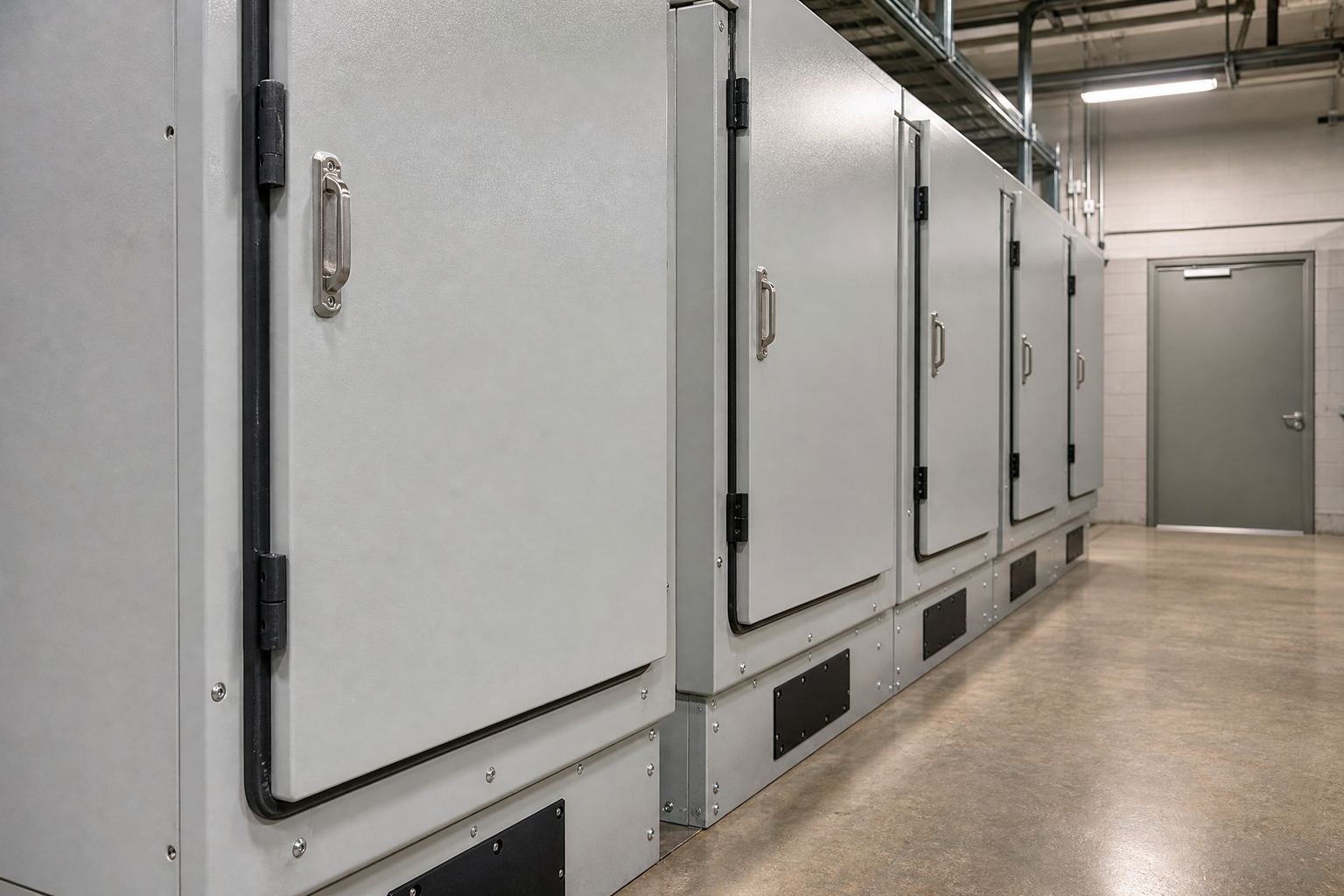
What Does an IP Rating Actually Measure?
The IEC, which publishes the code, describes it as a grading of the resistance of an enclosure against the intrusion of dust or liquids. It exists because vague marketing terms are useless in engineering: "waterproof" and "dust-resistant" have no test behind them, while an IP number refers to defined test conditions in the standard.
ABB states the same definition in its own switchgear catalogue: the IP protection degree is the resistance offered by the enclosure against penetration of solid objects and liquids, indicated by the prefix IP followed by two characters, where the first number identifies protection against the entrance of solid objects and the second relates to liquids.
Two consequences follow. First, the rating is a property of the enclosure as tested, not of the equipment inside it. Second, it is a statement about ingress only. Neither of those points is a technicality — most arguments about IP ratings on a project come from confusing one of them.
How Do You Read the Two Digits?
Read them as two independent declarations, in the order they appear.
- First digit — solids. A scale from 0 (no protection) to 6 (no ingress of dust). A higher number is a stronger declaration against solid objects, including tools, wires, fingers and dust.
- Second digit — liquids. A scale from 0 (no protection) to 9 (protection against high-pressure hot water from different angles). A higher number is a stronger declaration against water entry.
Many medium-voltage ratings are written with an X in the second position, such as IP4X or IP2X. The X is not a grade and not a zero: the enclosure is being declared for solid-object protection, and the manufacturer's documentation is where any liquid claim has to be found. If your specification needs a water claim, ask for the digit — not for the X.
The full definition of each level, including the test conditions that prove it, sits in IEC 60529. That matters commercially: two suppliers can both print IP54 and mean different things only if one of them has not actually tested to the standard. Ask for the test evidence, not the string.
What IP Ratings Do Medium-Voltage Switchgear Actually Carry?
The pattern is consistent across manufacturers because it follows the physics of the design: the enclosure that faces the room is rated for the room, the partitions inside are rated for contact, and anything sealed in gas is rated far higher because it is sealed.
| Where it appears in MV switchgear | What the manufacturer declares | Documented example | |
|---|---|---|---|
| IP2X | Partition between compartments, and the minimum declared for the enclosure itself | Contact protection inside the assembly, where an operator may reach a partition but not live parts | ABB UniGear ZS1 declares IP2X for the partition between compartments; Siemens 8DJH declares at least IP2X for the switchgear enclosure |
| IP3X | Indoor enclosure variants of gas-insulated secondary distribution switchgear | A higher solid-object declaration than IP2X for the enclosure | Siemens 8DJH lists IP2X/IP3X among its enclosure variants |
| IP4X | The standard indoor enclosure for metal-clad and metal-enclosed primary switchgear | The normal solid-object declaration for equipment installed in an indoor switchroom | ABB UniGear ZS1 is normally supplied with IP4X for the enclosure, with IP2X for the partitions between compartments |
| IP54 | Outdoor enclosures housing the same switchgear | Protection against dust and against splashing water, appropriate to a weather-exposed housing | Siemens lists IP54 for the outdoor enclosure of its 8DJH range |
| IP65 | High-voltage parts inside a gas-filled switchgear vessel | A sealed declaration for the gas vessel, well above what the outer enclosure claims | Siemens declares IP65 as standard for all high-voltage parts in the 8DJH switchgear vessel |
The table also explains a detail that surprises buyers comparing quotations: a higher enclosure rating is not automatically better. ABB notes that the electrical characteristics of the switchboard can vary for ambient conditions other than the standard ones, and also if a higher degree of protection is used. Sealing an enclosure more tightly changes how heat leaves it, and heat is already the limiting factor in a compact switchgear row.
Why Is an Indoor Enclosure Usually IP4X Rather Than IP54?
Because the environment does not require more, and the thermal cost of more is real. An indoor switchroom is dry, the equipment is behind a door, and the credible ingress risks are dropped tools, wire offcuts and dust from construction or maintenance. IP4X addresses that class of risk.
Raising the enclosure to a liquid-rated level usually means more sealing, tighter gasketing and fewer intentional ventilation paths. That is the right answer outdoors and often the wrong answer in a switchroom where the heat load has to leave somewhere. This is why manufacturers offer the higher rating "on request" and why the request should come with a thermal check rather than a wish.
Why Does an IP Rating for Switchgear Stop at Ingress?
The code grades ingress of solids and liquids. It does not grade, and must not be read as a statement about, any of the following:
- Corrosion resistance. A gasketed IP54 enclosure made of untreated steel will still rust in a coastal atmosphere. Corrosion is a materials and coating question, and it needs its own specification.
- Ultraviolet ageing. Sun exposure degrades polymer components, paint and gaskets. An outdoor IP54 rating says nothing about how long the seals will last under Gulf sunlight.
- Mechanical impact. Impact resistance is a separate characteristic; an enclosure can be tight against dust and fragile against a dropped spanner.
- Internal arc containment or personnel safety during an arc. Arc classification is a different declaration entirely, made under the switchgear standard rather than the enclosure standard.
- Seismic performance, fire behaviour or thermal performance. Each is tested and declared separately.
The practical rule: an IP number answers one question, and a specification that needs five answers must ask five questions.
What Changes When the Equipment Moves Outdoors?
Everything except the switchgear inside. An outdoor installation adds rain, wind-driven dust, solar gain and, in coastal or desert regions, salt and abrasive particles. The equipment is commonly the same chassis in a different housing, which is why the housing carries the higher rating — IP54 in the Siemens 8DJH outdoor enclosure, for example — while the internal switchgear keeps its indoor declarations.
The specification should therefore separate the two: the internal switchgear rating, the housing rating, and the environmental class of the housing. Condensation control is the fourth item and is frequently forgotten. A sealed enclosure that breathes nothing still condenses moisture out of the air inside it when the temperature falls, and that moisture does not care what the IP number says.
How Does Ingress Actually Happen in Practice?
Not through the sheet metal. In the field, water and dust enter through the interfaces that were created or modified after the factory test:
- Cable entries and gland plates. The single most common path. An unused entry with a plastic blanking plug, a gland of the wrong size, or a plate sealed with the wrong compound defeats the enclosure rating without touching the enclosure.
- Door and panel gaskets. Damaged during commissioning, painted over, compressed by a warped door, or perished after years of heat and sunlight.
- Pressure relief and ventilation paths. Designed to open under fault pressure. Their seals are part of the rating and are rarely inspected.
- Cuts made on site. A hole for a conduit, a new instrument cable or a mounting bracket. Every site modification is a new ingress path until it is sealed to the same standard as the original enclosure.
- Condensation. Water that never entered from outside and therefore was never covered by the ingress test.
What Should a Tender Specification State?
An IP rating for switchgear is only useful if the requirement can be verified, not merely quoted. Write it in six parts:
- State the rating per element. Enclosure, partition, gas vessel and outdoor housing are four different declarations and should be four different lines.
- Name the standard. IEC 60529 should appear in the specification so the test basis is fixed, and the manufacturer's declaration should reference it.
- Ask for the test evidence. A type test report for the enclosure, not a datasheet line. This is the only way to know the rating was measured rather than inherited.
- Separate the environmental requirements. Corrosion class, coating system, UV exposure and condensation control belong in their own clauses, because the IP code will not carry them.
- Define the cable entry responsibility. Who supplies the glands, who seals the spare entries, and to what standard. This is where most site ingress begins.
- Check the thermal consequence of a higher rating. If a higher IP is requested, the temperature rise and current rating should be confirmed for the sealed configuration rather than assumed from the unsealed one.
Nahu Group manufactures metal-enclosed switchgear, ring main units and 10–35 kV distribution equipment, and supplies enclosure and compartment ratings with the supporting type test documentation for each project configuration. The distribution cabinet range covers indoor and outdoor arrangements.
How Do You Verify the Rating After Installation?
At commissioning, verification is mostly inspection and documentation rather than testing, because the enclosure test cannot be repeated on site. Three checks carry most of the value: confirm that the installed enclosure matches the type-tested configuration, confirm that every cable entry is sealed with the specified gland or blanking plate, and confirm that no site modification has breached a gasket, a gland plate or a pressure relief flap.
Then put the rating into the maintenance schedule. Gaskets, seals and blanking plates degrade, and an enclosure that met IP4X on the day of handover can be an IP2X enclosure after five summers if nobody has looked at the door seal. The rating is a property to be maintained, not a certificate to be filed.
Frequently Asked Questions About IP Ratings for Switchgear
What does IP rating mean on switchgear?
It states how well the enclosure resists the entry of solid objects and liquids. The first digit grades solids from 0 to 6, the second grades liquids from 0 to 9, and the definition and test conditions are set out in IEC 60529.
What does the X in IP4X mean?
The X occupies the liquid-protection position, so the enclosure is being declared for solid-object protection only. If the project needs a water claim, the specification should require the second digit and the test evidence behind it.
Is IP54 better than IP4X?
They are not directly comparable, because IP4X makes no liquid declaration. IP54 declares both dust and splashing-water protection and is the usual choice for an outdoor housing, while IP4X is the normal indoor enclosure rating for metal-clad switchgear.
Why is the partition inside switchgear rated lower than the enclosure?
The partition separates compartments and only has to provide contact protection, while the enclosure faces the room and has to keep out dust and debris. ABB's UniGear ZS1, for example, declares IP4X for the enclosure and IP2X for the partitions between compartments.
Does a higher IP rating reduce the current rating?
It can. Sealing an enclosure changes how heat leaves it, and ABB notes that the electrical characteristics can vary when a higher degree of protection is used. The sealed configuration should be thermally confirmed rather than assumed.
Does an IP rating protect against corrosion?
No. The code grades ingress of solids and liquids only. Corrosion resistance comes from the material and coating system and has to be specified separately, which matters in coastal and desert environments.
Can an IP54 enclosure be installed outdoors in dusty or coastal conditions?
IP54 declares dust and splash protection, but it says nothing about salt, abrasion or ultraviolet ageing. For those environments the housing also needs a corrosion class, a coating specification and a gasket material suited to the exposure.
How is the IP rating verified after installation?
By confirming that the installed equipment matches the type-tested configuration and that every cable entry, gland plate and door seal is intact and correctly sealed. The enclosure test itself cannot be repeated on site, so documentation and inspection carry the verification.
Sources and Further Reading
- International Electrotechnical Commission — Ingress Protection (IP) ratings — the two-numeral structure, the 0–6 solid-object scale and the 0–9 liquid scale, with the reference to IEC 60529 for the full definitions and test conditions
- ABB — UniGear ZS1 medium-voltage air-insulated switchgear catalogue — the definition of the IP code, IP4X for the enclosure and IP2X for partitions, conformity with IEC 60529, and the note that electrical characteristics can vary with a higher degree of protection
- Siemens — Switchgear Type 8DJH for secondary distribution systems up to 24 kV — IP65 for the high-voltage parts in the gas-filled vessel, at least IP2X for the enclosure, IP2X/IP3X and IP3X/IP4X variants, and IP54 for the outdoor enclosure
An IP rating for switchgear is a starting point, not a conclusion. What decides whether an enclosure performs for twenty years is the specification around it — coating, cable entries, condensation control and a maintenance routine that actually inspects the seals. For the wider specification context, see the metal-enclosed switchgear guide, ring main unit types and configurations and 11 kV vacuum circuit breaker specifications.
Published October 17, 2026 · Nahu Group (NAHU Electric Technology)