
A surge counter is a device fitted in the earth connection of a metal-oxide surge arrester that registers how many discharge events the arrester has conducted. It answers one question — "how hard has this arrester worked?" — and it deliberately does not answer the more important one, which is whether the arrester can still do the job. The counter is a tally, not a diagnosis.
That distinction matters more than it sounds. Arrester failure is rarely dramatic until the end. The metal-oxide element degrades slowly, its resistive leakage current creeps upward, and nothing visible changes on the outside of the housing. A counter sitting at a low number tells you the site has not seen many lightning strokes; it tells you nothing about whether the block inside has aged.
This guide covers what a surge counter records, what the number means on a commissioning sheet and in a maintenance file, how leakage-current monitoring adds the missing half of the picture, and what a buyer should write into a specification so the monitoring actually produces usable evidence.
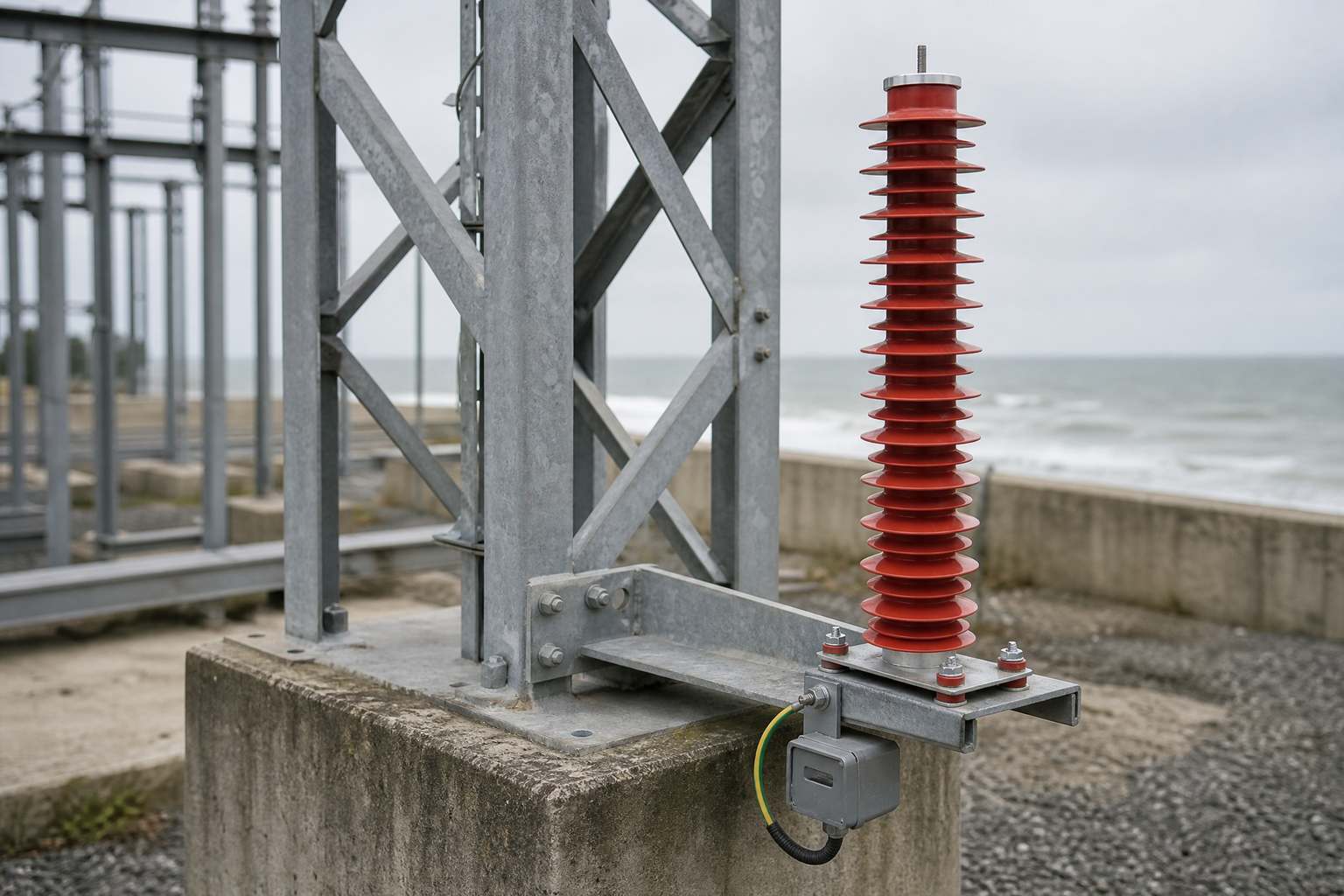
What Is a Surge Counter on a Surge Arrester?
A surge counter is an electromechanical or electronic register connected in series with the arrester's earth lead. When the arrester conducts a surge to earth, the current through that lead operates the counter, which advances by one. In its simplest form it is a five-digit mechanical drum with a reset facility; in its more useful form it is packaged with a milliammeter that reads the continuous leakage current passing through the same lead.
Two physical facts follow from that arrangement, and both affect how the reading should be treated:
- The counter is in the earth path, not the live path. Everything the arrester discharges passes through it, which is why the device has to be rated for the impulse current it may see, and why a counter is never simply "a meter" that can be swapped without checking the impulse rating.
- The counter observes events, not magnitude. A single 100 kA stroke and a modest switching surge both add one to the register. The number is a count of operations, never an energy total.
That second point is the origin of most misunderstandings in arrester maintenance records. A site with a high counter reading may simply have a tall structure and frequent small induced surges; a site reading one or two may have absorbed a single severe event that consumed most of the arrester's margin. The counter cannot distinguish between those two histories.
What Does the Number on the Counter Actually Tell You?
Used properly, the count is a trend indicator rather than a condition indicator. Its value comes from three comparisons, all of which require that somebody wrote the number down at the right moments.
- Commissioning baseline. The register should be read and recorded at energisation. Without a zero reference, later readings cannot be converted into "events since installation".
- Rate of change after a storm season. A jump after a known lightning period confirms the arrester was in the discharge path and gives the maintenance planner a reason to schedule a diagnostic measurement.
- Unexplained jumps between inspections. A register that advances without any recorded storm activity points at switching surges, resonance phenomena or an upstream insulation problem — all worth investigating on their own terms.
What the count cannot do is set a replacement threshold. There is no defensible statement of the form "replace after N operations", because the damage per operation depends on the amplitude and waveform of each surge, and the arrester's remaining margin depends on the energy it absorbed. Any specification that tries to convert the counter reading directly into a replacement decision is asking the instrument to do something it was never designed to do.
Why Is Counting Surges Not the Same as Measuring Condition?
The service life of a zinc-oxide arrester is usually described in decades rather than years. Published high-voltage engineering guidance puts the useful lifetime at at least 20 to 30 years, during which the unit is expected to absorb a large number of surges, tolerate temporary overvoltages and sit continuously under system voltage. Ageing is not a sudden event inside that window; it is a gradual drift in the voltage-current characteristic of the metal-oxide blocks.
That drift is what monitoring has to detect, and it is invisible to a counter. The same reference describes the end-of-life criterion used in many condition-monitoring techniques: when the resistive component of current and the power dissipation rise to more than twice their initial values, the arrester has reached a stage equivalent to the end of its useful life. The measurement that matters is therefore a current measurement, compared against a baseline, not an event tally.
What Is the Resistive Leakage Component, and Why Does It Matter?
Under normal service voltage an arrester carries a small continuous current. That current has two parts:
- A capacitive component, set by the geometry and capacitance of the arrester. It is large compared with the resistive part and is largely insensitive to ageing.
- A resistive component, set by the conduction of the metal-oxide material. It is small when the arrester is healthy and grows as the material degrades.
Because the capacitive part dominates the total, a meter that reads only total leakage current can show a stable number while the resistive part doubles. That is the blind spot described in field-testing guidance: total current is a poor early indicator precisely because the healthy-looking capacitive term masks the change that matters. The diagnostic value lies in separating the two.
The separation is done by harmonic analysis. The resistive current is non-linear, so it contains harmonics of the power frequency; the third harmonic is the component most commonly extracted and scaled to reconstruct the resistive current level. A monitoring device can implement that filter in hardware, and the technique has been used in patented monitoring equipment that evaluates the extracted third harmonic and issues a warning signal when it exceeds a threshold.
Surge Counter, Leakage Monitor or Offline Test: Which Do You Need?
The three approaches answer different questions, and a specification that asks for "monitoring" without saying which one will usually get the cheapest interpretation.
| Surge counter | Leakage-current monitor | Offline diagnostic test | |
|---|---|---|---|
| What it measures | Number of discharge operations through the earth lead | Continuous leakage current, with the resistive component separated or inferred | The voltage-current characteristic measured across a wide current range |
| What it proves | That the arrester has conducted surges, and how often | Whether the element is drifting from its baseline while in service | The actual condition of the element at the time of test |
| What it misses | Magnitude of each surge, and any change in the element | Damage that has not yet altered the leakage signature | Everything between tests, and it needs an outage |
| Outage required | No, but the earth lead is opened to read some types | No | Yes, plus transport or portable test equipment |
| Best used for | Event history and storm correlation | Trending and condition-based maintenance | Confirming a suspected unit before replacement |
The practical combination for a critical substation is a counter for event history plus a leakage reading for condition, with an offline test reserved for units that show either an unexplained count increase or a rising resistive trend. The laboratory technique — injecting DC or AC current and tracking the characteristic from the microamp region upward — is the most informative of the three, but the same source notes that it is not cost-effective as a routine method because it requires outages and careful transport arrangements.
How Is Leakage Current Read on an Energised Arrester?
Reading leakage current in service is a measurement discipline, not a glance at a dial. Four conditions determine whether the number means anything:
- The reference voltage. Leakage current is only meaningful against the voltage actually applied at the moment of measurement. Some techniques measure the applied voltage alongside the current; others rely on a stable system voltage and a consistent measurement point.
- The same instrument and the same tap point. Comparing a reading taken with one analyser against a reading from a different instrument, or from a different point in the earth connection, produces a trend line that is really an instrument artefact.
- Weather and surface condition. Moisture, pollution and condensation on the housing change the external leakage path. A reading taken in drizzle is not comparable with one taken in dry heat.
- The baseline. The criterion is a multiple of the initial value, so the initial value has to exist in the record. This is why the first measurement after commissioning is the most valuable one an operator will ever take.
Where a permanent monitor is installed, the same logic applies to its alarm settings. The setpoint is not a universal number; it belongs to the arrester type, the system voltage and the baseline measured on that unit. Treat any generic advice to "alarm at a fixed leakage value" with suspicion.
What Does an Arrester Monitor Not Tell You?
Monitoring instruments have a consistent set of blind spots, and a maintenance procedure that ignores them will produce false confidence:
- Mechanical condition. A cracked housing, a degraded shed, a corroded earth connection or a loose counter terminal can all exist on a unit whose electrical readings look normal. Visual inspection remains necessary.
- The disconnector. Where an arrester is fitted with a disconnect device, the state of that device is a separate check. A monitor cannot see it.
- Selectivity between parallel units. On a bank of arresters, an aggregated reading hides the one unit that is degrading while its neighbours compensate.
- What caused the surge. A rising count is a symptom. Deciding whether the cause is a shielding deficiency, a resonance condition or a switching practice requires engineering investigation, not instrument data.
When Should an Arrester Be Monitored Rather Than Replaced?
Replacement on age alone is expensive and, on a large population, wasteful. Monitoring earns its cost where at least one of the following is true:
- The unit protects equipment whose failure would cost far more than the arrester — a transformer, a GIS termination or a metering unit feeding a revenue meter.
- The site has a known surge history, whether from lightning exposure, capacitor switching or a resonance problem documented elsewhere on the network.
- The population is large enough that a trend-based replacement plan beats a calendar-based one. This is the case where leakage trending pays for itself, because it separates healthy units from marginal ones instead of replacing both.
- Access is difficult or outages are scarce. Live measurement avoids the coordination problem that causes offline testing to be postponed indefinitely.
Where none of these apply — a small population of low-criticality arresters with easy access and a cheap replacement cost — a counter and a visual round may genuinely be the rational choice. Monitoring is not a virtue in itself.
What Should an Arrester Monitoring Specification Ask For?
The clauses below are the ones that decide whether the delivered equipment produces usable evidence. Each is written so that it can be checked against a datasheet rather than argued about on site.
- Device type and function. State explicitly whether the requirement is a counter only, a combined counter and milliammeter, or a monitor that separates the resistive component. These are different products at different prices.
- Impulse current rating of the device. The counter sits in the discharge path and must be rated for the current the installation can deliver. Ask for the rating and the evidence behind it.
- Reading method and reset policy. A resettable register can erase history. If the maintenance system depends on cumulative counts, specify a non-resettable register or a documented read-and-record procedure.
- Environmental rating and mounting. The device is usually outdoors, often at height, and always at the same potential as the earth conductor. Specify the enclosure rating, the terminal arrangement and the mounting hardware.
- Baseline measurement at commissioning. Require that the initial leakage reading and the counter value are recorded, with the instrument identified and the weather noted, and handed over as part of the commissioning file.
- Alarm or output provision. If the monitor is to feed a SCADA point, specify the output type and the signal it carries. If it is a local display only, say so, so that nobody plans a remote alarm that does not exist.
Why Do Gulf and Central Asian Sites Need the Monitoring More?
Two site conditions shorten the margin an arrester has to work with, and both are common in the markets Nahu Group supplies.
The first is thermal. An arrester in full Gulf sun sits at a housing temperature well above ambient for much of the year, and the ageing processes inside the element are temperature-dependent. The second is atmospheric: coastal sites carry salt-laden air and repeated condensation cycles, which attack housings, sheds and — critically — the small terminals and earth connections that monitoring devices depend on. A monitor whose earth connection has corroded is worse than no monitor, because it produces a reading that looks reassuring.
Dust is the third factor, and it is the one most often missed in specifications written for European conditions. A layer of conductive dust bridging a polluted shed reduces the external creepage path and changes the surface leakage without changing the element. Any monitoring programme in these markets should pair the electrical reading with a cleaning and inspection cycle, and should record surface condition alongside the measurement.
Nahu Group manufactures metal-oxide surge arresters for 10–35 kV distribution networks alongside the current and voltage instrument transformers, metering boxes and switchgear that sit on the same overhead and cable systems. Arresters supplied for projects can be provided with a counter or a combined counter and leakage indicator where the specification calls for one; the engineering team can confirm what is available for a given type and what evidence accompanies it.
Frequently Asked Questions About Surge Counters
What is a surge counter in simple terms?
A surge counter is a register fitted in the earth connection of a surge arrester. It advances each time the arrester conducts a surge to earth, so it records how many discharge events the unit has handled. It does not record how large those events were or whether the arrester is still healthy.
Does a high counter reading mean the arrester needs replacing?
No. There is no valid count-based replacement threshold, because the damage per operation depends on surge amplitude and waveform, not on the number of operations. A high count is a prompt to measure condition, not a replacement instruction.
What is the difference between total leakage current and resistive leakage current?
Total leakage current is the sum of a capacitive component and a resistive component. The capacitive part is large and stable; the resistive part is small when the arrester is healthy and rises as it ages. Because the capacitive part dominates, total current can look steady while the resistive component has already doubled, which is why diagnostic methods separate the two.
How is the resistive component separated in practice?
The common method is harmonic analysis of the leakage current. The resistive current is non-linear and therefore contains harmonics of the power frequency; the third harmonic is extracted and scaled to reconstruct the resistive current level. Monitoring devices can implement that filtering internally and issue a warning when the extracted value passes a set threshold.
Can leakage current be measured without an outage?
In many field applications, yes. Live measurement is one of the reasons leakage analysis is used for condition-based maintenance, because it avoids the outage coordination that causes offline testing to be postponed. The reading still has to be taken with a consistent instrument, at a consistent point, and compared against a recorded baseline.
How often should an arrester monitor be read?
The interval follows asset criticality, environment, age and maintenance policy rather than a fixed rule. What matters more than the interval is consistency: the same instrument, the same measurement point and the same recorded conditions, so that consecutive readings form a genuine trend.
Does a surge counter protect the arrester?
No. It is a monitoring accessory, not a protective device. Protection comes from the arrester's own characteristics and from correct selection against the system voltage, earthing and overvoltage environment. A counter only reports that the protective path has been used.
What should be recorded when a reading is taken?
Record the counter value, the leakage reading and the instrument used, together with the date, the weather, the surface condition of the housing and the system voltage at the time. Without those fields the number cannot be compared with the next visit, and the trend that gives the measurement its value is lost.
Sources and Further Reading
- Monitoring of ZnO Surge Arresters — excerpt from Advances in High Voltage Engineering (IET), covering service life, the doubled-resistive-current end-of-life criterion and third-harmonic extraction
- US7336193B2 — Device for monitoring the leakage current of a surge arrester — the third-harmonic filter and warning-signal arrangement in a monitoring device
- Surge arrester leakage current analysis for condition monitoring — field practice on separating resistive from total current, and why total current alone is a weak early indicator
A surge counter is worth fitting, but only if somebody reads it, records it and treats it as one input among several. The instrument that answers "how hard has this arrester worked" is cheap and useful; the instrument that answers "can it still work" is the one that should drive the maintenance decision. Buyers who write that distinction into the specification get monitoring that produces evidence, and site teams who record a commissioning baseline get a trend instead of a number.
For 10–35 kV arresters, instrument transformers and metering equipment, Nahu Group supplies the arrester, the mounting and the project documentation as one package. See the high-voltage lightning arrester range, or send the system voltage and site conditions and the engineering team will confirm the type and the monitoring options that fit.
Related reading on this site: how to select a lightning arrester, condition monitoring of switchgear joints, and high-voltage insulators and pollution performance.
Published October 21, 2026 · Nahu Group (NAHU Electric Technology)