
Every power line is a battle between voltage and distance. The voltage wants to reach the grounded pole, the tower, the crossarm; the insulator's job is to hold the conductor physically and electrically apart from everything earthed. It is a simple job, but the consequences of getting it wrong — flashover, tracking, line drop — are anything but simple.
This guide covers the insulator types used on distribution and transmission lines, the materials they are made from, and the selection criteria engineers actually use: creepage distance, mechanical load and pollution class.
What Does a High-Voltage Insulator Do?
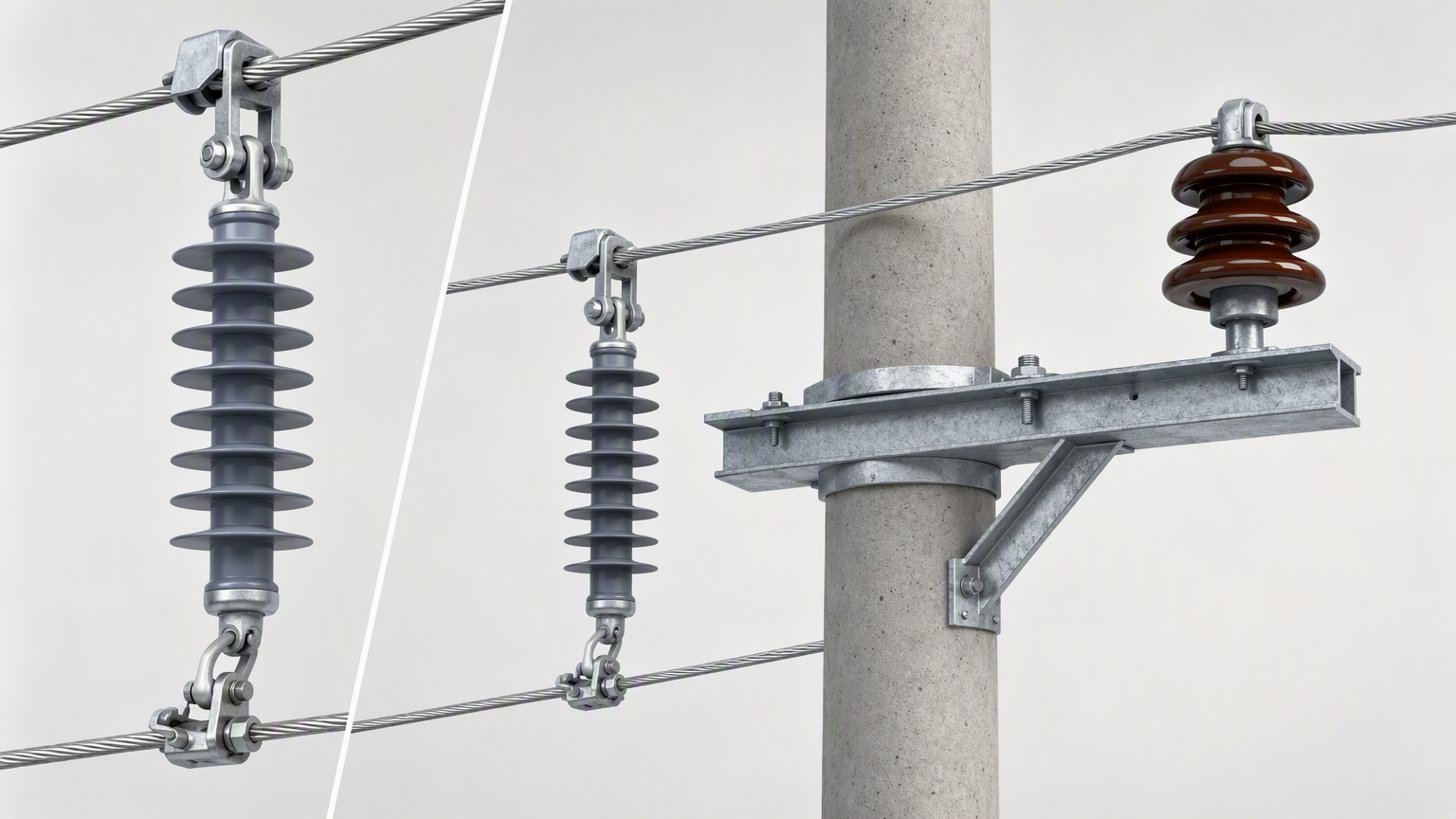
An insulator performs two duties at once: it supports the conductor mechanically — carrying the weight of the wire plus wind and ice loads — and it blocks the flow of current to ground. The visible sheds (the ribbed discs) extend the surface leakage path so that dirt, moisture and pollution cannot form a continuous conductive film from conductor to earth.
The key electrical parameter is creepage distance: the total surface path from the live end to the earthed end. More creepage means better performance in polluted or coastal environments.
Porcelain vs Glass vs Composite: Materials Compared
Three material families dominate the market:
- Porcelain — fired ceramic, the traditional choice. Excellent mechanical strength in compression, proven over a century of service, immune to UV ageing, and highly resistant to surface tracking
- Glass — used mainly in suspension strings; a damaged disc shatters visibly (self-indicating), making defects easy to spot from the ground
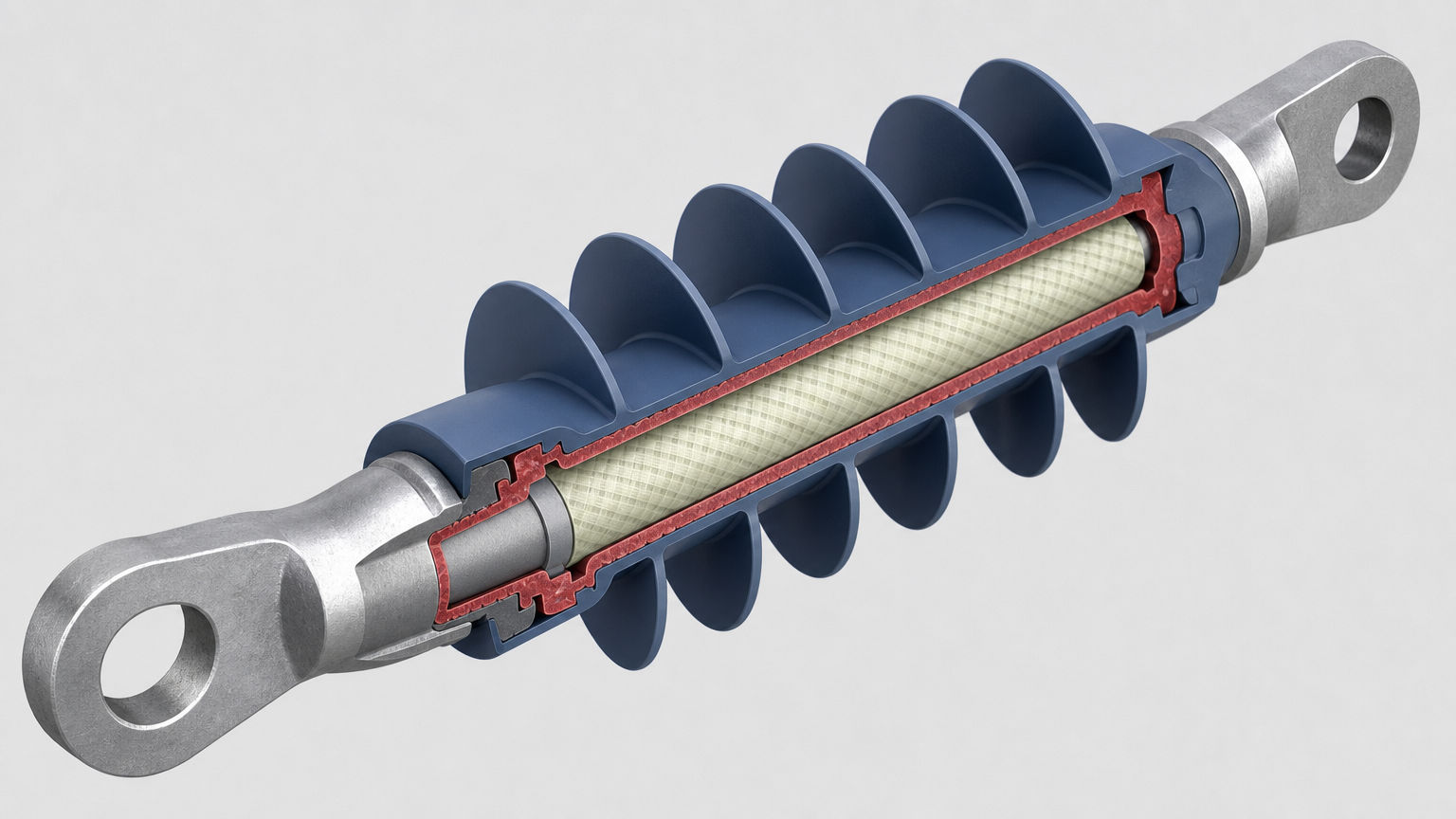
- Composite (polymer) — a fibreglass core rod sheathed in silicone rubber sheds. Lightweight (roughly a tenth of porcelain), shatter-proof, hydrophobic surfaces that shed water, and strong pollution performance. The main care point is correct handling, since the shed material can be damaged by tools or UV if poorly formulated
Composite insulators have become the default for new distribution construction because of weight, toughness and pollution performance — with the mechanical strength provided by the fibreglass core and the electrical performance by the silicone sheds.
Main Types of Insulators
Insulators are classified by their mechanical duty on the line:
- Pin insulators — mounted on a vertical pin, holding the conductor in a groove on top; used on distribution lines up to about 33 kV
- Suspension insulators — hanging strings of discs that carry tension and support conductors on lines from medium voltage upward; strings scale with voltage by adding discs
- Post insulators — rigid columns used in substations and on busbars, carrying both compression and bending loads
- Crossarm insulators — composite crossarms that replace the traditional wooden or steel crossarm plus insulator combination, combining insulation and support in one lightweight unit
- Bushings — hollow insulators that carry a conductor through an earthed barrier, such as a transformer tank or switchgear wall
Creepage Distance and Pollution Classes
Creepage is specified as millimetres per kilovolt of phase-to-earth voltage. IEC 60815 defines four pollution classes that map directly to required creepage:
- Light pollution (rural, clean air) — about 16 mm/kV
- Medium pollution (industrial areas, some agriculture) — 20 mm/kV
- Heavy pollution (cities, heavy industry) — 25 mm/kV
- Very heavy pollution (coastal salt, deserts, chimneys) — 31 mm/kV and above
Choosing an insulator with too little creepage for the site is the single most common cause of pollution flashovers, which typically happen in fog or light rain after a dry period has built up a conductive deposit on the sheds.
How to Choose an Insulator
Work through the line design data in order:
- System voltage and earthing — sets the insulation level and the creepage requirement
- Pollution class of the route — drives creepage distance per IEC 60815
- Mechanical load — conductor weight, span, wind and ice loading, plus a safety factor; composite core rods and porcelain bodies both have rated mechanical loads you must exceed with margin
- Mounting — pin, suspension, post, or crossarm application determines the fitting
- Material — composite for new distribution construction, porcelain where impact resistance or proven long-term service records matter, or a mix
- Standards — specify to IEC 60383 (porcelain/glass) or IEC 61109 (composite) so tests are comparable
Handling, Installation and Maintenance
Composite insulators are tough but not indestructible: never climb on them, never drop them, and keep tools away from the sheds — a damaged shed can become a tracking path. During installation, avoid bending the insulator beyond its rated cantilever load and keep the fittings clean. On porcelain, watch for cracked or chipped sheds during routine patrols. For all types, the leakage current across dirty insulators is the leading indicator of approaching flashover risk.
Q&A
Question: Which is better, porcelain or composite insulators?
Short answer: It depends on the duty. Composite insulators win on weight, shatter resistance and pollution performance; porcelain wins on proven longevity and impact resistance. Most new distribution lines choose composite.
Question: How much creepage distance do I need?
Short answer: Match the site pollution class per IEC 60815: roughly 16 mm/kV for light pollution up to 31 mm/kV or more for coastal and heavy-industrial routes.
Question: Why do insulators flash over in fog but not in rain?
Short answer: In fog, surface pollution dissolves into a continuous conductive film without being washed away; in rain, the deposits are rinsed off the sheds.
Question: Can composite crossarms replace conventional crossarms?
Short answer: Yes — composite crossarm insulators combine insulation and support in one unit, reducing weight and parts while improving pollution performance on distribution lines.
Nahu Group (NAHU Electric) manufactures composite crossarm insulators, pin insulators and dry-type bushings — high mechanical strength, pollution resistance and lightweight construction for distribution and substation use. For ratings and application support, see our high-voltage insulator range, or contact our engineering team.
Published August 12, 2026 · Nahu Group (NAHU Electric Technology)