
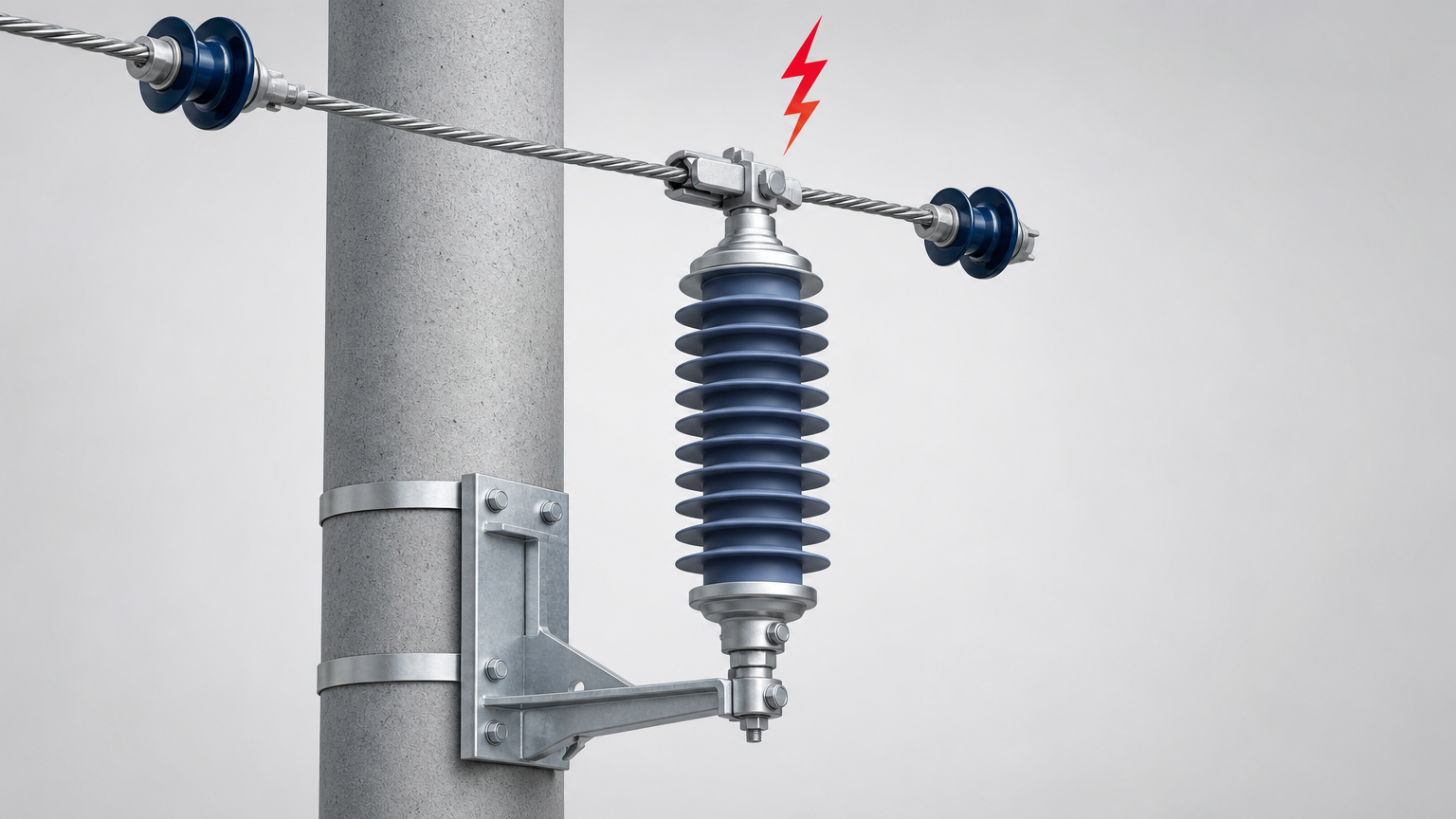
Lightning strikes are the leading cause of transformer and insulator failures on distribution lines. A lightning arrester — more accurately called a surge arrester — is the device that takes the hit instead. Mounted at transformer poles, cable terminations and substation entrances, it clamps the overvoltage to a safe level and conducts the surge current to earth.
Without arresters, a single direct or nearby strike can punch through transformer insulation, destroy metering equipment and cause outages that take days to repair. With them, the same strike passes harmlessly to ground in microseconds.
What Is a Lightning Arrester?
A lightning arrester is a voltage-limiting device connected between a live conductor and earth. Under normal conditions it is essentially an open circuit — it carries no current. When an overvoltage appears, it becomes conductive in nanoseconds, shunting the surge to earth. When the surge passes and the voltage returns to normal, it reverts to an open circuit and stops conducting.
This "normally open, conducts on demand" behaviour is what distinguishes an arrester from an insulator: the insulator keeps the conductor away from earth, while the arrester deliberately provides a controlled path to earth for surges only.
How a Zinc-Oxide Arrester Works
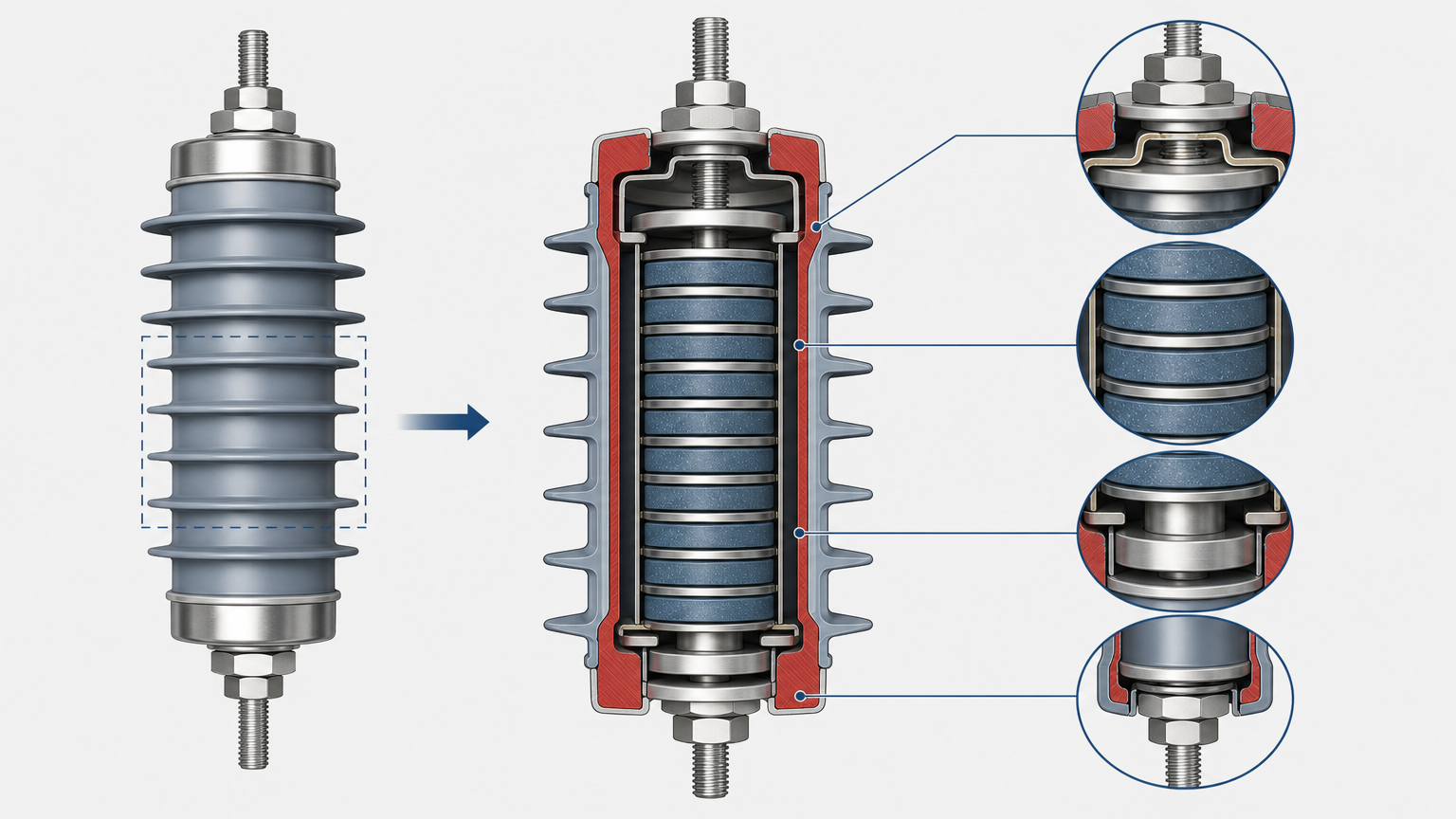
Modern arresters are metal-oxide arresters (MOA): a stack of zinc-oxide (ZnO) varistor discs enclosed in a porcelain or composite housing. The ZnO discs have a remarkable property — highly nonlinear resistance:
- At normal system voltage, the discs are near-insulators and leakage current is microamps
- When voltage exceeds the switching threshold, resistance collapses and the disc conducts heavily, clamping the voltage
- As the surge decays, resistance recovers almost instantly — no follow current, no arc to extinguish
The result is a device with no moving parts, no gas, and a very flat protective voltage characteristic: the protected equipment sees a voltage limited to the arrester's residual voltage, regardless of surge magnitude within its rating.
Main Types of Lightning Arresters
For 10–35 kV distribution systems, arresters come in several construction families:
- External-gap arresters — a visible spark gap in series with the varistor; rugged and simple, common on pole-mounted transformers
- Drop-out (disconnect) arresters — fitted with a disconnector that detaches the arrester and drops it visibly when it fails, so crews can identify a failed unit without close inspection
- Through-type arresters — the conductor passes through the arrester body, providing a compact mounting on lines and cables
- Station-class arresters — higher energy capacity for substation and cable applications where surge exposure is severe
Housing material also matters: porcelain offers proven mechanical strength, while composite (silicone) housings are lighter, tougher against vandalism, and have better pollution performance.
Why Transformers and Switchgear Need Arresters
Transformer insulation is not designed to absorb lightning impulses. A surge arriving at the winding sees a steep voltage rise that can punch through the inter-turn insulation long before the line fuse or breaker reacts. Arresters protect by limiting the voltage to a level below the equipment's withstand strength. The same applies to:
- MV/LV distribution transformers — the classic pole-mounted application
- Cable terminations and overhead-to-cable transitions — where reflections double surge severity
- Metering points and instrument transformer circuits
- Ring main units and distribution cabinets
The rule of thumb for installation: the closer the arrester is to the protected equipment, the better. Every metre of lead adds voltage drop that reduces protection effectiveness.
How to Select a Lightning Arrester
Selection follows a few well-defined steps:
- System voltage — choose the correct rated voltage class (10 kV, 20 kV, 35 kV) for your network
- Continuous operating voltage (MCOV) — the maximum sustained voltage the arrester can see; must cover temporary overvoltages from earth faults and load rejection
- Nominal discharge current — 5 kA and 10 kA classes cover most distribution duties; 20 kA for severe substation exposure
- Energy class — station-class arresters for high-energy locations
- Mounting and leads — top/bottom line terminals, disconnect option, and short, direct earth lead
- Standards — specify to IEC 60099-4 for metal-oxide surge arresters
A common error is oversizing the arrester's voltage rating "for safety". Too high a rating raises the protective level and leaves equipment exposed; the rating should be matched to the system and its actual temporary overvoltage, not the highest voltage ever heard of.
Maintenance and Testing
Arresters are passive and need little attention, but they do fail — usually at end of life, when the varistor degrades and leakage current rises. Routine checks include visual inspection for cracked housings and flashover marks, confirming the disconnector has not dropped, and periodic leakage-current measurement where test access exists. The earth connection deserves the most scrutiny: a poor earth lead makes the arrester ineffective even when healthy.
Q&A
Question: What is the difference between a lightning arrester and a lightning rod?
Short answer: A lightning rod captures and routes a strike on a structure; an arrester limits the voltage on a power circuit and shunts the surge current to earth. Distribution networks use arresters, not rods, for overvoltage protection.
Question: How long does a zinc-oxide arrester last?
Short answer: Typically 15–25 years in distribution service; repeated severe surges accelerate ageing, which is why leakage-current checks are recommended.
Question: Does every transformer need an arrester?
Short answer: Yes — any transformer connected to an overhead line, however short the spur, is exposed to lightning-induced surges and should be protected with an arrester at its terminals.
Question: What happens when an arrester fails?
Short answer: With a drop-out disconnector the failed unit detaches and hangs visibly, so crews spot it on patrol and replace it; without one, the unit typically becomes a short-circuit and must be found by fault indication.
Nahu Group (NAHU Electric) manufactures composite and zinc-oxide surge arresters for 10–35 kV systems — external-gap, drop-out and through-type designs protecting transformers and switchgear from lightning overvoltage. For ratings, residual-voltage curves and selection support, see our lightning arrester range, or contact our engineering team.
Published August 12, 2026 · Nahu Group (NAHU Electric Technology)