
The vacuum circuit breaker (VCB) is the workhorse of medium-voltage distribution. It interrupts short-circuit currents without oil, without gas, and with an interrupter that can handle tens of thousands of operations. For utilities, industrial plants and substations working at 12 kV to 40.5 kV, it is usually the most cost-effective protection choice available.
This guide explains how a vacuum circuit breaker works, the types you will meet on the market, how a VCB compares with SF6 breakers, and the key ratings to check before you buy.
What Is a Vacuum Circuit Breaker?
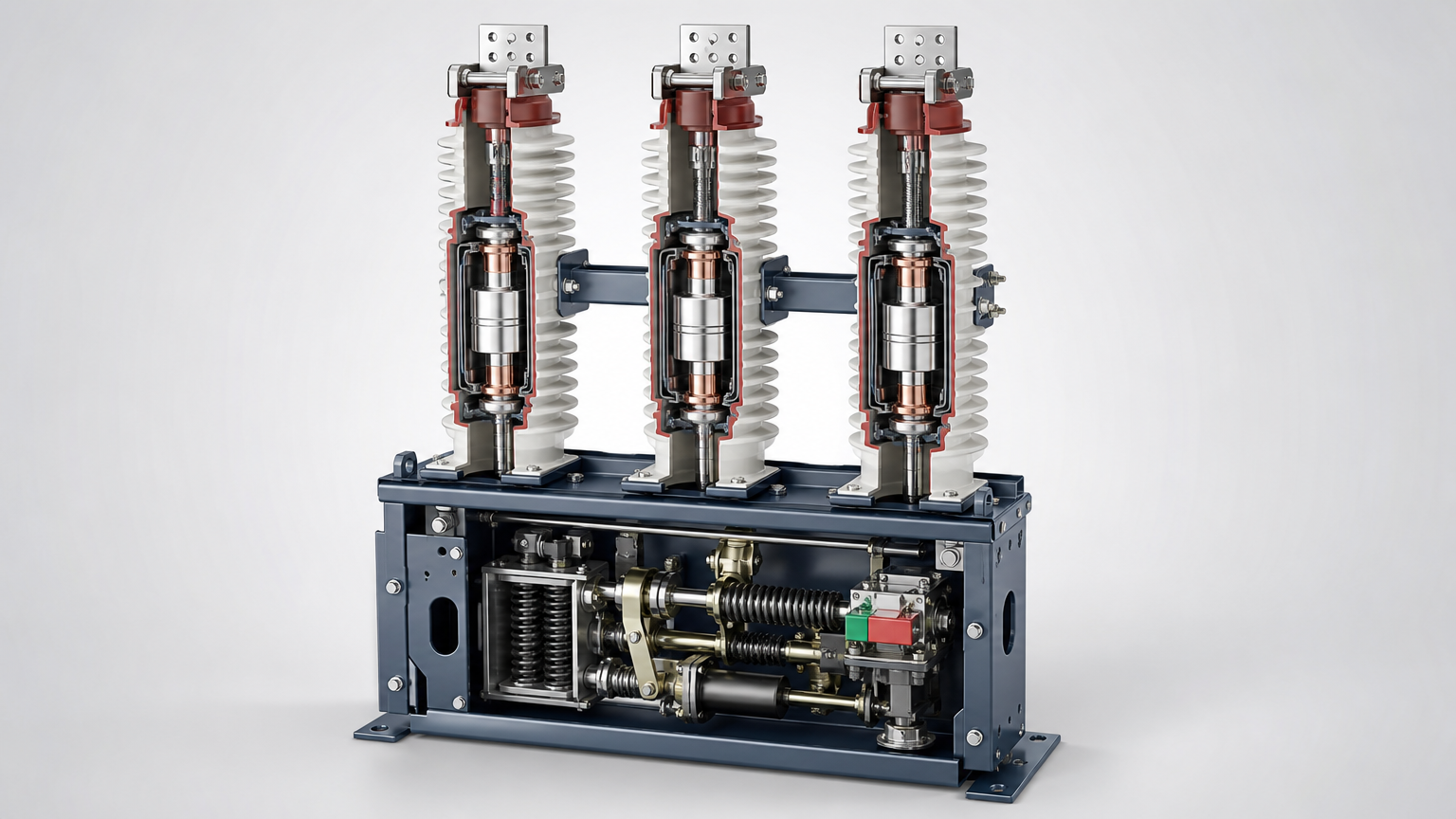
A vacuum circuit breaker is a switching device that makes and breaks electrical circuits in medium-voltage networks. The name comes from the heart of the breaker: the vacuum interrupter, a sealed ceramic or glass chamber in which the contacts are separated and the arc is extinguished in a near-perfect vacuum.
When the breaker opens, the contacts part inside the vacuum chamber. The arc that forms is rapidly extinguished because a vacuum has no ionisable medium to sustain it — the arc goes out at the first natural current zero, usually within a few milliseconds. Because there is no gas to recycle and no oil to maintain, the interrupter can switch far more operations than older technologies.
How a Vacuum Interrupter Works
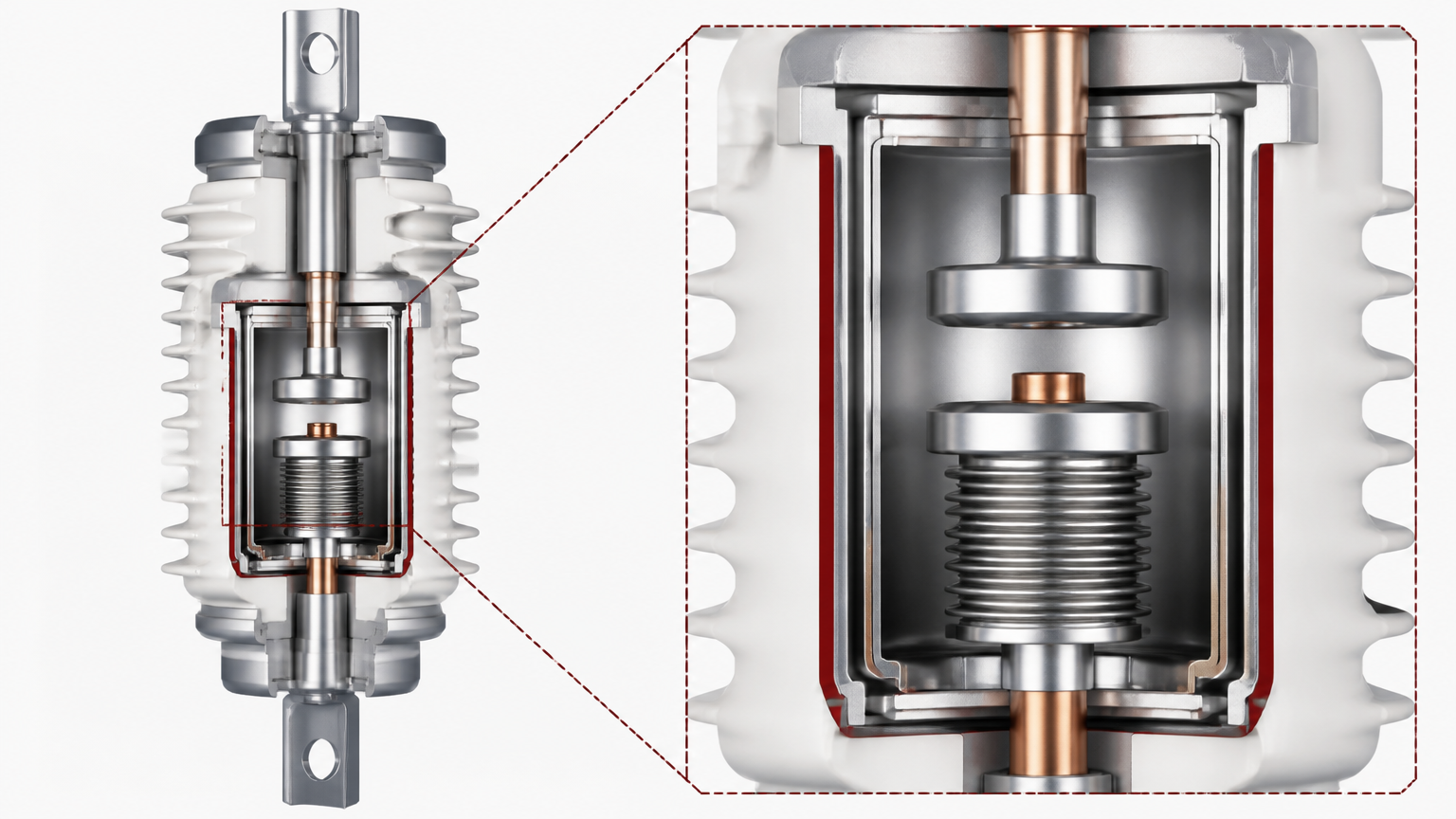
The vacuum interrupter is a small but critical assembly. Inside the sealed chamber you will find:
- A fixed contact and a moving contact, typically copper-chromium alloy
- A stainless-steel bellows that lets the moving contact travel while keeping the vacuum sealed
- A metallic arc shield that condenses metal vapour so the insulating gap recovers quickly
- A ceramic or glass envelope rated for the full insulation voltage of the breaker
During interruption, the contact surfaces vaporise slightly and the arc burns in metal vapour rather than in gas. At current zero the vapour condenses onto the shield almost instantly, restoring dielectric strength within tens of microseconds. That fast recovery is what lets a VCB clear a fault cleanly and reclose without waiting for the medium to recover.
Main Types of Vacuum Circuit Breakers
VCBs are grouped by installation location, by construction, and by the operating mechanism that drives the contacts.
Indoor vs Outdoor
Indoor VCBs are installed inside switchgear panels and substation buildings. They are compact and rely on the enclosure for protection against weather. Outdoor VCBs are pole-mounted or yard-mounted with weatherproof porcelain or composite housings, and are built for direct exposure to sun, rain and pollution.
Fixed vs Withdrawable
Fixed breakers bolt directly into the panel — simpler and cheaper. Withdrawable (truck-type) breakers slide in and out of the panel on wheels, which lets maintenance staff remove a breaker for inspection or replacement while the rest of the switchboard stays energised.
Spring vs Permanent-Magnet Mechanism
Spring mechanisms store closing energy in charged springs and are the industry standard — reliable, proven, and easy to maintain. Permanent-magnet mechanisms use magnetic latching with fewer moving parts, giving faster operation and lower maintenance, at the cost of a more complex control unit. Both are widely used; the choice depends on how often the breaker operates and how your control scheme is built.
VCB vs SF6 Circuit Breaker
SF6 breakers use pressurised sulphur hexafluoride gas to quench the arc. Both technologies interrupt fault currents reliably, but the differences matter in practice:
- Maintenance: vacuum interrupters need almost none; SF6 breakers need gas density checks and periodic handling of pressurised gas
- Environmental impact: SF6 is a potent greenhouse gas with strict handling and reporting rules in many regions; vacuum technology has no greenhouse-gas footprint
- Switching performance: both clear faults well, but vacuum excels at frequent operation — ideal for capacitor banks and motor switching
- Cost of ownership: the VCB's lower maintenance and simpler auxiliary equipment usually give it the lower lifetime cost
For most 12–40.5 kV distribution applications, vacuum is now the default choice, which is why NAHU builds its medium-voltage breaker range around vacuum interruption.
How to Choose a Vacuum Circuit Breaker
The first rule of VCB selection: match the breaker to the system, not to the load nameplate alone. Start with these ratings:
- Rated voltage — must equal or exceed the system voltage (12 kV, 24 kV, 36 kV or 40.5 kV classes)
- Rated normal current — the continuous current the breaker carries without overheating, chosen from the feeder load plus margin
- Rated short-circuit breaking current — the maximum fault current (kA) the breaker must interrupt; check it against your substation's maximum fault level
- Rated short-time withstand current — the fault current the breaker can carry in the closed position for 3 or 4 seconds
- Operating mechanism — spring or permanent magnet, plus control voltage for the close/open coils (110 V DC, 220 V DC, 230 V AC)
- Standards — specify to IEC 62271-100 so type tests, operation counts and test reports are comparable across suppliers
If the breaker feeds a transformer or capacitor bank, also confirm the rated frequency of operation — vacuum interrupters are suited to high-frequency duty, but the mechanism and auxiliary contacts must match your switching pattern.
Installation and Maintenance Basics
A VCB is a low-maintenance device, but it is not a no-maintenance one. On a fixed schedule, check:
- Mechanism operation — trip and close times, and the spring-charging motor
- Contact wear — many interrupters expose a wear indicator, and contact erosion should be recorded at each inspection
- Insulation — porcelain or composite poles cleaned and inspected for tracking or cracks
- Auxiliary contacts and heaters — condensation is a common cause of failures in humid substations
Installation itself must respect the breaker's orientation and clearances, with the mechanism compartment earthed and the control wiring tested before first energisation.
Q&A
Question: How long does a vacuum circuit breaker last?
Short answer: The vacuum interrupter itself typically lasts 20–30 years; the mechanism usually defines the service life, and with regular inspection a VCB routinely exceeds 10,000 mechanical operations.
Question: Can a VCB interrupt fault current without SF6 or oil?
Short answer: Yes. The vacuum environment extinguishes the arc at current zero in microseconds, so no insulating medium other than the sealed vacuum is required for interruption.
Question: What voltage range are vacuum circuit breakers used in?
Short answer: Typically 3.6 kV to 40.5 kV for distribution and industrial networks — NAHU's range covers 12 kV to 40.5 kV indoor and outdoor applications.
Question: How do I know which breaking capacity I need?
Short answer: Calculate the maximum three-phase fault current at the breaker's busbar from your utility's fault level data, then select a rated breaking current above that value with the standard margin.
Nahu Group (NAHU Electric) designs and manufactures indoor and outdoor vacuum circuit breakers from 12 kV to 40.5 kV, with spring and permanent-magnet mechanisms, built-in current transformers and intelligent protection options. For specifications, test reports and lead times, see our vacuum circuit breaker range, or contact our engineering team.
Published August 12, 2026 · Nahu Group (NAHU Electric Technology)