
An expulsion fuse is a vented high-voltage fuse: when its element melts, the arc is quenched by gas released from the tube lining and blasted out of the open end of the tube. It does not limit the fault current, it cannot be reset, and on an 11 kV overhead tee-off it is the replaceable link in front of the pole-mounted transformer.
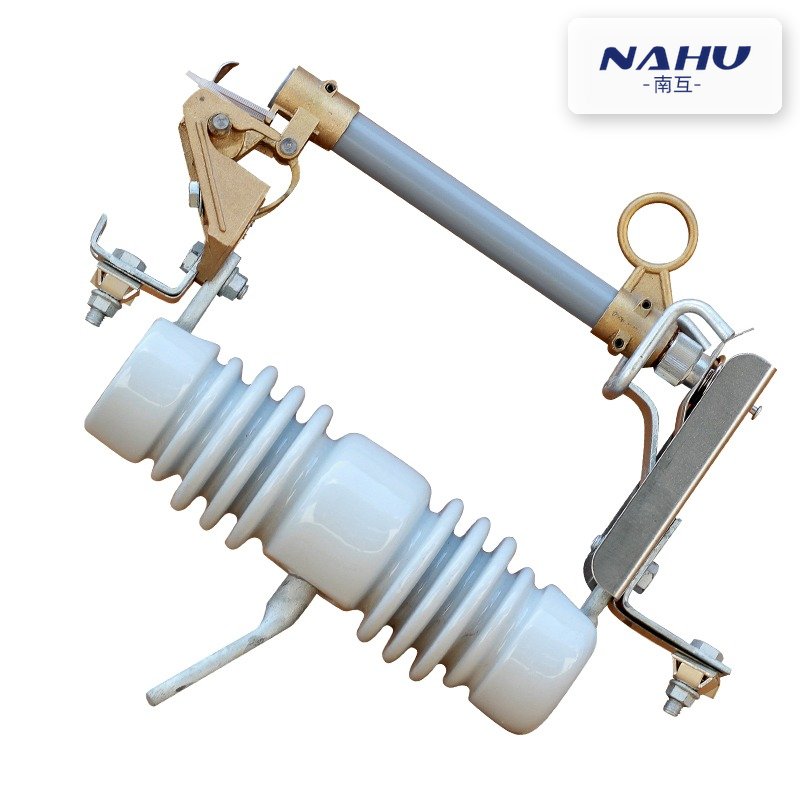
The name describes the interrupting principle rather than a shape. The devices sold as drop-out fuse cutouts, jet-type fuses and expulsion cutouts all share it: a tube with a lining that gives off gas under arc heat, a mechanism that lets the tube swing open or drop once the arc is out, and a fuse link that a lineman replaces by hand. IEC 60282-2 is the standard that covers the family.
Two consequences follow for anyone specifying one. The clearing action is tied to a natural current zero, so the prospective fault current flows almost unimpeded up to its first peak. And the visible gap left after operation is a byproduct of the mechanism, not a switching rating: the unit is a fault-clearing element that happens to leave an isolating gap. That second point decides whether the device belongs at the point you have in mind. The wider family and how each type is built and maintained sits in the drop-out fuse cutout guide.
The parts of a cutout that go into a specification
A cutout is an assembly, not a fuse on its own. On a porcelain or polymer unit the items that matter in a datasheet are the insulator and its creepage, the upper and lower contacts, the fuse tube with its liner, the pull ring and trunnion that let a hot stick change the link, and the mounting bracket that sets the tilt. Everything else is hardware.
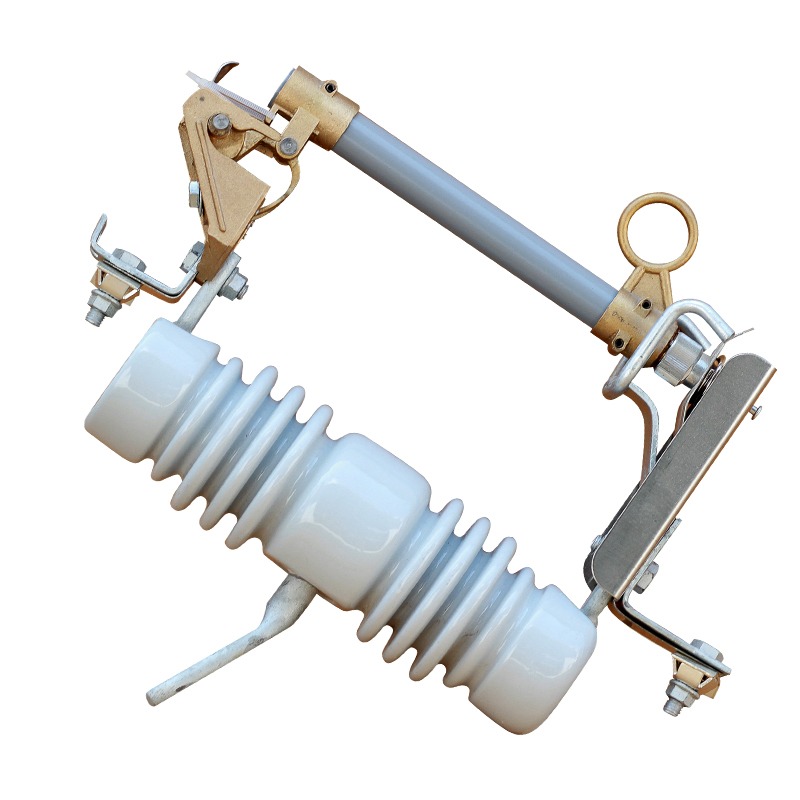
The RW12 cutout in the 12(15) kV class shows what a quotation should carry for the 100 A and 200 A versions:
| Parameter | 100 A unit | 200 A unit |
|---|---|---|
| Rated voltage | 12(15) kV | 12(15) kV |
| Rated current | 100 A | 200 A |
| Rated frequency | 50 Hz | 50 Hz |
| Rated short-circuit breaking current (kA/A) | 8/100, 12.5/100, 16/100 | 12.5/200, 16/200 |
| Power-frequency withstand, dry (kV) | 50/55 | 50/55 |
| Power-frequency withstand, wet (kV) | 45/55 | 45/55 |
| Rated lightning impulse withstand (kV) | 125 | 125 |
| Creepage, datasheet figure (mm/kV) | 330 | 330 |
| Mechanical life (operations) | 500 | 500 |
| Ambient temperature | −30 to +40 °C | −30 to +40 °C |
| Outline dimensions (cm) | 50 × 36 × 12.5 | 50 × 36 × 12.5 |
Read the breaking capacity row with care. It is quoted as a pair — kA at a link rating — so a unit that clears 16 kA with a 100 A link is not thereby a 16 kA device with any link. The kA figure that goes into your fault-level check is the one that sits against the link you actually intend to fit.
Why “not current-limiting” is a procurement problem, not a technicality
In a vented fuse the arc is drawn along the tube and held until a current zero arrives. Until then the prospective fault current flows through the fuse, first asymmetrical peak included, and everything downstream sees that peak. A current-limiting fuse is built to do the opposite: it forces the current to zero inside the first quarter cycle, before the peak, and holds the let-through value well below the prospective value. For the buyer the difference shows in two places — the peak withstand of the cable and switchgear behind the fuse, and a clause in the specification that says current limiting and means it.
Where the fault level is modest, the distinction costs nothing. A tee-off at the end of a long rural feeder is the classic cutout position: a few kA prospective, a transformer of a few hundred kVA, and nothing downstream that needs protection from a first peak. Where the tee-off comes off a station bus, or the device sits inside a metal-enclosed cubicle, a cutout is the wrong purchase — and the specification usually already says so.
Expulsion fuse, current-limiting fuse and disconnector side by side
The three appear on one single-line diagram and are often bought on one requisition, so it is worth separating what each of them actually does. Read the table by row, not by product name.
| Question | Expulsion fuse (cutout) | Current-limiting fuse | Disconnector |
|---|---|---|---|
| How the arc is put out | Gas from the tube lining blasts the arc out of the open end | Arc is forced into sand and cooled, resistance rises until current is cut off | No arc to interrupt in normal service; opens a circuit already at no current |
| Current limiting | No — clears at a current zero | Yes — cuts off before the first peak | Not applicable |
| State after an operation | Tube open or dropped, link consumed, visible air gap | Body intact, element consumed, no visible break | Unchanged and reusable |
| What is replaced | The fuse link only | The whole fuse | Nothing |
| Load breaking | Not a load-break device on a standard datasheet; check the rating before opening on load | Not a switching device | No — it isolates, it does not break load |
| Usual position | Overhead tee-off, pole platform, transformer primary | Metal-enclosed cubicle, transformer primary in a packaged substation | Section isolation for maintenance |
| Standard | IEC 60282-2 | IEC 60282-1 | IEC 62271-102 |
Two rows decide most purchases. “Current limiting” decides whether the device may be used at that fault level at all. “State after an operation” decides what the maintenance crew has to carry and what the switching procedure can assume. If the real requirement behind the question is a way to isolate a transformer for work, no fuse is the right answer — the item to specify is an isolating switch, and the fuse is a separate line on the same drawing.
Where the cutout sits on an 11 kV pole-mounted transformer
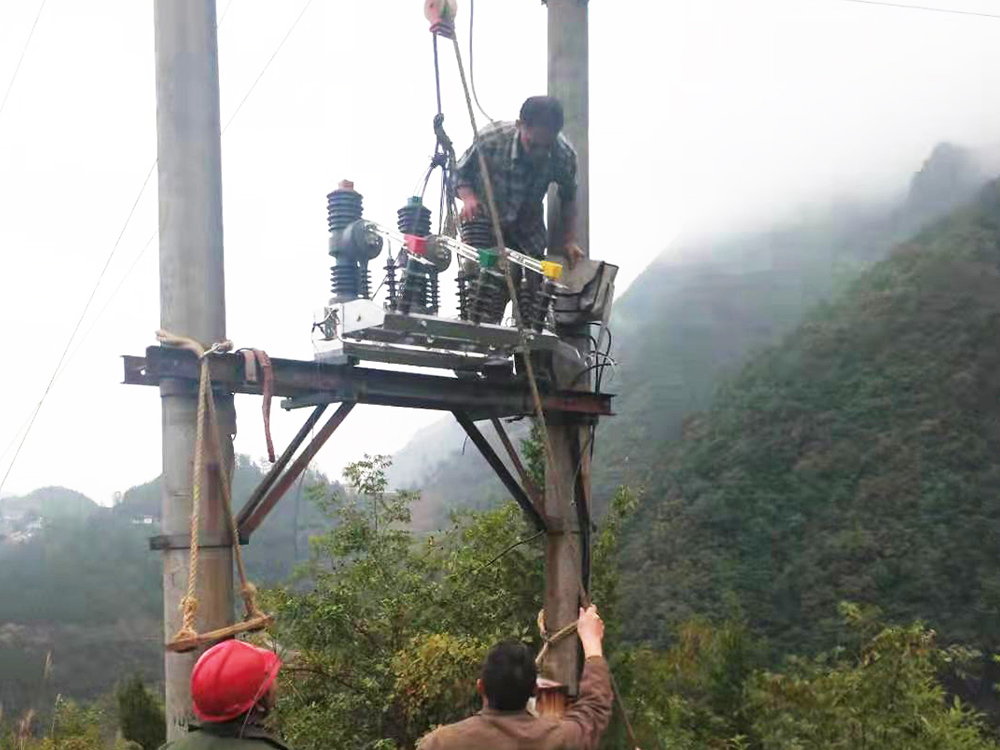
On a standard pole platform the three cutouts sit between the line and the transformer terminals, one per phase, on a bracket at the transformer's high-voltage side. A lineman opens them with a hot stick to isolate the transformer and closes them to energise it once the link is changed. Above them the line runs on to the next pole; below them are the transformer and the low-voltage distribution.
The cutout sets the ceiling, the link sets the curve. A 100 A cutout will not take a 200 A link, and fitting a larger cutout to “leave headroom” changes the breaking rating you end up relying on. The link rating comes from the transformer's full-load current with margin for inrush, not from the cutout's rated current; the arithmetic for 50 kVA to 1,000 kVA transformers at 11 kV and 33 kV, and the K against T class question, are on the fuse link selection page. Where the system runs at 33 kV or 35 kV, the polymer-housed 35 kV cutout covers the same duty at the higher class.
Two site conditions change what should be ordered. Above 40 °C ambient the quoted current has to be checked against a derating, because the datasheet range ends there. On a polluted or coastal site the creepage figure matters more than the voltage class: the datasheet quotes creepage as 330 mm/kV, while what belongs in the RFQ is the total creepage in millimetres for the pollution level, because the two are not the same number and only the second one can be checked against the site.
The mistakes that cost a rework or a failed inspection
Most of the money lost on this device is lost before it is installed. Four failures account for most of it:
- A cutout specified where the clause says current limiting. The units arrive, the inspection fails on the standard number, and the replacement has a different footprint and a different cable termination.
- A link chosen to suit the cutout rather than the transformer. A 100 A link on a 100 kVA transformer protects the cutout and does nothing for the winding.
- A cutout opened on load as though it were a switch. A standard unit is not rated for that duty, the arc lands on the contacts, and the cutout comes out of service with burned tips. A load break switch is the device for that job.
- Phase spacing and drop clearance treated as cosmetic. A tube that cannot fall clear never produces the visible gap the isolation procedure assumes.
Each of these surfaces late — at inspection, at energisation, or on the first storm night — and each is paid for in a second crew visit, a second shipment, or a date that moves. The dimensions that prevent the last one, including the mounting tilt and the free-fall clearance below the tube, are on the cutout installation clearance page.
What to write into the RFQ or the datasheet
An enquiry that says only “11 kV, 100 A drop-out fuse” leaves the supplier to choose the breaking capacity, the creepage and the tube form. State them instead:
| Item | What the enquiry should say |
|---|---|
| Voltage class and rated current | 12 kV or 36 kV class for the highest system voltage; rated current at or above the largest link to be fitted |
| Breaking capacity | The kA figure against the link rating you intend to use, and the prospective fault level at the tee-off it has to cover |
| Current limiting | State it explicitly, either way. A clause requiring current limiting means this device is not the answer |
| Creepage | Total creepage in millimetres for the site pollution level, not only the mm/kV figure |
| Link class and rating | K or T with the reason recorded, the rated current from the coordination study, and the curve reference |
| Tube and link form | Cap type, length and diameter as shown on the cutout drawing, so spares fit the tube you bought |
| Standard and documents | IEC 60282-2, type test report, routine test report, time-current curves and an outline drawing for approval |
| Marking and packing | Rating marked on each unit and each link, sealed moisture-proof packing, spare links quoted per rating |
Send the drawing and the ratings rather than the category name. A supplier holding the prospective fault level and the pollution level can quote the kA class and the creepage without a second round of questions, and the quotation becomes something you can compare line by line with the next one.
Frequently asked questions about expulsion fuses
What is an expulsion fuse best described as?
A vented high-voltage fuse in which the arc is extinguished by gas evolved from the tube lining and expelled from the open end of the tube. It interrupts at a current zero, so it never limits fault current, and its link has to be replaced after every operation. IEC 60282-2 is the standard that defines the family and the ratings quoted on its datasheet.
Is a drop-out fuse the same thing as an expulsion fuse?
In practice, yes. The cutouts sold as drop-out fuses and jet-type fuses all use the expulsion principle. “Drop-out” describes the mechanism that releases the tube after clearing; “expulsion” describes how the arc is put out. One unit is both, which is why the two names sit on the same datasheet line without contradicting each other.
Can an expulsion fuse be installed indoors in a cubicle?
Not normally. The device vents hot gas and liner material out of the open end while it clears, so it is built for outdoor mounting on a pole or a platform. Inside a metal-enclosed cubicle the usual choice is a current-limiting fuse, which does not vent. Ask the manufacturer for the mounting instructions in writing before putting a cutout inside any enclosure.
Does a cutout break load current?
A standard cutout is a fault-clearing device, not a load-break switch. Opening one on a loaded transformer draws an arc at the contacts, and most datasheets do not rate or test the unit for that duty. Isolate upstream, or use a load-break switch, before opening a cutout that is carrying current to a transformer or a feeder.
How do I know whether I need a current-limiting fuse instead?
Two signals. The specification says current limiting or names IEC 60282-1, or the prospective fault level at the installation point is high enough that the first-peak let-through matters to the cable and switchgear downstream. At a station bus or inside a cubicle, a cutout is the wrong device; on a rural tee-off with a modest fault level it is the standard one.
What does a 100 A cutout actually protect?
The cutout carries a breaking rating in kA at 100 A, and that is a ceiling rather than a setting. What protects the transformer is the link inside it — typically sized at one and a half to two times the transformer's full-load current, then checked against inrush and coordination with the device upstream. A 100 A link on a 100 kVA transformer does nothing for the winding.
Sources and further reading
- IEC 60282-2 — High-voltage fuses, Part 2: Expulsion fuses. The standard the cutout ratings on this page are quoted against.
- IEC 60282-1 — High-voltage fuses, Part 1: Current-limiting fuses. The device the comparison table sets against an expulsion fuse.
- IEC 62271-102 — Alternating current disconnectors and earthing switches. The switching duty a fuse is sometimes wrongly asked to cover.
- IEC Webstore — official catalogue for the current editions of the three standards above.
- Drop-type fuse cutouts, 10 kV to 35 kV — the product range these ratings come from.
Published Nov 21, 2026 · Nahu Group (NAHU Electric Technology)