
For a transformer tee-off where the drop-out cutout is the only protection, specify a K link sized 1.5 to 2 times the transformer's high-voltage full-load current. Specify a T link instead when the line recloses upstream, when the load has a sustained starting current, or when a transient fault has to be cleared by the recloser before the link sees it. K and T are not quality grades: they are time-current classes, and the choice decides whether the link protects the transformer or takes the feeder out with it.
Two links of the same 10 A rating, one K and one T, carry the same continuous current and fit the same tube. They separate only above the load current, which is where a specification has to be explicit.
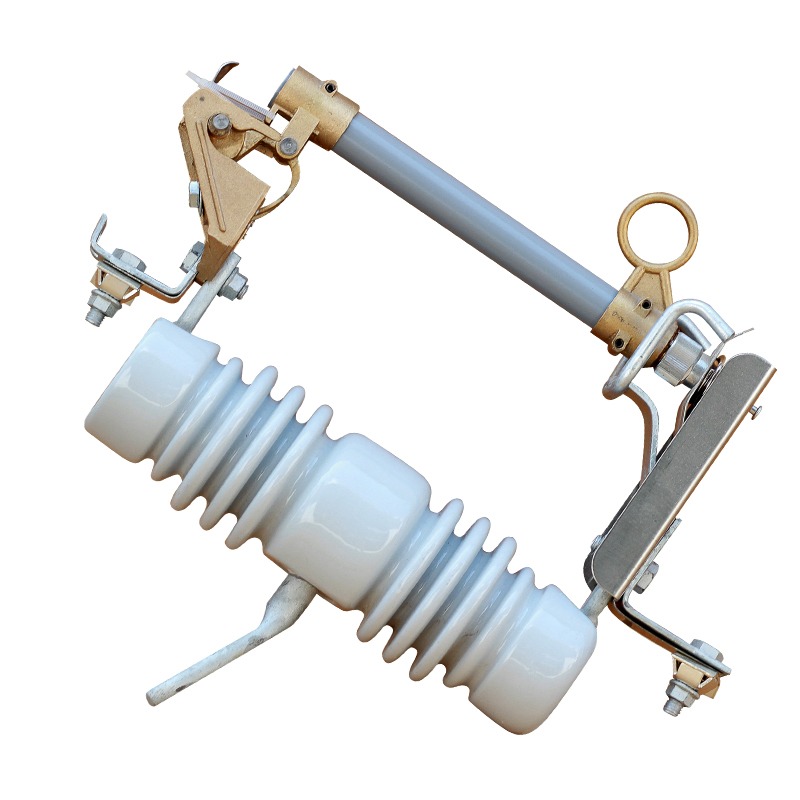
What the K and T Markings Change on the Curve
IEC 60282-2 covers expulsion fuses and defines the two characteristic classes used in distribution cutouts. A K link has the faster melting curve and a tighter tolerance band; a T link is deliberately slower and tolerates a wider one. Both are correct answers to different questions.
| Behaviour | K link (fast class) | T link (slow class) |
|---|---|---|
| Melting time at fault current | Shorter, so transformer damage is limited | Longer, so the upstream device gets time |
| Tolerance on melting time | Tighter, easier to coordinate | Wider, needs more margin |
| Transformer inrush | Can operate if sizing leaves no margin | Built to ride through normal inrush |
| Reclose dead time | Each reclose is another inrush test | Survives repeated energisation better |
| Typical use | Transformer protection on a non-reclosing feeder | Lines with reclosers, capacitor banks, motors |
The class letter is normally marked on the link cap. Links that arrive loose and unmarked cannot be verified against a curve, and should be rejected at goods-in inspection, before they reach a pole.
From Transformer kVA to Link Rating
Work from the high-voltage current, not the low-voltage current: divide the transformer rating by the square root of three times the line voltage. A 400 kVA transformer on an 11 kV feeder carries about 21 A on the primary, and the link is chosen on that 21 A, not on the 577 A that appears at 400 V.
The multiplier is the engineering judgement. A factor of 1.5 suits a transformer running near nameplate in a normal ambient; 2.0 leaves room for sustained overload, high ambient and the tolerance of the link itself. Below 1.5 the link will operate on inrush sooner or later; above roughly 2.5 the transformer has lost its primary protection and one fault trips the whole feeder.
| Transformer | HV current at 11 kV | HV current at 33 kV | Range at 1.5–2× | Size to quote |
|---|---|---|---|---|
| 50 kVA | 2.6 A | 0.9 A | 3.9–5.2 A | 6.3 A |
| 100 kVA | 5.2 A | 1.7 A | 7.9–10.5 A | 10 A |
| 200 kVA | 10.5 A | 3.5 A | 15.8–21 A | 16 or 25 A |
| 315 kVA | 16.5 A | 5.5 A | 24.8–33 A | 31.5 A |
| 400 kVA | 21.0 A | 7.0 A | 31.5–42 A | 40 A |
| 630 kVA | 33.1 A | 11.0 A | 49.7–66 A | 63 A |
| 800 kVA | 42.0 A | 14.0 A | 63–84 A | 80 A |
| 1000 kVA | 52.5 A | 17.5 A | 78.8–105 A | 100 A |
At 33 kV the arithmetic gives a link smaller than most cutout tubes are built to hold, so the tube and the utility's standard stock usually set the floor. Confirm both before a size goes into the datasheet.
Cutout Rating, Link Rating and Tube Fit Are Three Different Limits
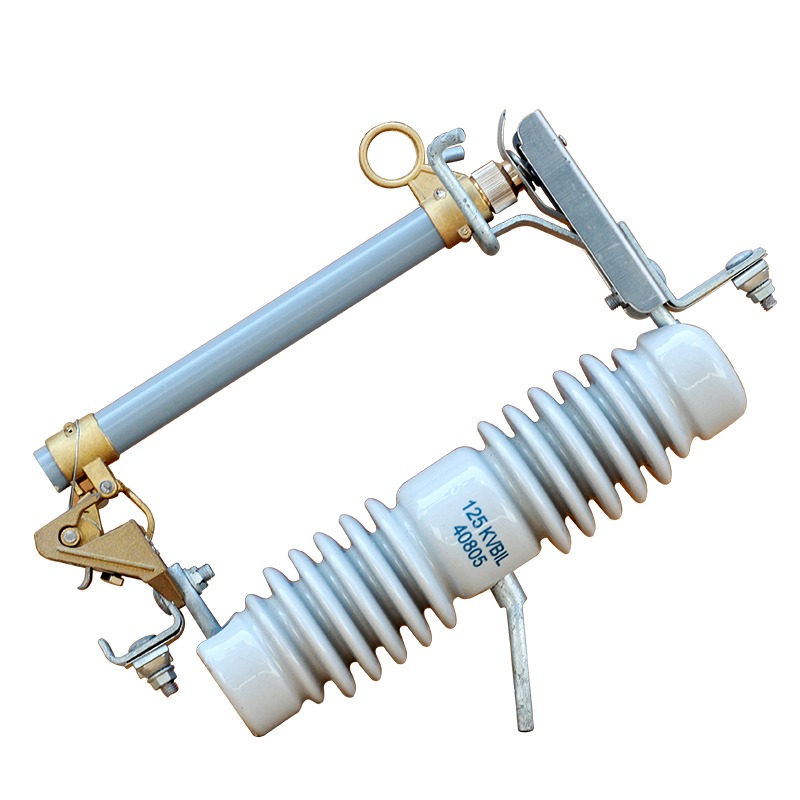
A 200 A cutout holding a 63 A link is a normal installation. A 100 A cutout holding a 200 A link is a fault waiting for a reason: the link passes current that the cutout cannot interrupt, so the cutout becomes the fault. Four cutout numbers belong in the specification, and none of them is the link size.
- Rated voltage at or above the highest system voltage, not the nominal value.
- Rated current at or above the largest link you will ever fit, and above the load.
- Breaking capacity above the prospective fault level at the pole, which on a strong urban feeder is often far above the transformer rating.
- Creepage distance matched to site pollution and stated in millimetres, not as a class name.
Nahu's HRW12-15F and RW12-15F cutouts are rated 12(15) kV at 200 A, which covers most 11 kV tee-offs; the full drop-type fuse range lists the models and their 10–35 kV applications.
Fit is the part buyers forget. Cap diameter, link length and the seating in the upper contact are model-specific, so a link that is electrically right can be mechanically wrong. Ask for the cutout and link drawings as one set, and check the tube length against the link you intend to stock.
Coordination With the Transformer and the Upstream Device
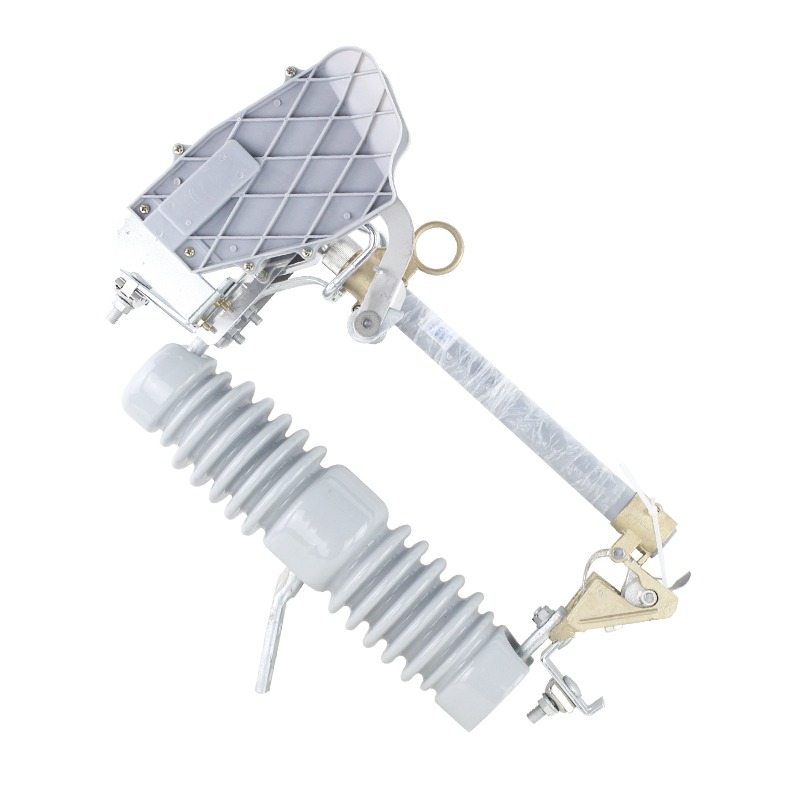
Three curves decide the size, and the link has to sit between them. If any one is missing from the submittal, the coordination has not been done, whatever the datasheet says.
- Below the transformer damage curve at every current, so the link melts before the winding is damaged.
- Above the inrush point, typically 8 to 12 times full-load current for about 0.1 s on a distribution transformer.
- Below the upstream recloser or breaker curve, so the link clears the transformer fault and the feeder stays on.
Check at two currents rather than one. At the maximum fault level the link must not be overtaken by the upstream device; at the minimum fault current at the far end it must still operate inside the time the transformer can take. A link that coordinates at 4 kA and not at 600 A passes the study and fails on a real fault.
Ambient, Dust and Reclosing: Where the Table Stops Being True
- Ambient above 40 °C. Link ratings assume a reference ambient. At 50 °C, an ordinary Gulf afternoon, the link runs closer to its melting band and the contacts run hotter. Many utilities step one size up; the link maker's derating data is the authority, not the table above.
- Dust, sand and coastal humidity. The failure is mechanical: grit in the hinge and latch stops the tube dropping after the link melts, so the visible break the crew relies on is not there, and salt air reaches the hinge and contacts before it reaches the link.
- Reclosing. Every reclose puts inrush through the link again; a link marginal on first energisation will not survive three.
- Lightning. The link clears faults but does not limit surge voltage. A cutout is no substitute for an arrester at the transformer.
Mistakes That Show Up as Outages or Failed Inspections
- Undersized link. Nuisance operations on inrush, usually in the hottest week of the year, then a crew that fits bigger links to stop the complaints.
- Oversized link. The transformer fault is cleared upstream, the feeder goes out, and the transformer is damaged before anything operates in the tee-off.
- Mixed classes across phases. One phase clears while the other two keep feeding the fault until the upstream device trips.
- Same rating, different curve. A second-source link breaks a coordination study that was correct on paper, and the failure appears months later.
- Unmarked links and damp spares. An inspector who asks for time-current data ends the discussion, and links stored in a humid yard interrupt poorly when finally used.
What to Write in the RFQ and on the Datasheet
Write requirements, not preferences. A clause asking for "quality fuse links" gets you what you already had; the lines below produce a link that can be checked on arrival and coordinated at the substation.
| Item | What the specification should state |
|---|---|
| Cutout voltage and current | 12 kV or 36 kV class for the highest system voltage; rated current at or above the largest link to be fitted |
| Breaking capacity | Greater than the prospective fault level at the installation point |
| Creepage distance | Stated in mm for the site pollution level |
| Link class | K or T, with the reason recorded (reclosing, inrush, fault clearing) |
| Link rated current | The size from the coordination study, with the curve reference |
| Link physical form | Cap type, length and diameter as shown on the cutout drawing |
| Standard and documents | IEC 60282-2; type test report, routine test report, curves, outline drawing |
| Marking and packing | Class and rating on each link; sealed moisture-proof packing; spares quoted per rating |
Where Nahu Group Fits
Nahu Group manufactures drop-out fuse cutouts for 10–35 kV pole-mounted distribution: the HRW12-15F, RW12-15F and RW12 models are rated 12(15) kV at 200 A. If you are comparing cutouts for a transformer tee-off, start from the drop-type fuse range; the cutout guide covers operation and maintenance of the same equipment.
To get a configuration back, send the system and highest system voltage, transformer kVA with impedance, prospective fault level at the cutout, whether the line recloses and on what curve, ambient and pollution level, and the utility standard you work to. We will return the cutout drawing, the link size that fits it, and the curves for your coordination study.
Frequently Asked Questions About Fuse Link Selection
What is the difference between a K-type and a T-type fuse link?
Both are expulsion links to IEC 60282-2 with the same continuous rating; the difference is the melting curve. A K link melts faster at high fault current with a tighter tolerance, so a transformer fault clears quickly. A T link is slower, which lets it ride through inrush and reclose cycles. Choose by what the link must survive, not by the last project.
How do I size a fuse link for a 200 kVA transformer on 11 kV?
The primary full-load current is about 10.5 A. Multiply by 1.5 to 2 and you land between 16 A and 21 A, so a 16 A or 25 A link is the starting point. Then confirm the curve stays below the transformer damage curve and above the inrush point, and that the cutout can interrupt the fault level.
Can a 100 A link be fitted in a 200 A cutout?
Yes, provided the link suits the tube and seats in the upper contact. A 200 A rating is the cutout's maximum, not a fixed link size. What you must not do is fit a link above the cutout's rated current, or one whose cap and length do not match the tube the manufacturer supplies.
Why does the link operate every time the transformer is energised?
Inrush on energisation is typically 8 to 12 times full-load current for about 0.1 s, then decays as the core settles. A link sized too close to full-load current, or a K link with no margin above the inrush point, will operate on that current. Re-check against the inrush point, then consider a T link or one size up.
Does a drop-out fuse protect the transformer against lightning?
No. The link clears overloads and faults in the transformer circuit; it does not limit the surge voltage arriving on the line. Surge protection is a separate arrester at the transformer, coordinated with its insulation level. A cutout and an arrester do different jobs, and a pole-mounted transformer specification needs both.
Published Nov 4, 2026 · Nahu Group (NAHU Electric Technology)