
The drop-out fuse cutout is the most common overcurrent protection device on distribution systems. Mounted on every pole-mounted transformer, it does three jobs at once: it protects the transformer and line from short circuits, it provides a visible disconnection point for maintenance, and — after it operates — it announces itself by literally dropping open, so the faulted phase is obvious from the ground.
For 10–35 kV distribution networks it remains the most economical protection package ever invented, and it shows no sign of disappearing.
What Is a Drop-Out Fuse Cutout?
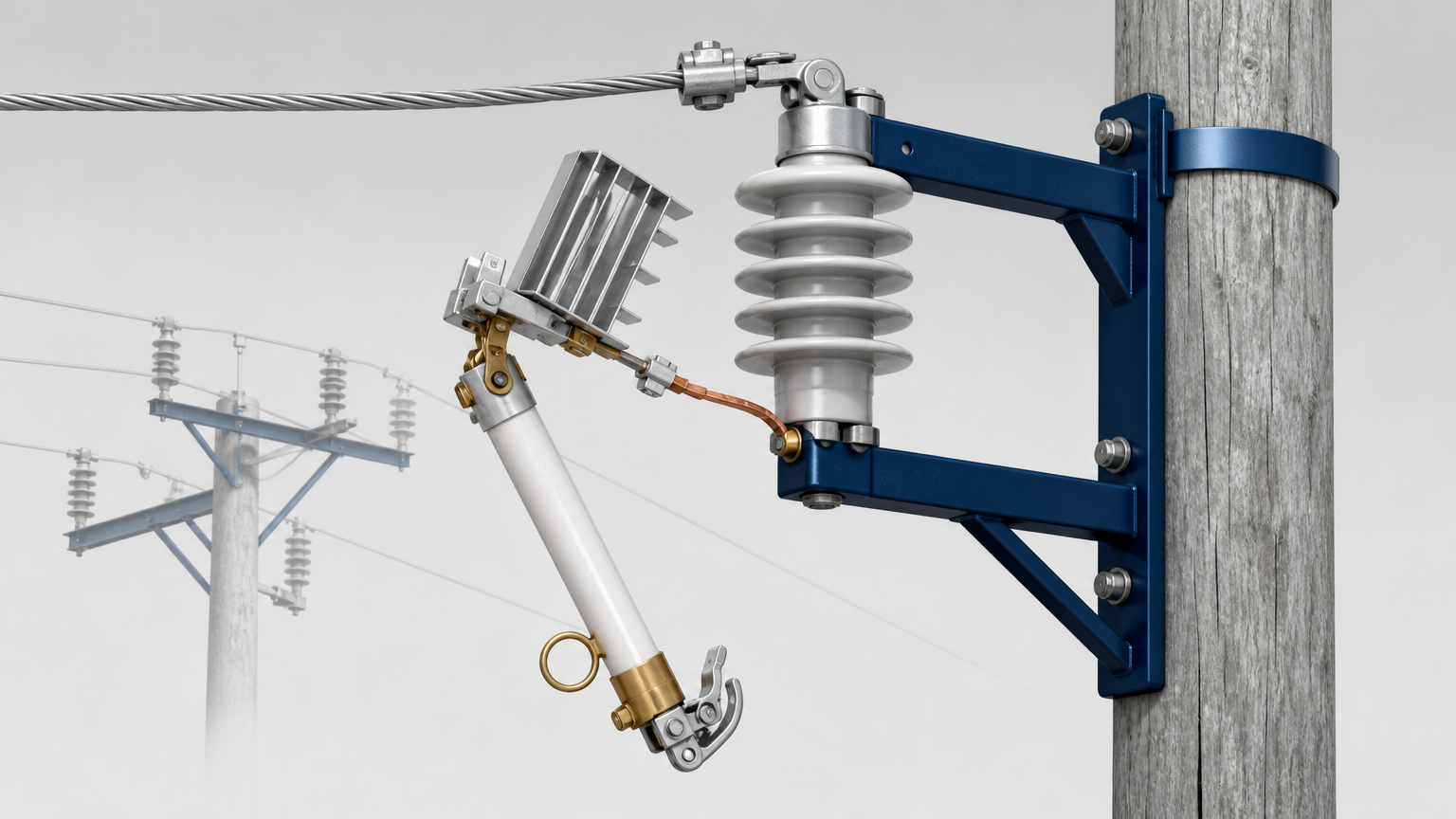
A drop-out fuse cutout (also called a fuse cutout or expulsion fuse) is a combination of a fuse holder and an insulating mounting. The fuse link sits inside a fuse tube — a fibre or composite tube with metal contacts at both ends — which is held between two contact jaws on a porcelain or composite insulator. One jaw holds the upper contact; the other holds the lower, hinged end of the tube.
Under normal conditions the tube stays latched in place, carrying current through the fuse link. When a fault blows the link, the tube disengages from the upper contact and swings down on its hinge — the "drop-out" — opening a visible air gap and isolating the circuit.
How an Expulsion Fuse Works
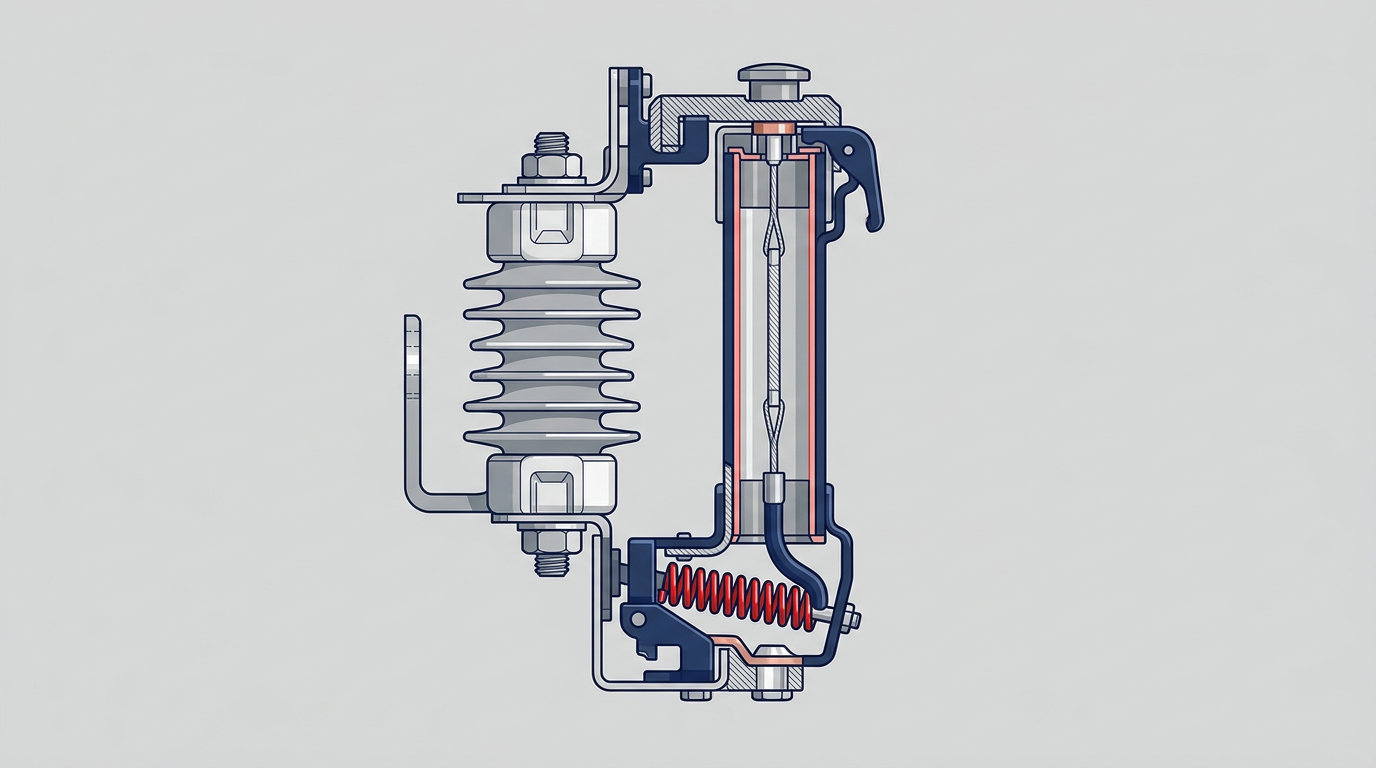
The fuse link is a thin element sized to melt at a defined overcurrent. When it melts, an arc forms inside the tube. The tube lining — traditionally a fibre that releases gas when heated — generates high-pressure gas that blows the arc out violently. This "expulsion" extinguishes the arc and interrupts the fault current.
The sequence is fast and entirely self-contained:
- Overcurrent melts the fuse element
- The arc inside the tube is blasted out by gas pressure
- The tube's upper contact releases and the tube drops open
- A visible air gap isolates the circuit until the link is replaced
Types of Fuse Cutouts
Cutouts are classified by their application and mounting:
- Distribution cutouts — the standard pole-mounted type protecting transformers, capacitor banks and line taps; single- or three-phase
- Power (substation) cutouts — larger units with higher interrupting ratings for substation and heavy-duty circuits
- Open vs enclosed types — open cutouts for outdoor poles, enclosed or oil-immersed types for indoor and underground applications
- Porcelain vs composite insulation — porcelain for proven toughness, composite (polymer) for lighter weight and better pollution performance
Insulation level follows the system: 10 kV and 35 kV classes cover the distribution voltages NAHU serves, with the cutout's BIL (basic insulation level) matched to the network.
How to Select a Fuse Cutout and Fuse Link
Selection is two separate decisions: the cutout itself, and the fuse link inside it.
For the cutout, match:
- Rated voltage — 10 kV or 35 kV class matching the system
- Rated current — the continuous current rating (e.g. 100 A, 200 A) above the circuit's maximum load
- Interrupting rating — the maximum fault current the cutout can clear safely; must exceed the maximum fault level at the installation point
For the fuse link, the rule is coordination, not guesswork:
- Transformer protection — the link must carry the transformer's full-load current plus inrush (typically 1.3–2 times full load), yet melt before transformer damage on faults
- Upstream coordination — the link must blow before the feeder breaker or upstream fuse, so only the faulted transformer is isolated
- Downstream coordination — must not blow for load-side momentary currents
Manufacturers publish time-current curves for every link size; the selection is done by plotting the transformer's inrush and the upstream protection onto those curves.
Installation and Replacement with a Hot Stick
Cutouts are designed for live-line operation: crews open and close them with a hot stick without de-energising the line. Installation rules are simple but strict:
- Mount the cutout vertically, with the hinge at the bottom and enough clearance for the tube to drop fully
- Keep the required phase-to-phase and phase-to-ground clearances
- After any operation, verify the tube is seated correctly in the upper contact and the link is intact
- Never close a cutout onto a circuit with a known fault — locate and clear the fault first
Maintenance and Inspection
Cutouts fail in predictable ways, so patrols should check:
- Contact condition — burned, pitted or corroded contacts increase resistance and can overheat under load
- Fuse tube condition — cracked, eroded or moisture-affected tubes must be replaced
- Insulator integrity — cracked porcelain or damaged composite sheds
- Latch and hinge operation — a stiff latch can prevent drop-out, leaving a dangerous condition
Fuse links have a shelf life too: keep them dry, use fresh stock, and replace links that show corrosion or damage before energising.
Q&A
Question: Why does the fuse tube drop out after blowing?
Short answer: The drop-out mechanism creates a visible air gap so crews can identify the faulted phase from the ground and so the circuit is physically isolated until the link is replaced.
Question: How do I size the fuse link for a transformer?
Short answer: Carry full-load current and transformer inrush, but melt before transformer damage; verify by plotting the link's time-current curve against the transformer's inrush and the upstream protection.
Question: Can a fuse cutout be operated under load?
Short answer: The cutout is rated to break load current up to its rating and is operated with a hot stick; never operate it to clear a fault or with an unknown fault downstream.
Question: What is the difference between a fuse cutout and a circuit breaker?
Short answer: A cutout is a sacrificial, single-shot fuse that must be re-fused after operation; a circuit breaker re-closes automatically and clears repeated faults, at a much higher cost.
Nahu Group (NAHU Electric) manufactures high-voltage drop-out fuse cutouts for 10–35 kV pole-mounted distribution — reliable overcurrent and short-circuit protection with easy hot-stick replacement. For ratings, time-current curves and coordination support, see our drop-type fuse range, or contact our engineering team.
Published August 12, 2026 · Nahu Group (NAHU Electric Technology)