
An earthing switch interlock exists to enforce one order of operations, and it fails as a protection if any single condition can be bypassed. The switch cannot tell whether the cable is live, so the enclosure, the mechanism and the key exchange have to prove it before the earth is applied.
What Does the Earthing Switch Interlock Actually Prevent?
It prevents two events that look different on a drawing but come from the same mistake, a switching operation performed in the wrong order. The first is earthing a circuit that is still live, which turns the switch into a fault-making device under conditions nobody designed for. The second is energising a circuit that is still earthed, which is a deliberate three-phase short circuit through the switch and the earth bar.
Both are switching errors, not equipment failures, which is why the countermeasure is a logic rather than a rating. A 12 kV earthing switch range can be perfectly rated and still be dangerous if the logic only works in one direction: an arrangement that stops the earth being closed on a live section, but allows the section to be energised with the earth still closed, is a design defect and not a compromise.
Which Five Conditions Must Be Proved Before the Earth Goes On?
The five conditions below are the ones that recur in utility switching schedules. Each has a mechanical, electrical or key-based way of being enforced.
| # | Condition to be proved | What it prevents | How it is normally enforced |
|---|---|---|---|
| 1 | Interrupting device is open | Earthing a loaded or faulted circuit | Mechanical interlock with the breaker or switch mechanism |
| 2 | Isolating device is open, visible break established | Earthing a section still connected to a source | Interlock with the disconnector; three-position mechanism on combined designs |
| 3 | Section proved de-energised at the point of earthing | Earthing a back-fed or induced-voltage cable | Voltage presence indicator plus a live-line detector at the cable end |
| 4 | Earth switch closed before compartment access | Access to a compartment that is not earthed | Key exchange or mechanical shutter linked to the switch position |
| 5 | Earth switch open before the disconnector or breaker closes | Energising an earthed section | Reverse-direction interlock, the one most often missing |
Condition 3 is the one a drawing cannot enforce, and it is where site practice matters more than the panel. A voltage presence indicator tells the operator that the cable side is dead at the panel, not that the remote end has been earthed by a line crew.
Two cases defeat the assumption that an open breaker means a dead circuit: a cable back-fed from a generator or from a second feeder at the far end, and an induced voltage on a long circuit parallel to a loaded line. Both call for earthing at the point of work.
What Is the Correct Sequence From Service to Earthed?
The sequence is short, and every step exists because skipping it creates a specific hazard. Written as a switching schedule, it reads like this:
| Step | Action | What must be true before it |
|---|---|---|
| 1 | Transfer or shed load, then open the breaker or load break switch | Load current accounted for at the upstream node |
| 2 | Open the disconnector to create the visible break | Interrupting device proved open |
| 3 | Prove the section de-energised at the earthing point | Voltage indication absent, detector tested on a known live source first |
| 4 | Close the earthing switch | Steps 1 to 3 complete, and the switch is fault-making where the cable can be back-fed |
| 5 | Release the key, open the compartment, work | Earth switch closed and its position indicator visible |
Restoring service runs the same list backwards, and that is where the reverse interlock earns its place: the earth switch must be open before the disconnector closes, and the disconnector must be closed before the breaker closes. Every step in the reverse direction is a condition in the logic, not an operator reminder.
Which Step Order Causes the Accident?
Four order-of-operation errors account for most incidents that reach an investigation report:
- Energising with the earth closed. The reverse interlock was absent or defeated, and the closing operation put a three-phase fault on the source. This is the error that damages the switchgear and injures the operator beside it.
- Opening the disconnector on load. The disconnector has no breaking capability, so the arc transfers to the air gap. It happens when a load break switch was left out of the scheme; the boundary between the two duties is set out in whether a disconnect switch can break load current.
- Earthing without proving dead. A back-fed cable, a paralleled feeder or an induced voltage on a long parallel run defeats the assumption that an open breaker means a dead circuit.
- Access without earth. The key was released before the earth switch closed, usually because the key exchange was added after the panel was designed rather than built into it.
The standard has moved in the same direction as this list. The current edition of IEC 62271-102 adds withstand requirements for interlocking devices and a subclause for testing mechanical interlocks, so the earthing switch interlock is a rated, testable function rather than an accessory bracket. How the ratings themselves are read is covered in the earthing switch rating and selection guide.
How Is the Earthing Switch Interlock Proved at Commissioning?
The place of the interlock inside the assembly is fixed by IEC 62271-200: compartment access, shutter operation and the earth switch position are one arrangement, not three independent fittings.
An interlock that has not been deliberately operated in the wrong order has not been tested. Do the following on every bay before energisation, with the circuit isolated:
| Test | Method | Acceptance |
|---|---|---|
| Earth closed, attempt to close the breaker | Operate the closing mechanism by hand or by test supply | Closing is blocked mechanically; no trip coil energises |
| Breaker closed, attempt to close the earth switch | Operate the earth switch lever with normal force | Blocked before the contact makes; no partial travel |
| Disconnector closed, attempt to close the earth switch | Repeat at each earth switch position | Blocked; interlock not defeated by lifting the lever |
| Key exchange | Follow the key schedule through a full earth and restore cycle | One key released only when the earth is closed; no duplicate |
| Earth continuity through the switch | Low-resistance measurement across the closed contacts to the main earth bar | Within the value stated in the specification |
| Position indication | Compare the mechanical indicator with the actual contact position | Reads open when open, closed when closed, at both ends of travel |
Record each attempt, including the ones correctly refused. The commercial consequence of a missing reverse interlock is never the cost of the interlock. It is the bay rebuild after a three-phase fault, the weeks of delayed energisation, and the liability question that follows an injury. That asymmetry is why the logic belongs in the technical evaluation, next to the ratings; the bonding side of the same installation is covered in switchgear earthing and bonding practice.
What Should the RFQ and Datasheet State?
The earthing switch interlock is a requirement that has to be written, not inferred from a general arrangement drawing. Five lines cover it:
- Rated voltage, short-time withstand current and short-circuit making current of the switch, with the class of making duty required where the cable can be back-fed.
- Type of interlock: mechanical only, mechanical plus key exchange, or mechanical plus electrical, named per bay rather than for the panel as a whole.
- Both directions, stated explicitly: earth cannot close on a live or connected section, and the section cannot be energised with the earth closed.
- Access logic: which compartment doors or shutters the earth switch position governs, and what the key schedule looks like.
- Documents: type test report covering the interlock, functional test record, and drawings showing each blocking element.
Where Nahu Group Fits
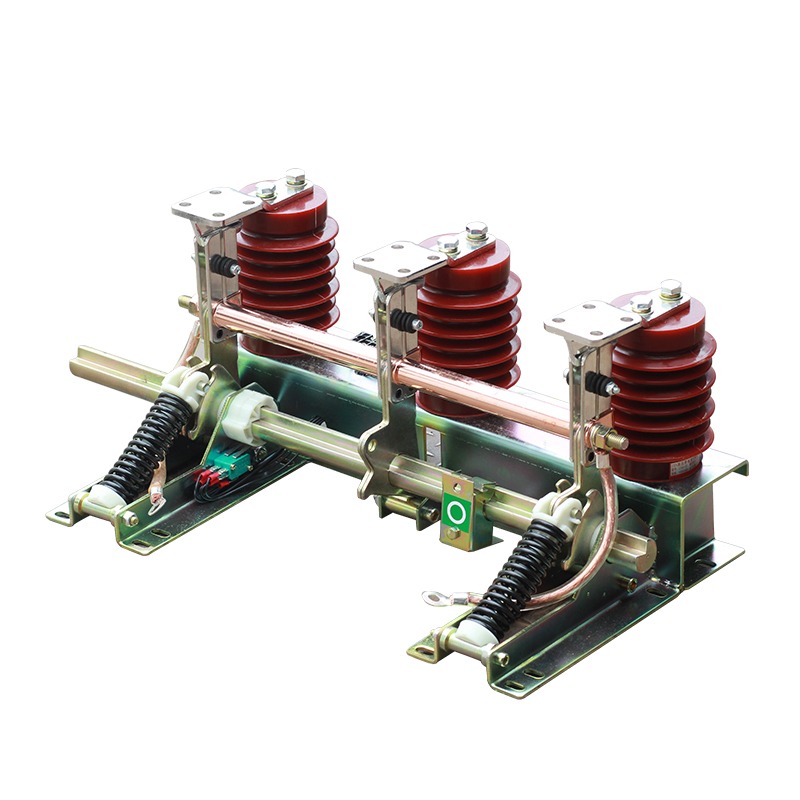
Nahu Group supplies the JN15-12/31.5 indoor earthing switch as a separate three-pole device for 3 to 12 kV switchgear, with a rated short-time withstand current of 31.5 kA and a defined closing capability, mounted in the cable compartment and interlocked with the panel's switching device. For projects that combine the earthing function with the feeder, the same requirement is written into the metal-clad distribution cabinet specification.
To get a configuration, send the single-line diagram, the switching device arrangement per bay, the interlock logic required, the short-circuit level, the compartment access arrangement and the key schedule. The interlock drawing is issued for approval before manufacture, so the sequence can be reviewed while it is still a drawing.
Frequently Asked Questions About the Earthing Switch Interlock
What is an earthing switch interlock?
It is the mechanical, key-based or electrical logic that stops an earthing switch closing unless the circuit is isolated and proved dead, and stops the circuit being energised while the earth is applied.
Can an earthing switch clear a fault once it is closed?
No. It carries short-circuit current for the rated duration but does not interrupt it. A fault-making earth switch can close onto a live circuit, which is why that closing capability is rated and type tested separately, but clearing the fault remains the job of the upstream breaker.
Why is a one-way interlock considered a defect?
Because it protects the operator applying the earth and not the one who later closes the breaker. If the panel allows the circuit to be energised with the earth still closed, the most damaging of the five conditions is left unenforced, and a routine switching error becomes a three-phase fault at the source.
How is the interlock tested at commissioning?
By attempting each wrong-order operation deliberately and recording the refusal: earth closed then attempt to close the breaker, breaker closed then attempt to close the earth, and the full key exchange cycle. A test record that lists only the successful operations does not demonstrate the interlock.
Does the interlock replace a switching schedule?
No. The interlock enforces the part of the sequence that happens inside the enclosure. Proving the cable dead at the far end, coordinating with a line crew and earthing at the point of work are outside its reach, so the written schedule remains the controlling document for the operation.
Sources and Further Reading
- IEC 62271-102:2018 — High-voltage switchgear and controlgear, Part 102: Alternating current disconnectors and earthing switches — the making and breaking duties of an earthing switch, its endurance classes, and the requirements and tests for interlocking devices
- IEC 62271-200:2021 — High-voltage switchgear and controlgear, Part 200: AC metal-enclosed switchgear and controlgear for rated voltages above 1 kV and up to and including 52 kV — how earthing, compartment access and shutters are interlocked inside the assembly, and what the type tests have to demonstrate
Published Nov 11, 2026 · Nahu Group (NAHU Electric Technology)