
Condensation in switchgear is water that forms inside an enclosure when the air next to a cold internal surface falls below its dew point. It is not water that came through the door seal. A medium-voltage cabinet is a gasketed steel box holding a volume of air, and that air carries water vapour. When the steelwork cools faster than the air around it, the vapour next to the steel condenses out as droplets, and the process repeats every night the cabinet cools. The enclosure can be perfectly sealed and still be wet inside.
This matters because the damage happens before anyone sees standing water. A damp dust layer on a busbar support is a conductive path. A corroded bolted joint is a hot joint. A fogged inspection window hides the fault indicator that was supposed to show the fault. By the time water is visible in the cable box, the insulation surfaces above it have been cycling wet and dry for months.
This guide explains where the moisture comes from, which compartments collect it first, why an ingress protection rating does not address it, and the lines that make anti-condensation provision verifiable in a specification rather than a line item added after the quotation.
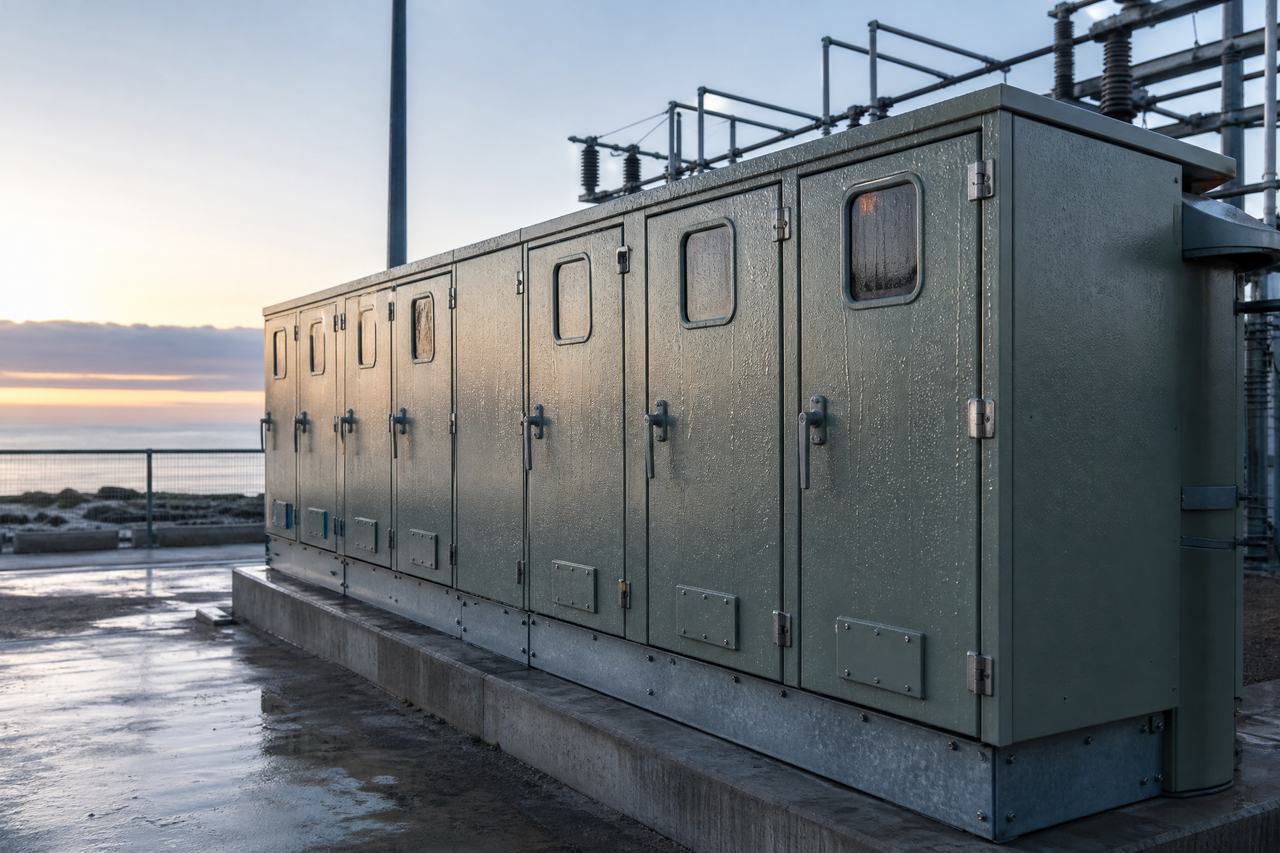
Why Does a Sealed Enclosure Collect Water?
Air holds water vapour in proportion to its temperature. Warm air holds more; cold air holds less. As STEGO puts it in its own explanation of enclosure heating, the warmer the air the more humidity it can contain, and when it cools the humidity is precipitated onto surfaces. The temperature at which that precipitation begins is the dew point, and everything about condensation control follows from it.
Two numbers make the margin concrete. Axair uses a control cabinet at 27 C and 75 percent relative humidity: drop the temperature to 22 C or below and condensation starts inside the enclosure. ElectraCOOL publishes the same relationship as a table, where air at 25 C and 75 percent relative humidity has a dew point of 20.3 C. In both cases the air does not have to cool very far. On a coastal site the night-time drop is larger than that every clear night.
Inside a sealed cabinet the absolute amount of water is fixed, so cooling does not add moisture. What changes is the capacity of the air to hold it. The consequence is counter-intuitive and worth stating plainly: the cabinet that is tightest against rain is often the one that stays wettest, because the moisture sealed in at assembly, or drawn in through cable entries during a pressure change, has nowhere to go.
Three further effects decide which surface wins the race to the dew point. Thermal mass matters, so thin sheet steel and small terminal boxes cool first. Radiant loss matters, so an enclosure wall facing a clear night sky drops below air temperature. And de-energisation matters, because a cabinet that has been carrying load is warm, and switching it out for maintenance in cool, humid weather turns the whole interior into a condensing surface at once.
Where Does Condensation in Switchgear Actually Form?
The water does not distribute itself evenly. It collects where cold steel meets humid air, and those places are predictable on a distribution cabinet.
- Cable compartment. The largest cold steel area, the closest contact with the ground and the cable trench, and the compartment with the most entries. Droplets form on the partition and run down toward the terminations and the earthing switch.
- Insulator and busbar-support surfaces. Epoxy and porcelain surfaces collect dust, and damp dust is the mechanism by which a clean-looking support becomes a tracking path.
- Instrument transformer terminal boxes. Small volume, thin walls, mounted on the outside of the enclosure, so they follow ambient temperature closely while the current transformer inside does not.
- Mechanism and operating boxes. Springs, cams, latches and auxiliary contacts are machined surfaces with little clearance. Corrosion here does not merely look bad, it changes operating force and timing.
- Low-voltage and relay compartment. The electronics are the least tolerant occupant of the cabinet and usually sit in the compartment with the smallest thermal mass.
- Outdoor metering and branch enclosures. Solar gain by day and radiant loss by night produce the largest internal temperature swing of any enclosure on the network.
Note what is not on that list. The sealed gas compartment of a ring main unit is not the problem, and neither is the vacuum interrupter. The problem is the air space inside the enclosure that surrounds them, and the surfaces that air touches.
What Does Moisture Damage Before It Is Visible?
GoSwitchgear's summary of the failure modes is a useful checklist because it separates the electrical consequences from the mechanical ones: progressive loss of component performance, heat build-up as resistance rises, short-circuit risk where the moisture film carries impurities, corrosion of the enclosure and the equipment inside it, shock risk to maintenance staff, frost in freezing conditions, and mould growth. Each of those has a different inspection signature.
The electrical mechanism deserves a sentence of its own. Water alone is a poor conductor, which is why a wet busbar does not simply fail on contact. The risk comes from what the water dissolves and carries. Dust, salt and metal salts from corrosion form a film along an insulating surface, and once that film bridges enough of the creepage path the surface tracks. That is why the inspection that matters is not whether the cabinet is dry today, but whether the insulating surfaces are clean and whether the environment keeps them dry.
The mechanical signature is quieter. Hinges stiffen, latch clearances close up, auxiliary contact resistance drifts, and a mechanism that was set at commissioning no longer closes at the same speed. None of that announces itself. It shows up as a breaker that operated correctly in every test until the day it did not.
Symptom, Mechanism and the Control That Fits
The table below maps what an inspector sees to what is happening and to the measure that addresses the cause rather than the symptom.
| What is happening | Control that addresses it | |
|---|---|---|
| Droplets on the inside of door panels and partitions | Internal air is at or below its dew point while the steel is colder still | Raise surface temperature above the dew point with a controlled heater |
| Damp dust on busbar supports and insulators | Hygroscopic dust holds moisture against an insulating surface and forms a leakage path | Clean surfaces, seal entries and keep the compartment above dew point |
| White or green corrosion at bolted joints | Moisture plus dissimilar metals at a contact surface, raising joint resistance | Correct plating and joint treatment, plus humidity control |
| Fogged inspection window | The window is the coldest transparent surface and condenses first | Heater with air circulation, or a heated window where visibility is critical |
| Relay or meter failures after a cold snap | Electronics in a low thermal mass compartment condense before the cabinet warms | Separate compartment control, or heater sized for the whole enclosure |
| Water standing in the cable box | Condensate from the compartment above has run down and collected at the lowest point | Drain provision, sealing of entries, and elimination of the condensing surface |
Heater, Dehumidifier or Ventilation: Which One Do You Need?
There are four practical families of control, and they are not interchangeable.
An enclosure heater
A heater raises the temperature of internal surfaces so that the local air can no longer reach its dew point there. STEGO describes the three forms that have become standard: a convection heater that warms the air around its body and relies on the chimney effect to circulate it, a fan heater that adds forced circulation and higher output in the same footprint, and a contact heater clamped against the enclosure wall for cabinets too densely packed for a free-standing body. For a tall distribution cabinet the fan type distributes heat more evenly, which matters because the goal is every surface, not the average air temperature.
Axair adds the control detail that decides whether the heater works: a PTC element reduces its own consumption as its temperature rises, so it cannot overheat the cabinet, and it is switched either by a hygrostat, which measures relative humidity directly, or by a normally closed thermostat set to the conditions of the site. The hygrostat is the more direct instrument; the thermostat is the cheaper one and is adequate where the humidity is stable.
Ventilation
A filtered fan removes heat and equalises the internal air with the outside. On a hot dry site that is exactly right. On a humid site it can be exactly wrong, because it replaces dry internal air with humid external air and accelerates the problem it was meant to solve. GoSwitchgear makes the same point from the other direction: ventilation helps where the issue is heat build-up, and the humidity level should be monitored so that ventilation runs when it is useful rather than continuously.
Dehumidification and desiccants
A dehumidifier removes water from the air rather than raising the surface temperature, which is the better match where the enclosure must stay close to ambient. Desiccant packs work on the same principle with no power, but GoSwitchgear notes the operational catch honestly: they saturate, and replacing them is site labour that has to be scheduled or it stops happening. That is a maintenance commitment, not an installation detail.
Air conditioning
Where the ambient routinely exceeds 40 C, as it does in Gulf summers, cooling rather than heating becomes the primary need. GoSwitchgear recommends air conditioning for enclosures in those conditions and adds the caveat that humidity still has to be managed, because cooling introduces a new cold surface. ElectraCOOL's guidance on the same problem is practical: the cold-side heat sink is the coldest point in the enclosure, so mount the unit on a door or side wall where condensate can be kept away from the electronics, and add a drip tray below it.
How Do You Stop Condensation in Switchgear With a Heater?
A heater is easy to install badly. Five rules cover most of the failure modes.
- Target surfaces, not air. The setpoint should keep the coldest internal surface above the dew point of the enclosed air, which is a different objective from keeping the cabinet warm.
- Control on humidity where the swing is large. A hygrostat responds to the variable that causes condensation. A thermostat set a few degrees above the expected minimum is a workable proxy on a stable site.
- Place the heater low and clear. Convected heat rises, so a low mounting heats the whole volume; keep the body clear of wiring, plastic parts and instrument transformer secondary boxes.
- Dry the cabinet before sealing it. A heater cannot remove water held in a concrete plinth, in cable bedding compound or in a dust layer. Seal a damp cabinet and the moisture stays for the life of the installation.
- Size it for the enclosure, not the catalogue page. Ask for the calculation behind the wattage: enclosure surface area, material and insulation, coldest surface, design ambient and the dew point the site actually reaches.
One interaction is worth flagging because it is counter-intuitive: improving the ingress protection makes the condensation problem worse unless the heater provision improves with it. A tighter enclosure exchanges less air with the room, so moisture that enters during installation stays longer. The IP rating guide makes the same point about what an IP number does and does not cover.
What Changes on a Gulf or Coastal Site?
High absolute humidity, a large day to night swing, intense solar gain on outdoor enclosures and salt in the air combine into the worst case for condensation in switchgear. The cabinet is heated by the sun during the day, which drives moisture out of the insulation and into the internal air, and then cools rapidly after sunset, which drives that moisture onto the steel. The daily cycle does the work of a test chamber, four hundred times a year.
Three site measures change the outcome. A sunshade or double roof reduces the daytime peak and therefore the night-time swing. A coating system and gasket material selected for the corrosion class reduce the damage that damp air does while it is there, which is the subject of the coastal corrosion guide. And a controlled heater with a hygrostat, verified at commissioning, keeps the surfaces above dew point on the nights that matter.
There is one local trap worth naming: a heavily air-conditioned switch room can put a cabinet below the dew point of the room air whenever the door is opened. The cabinet is then colder than the air that enters it, and it condenses on contact. Where the room is cooled hard, the enclosure needs its own humidity control rather than relying on the room.
What Should the Specification Say?
Condensation control is usually lost between the enclosure datasheet and the site conditions, so it is worth writing down as clauses rather than leaving it to the supplier's standard fit.
- Site maximum and minimum ambient temperature, and the design relative humidity, stated as numbers rather than as a climate description.
- Whether the enclosure is indoor, outdoor, shaded or exposed, and whether it is de-energised for long periods.
- Anti-condensation provision: heater type and rating, control device and its setpoint, and the compartment it serves.
- Cable entry sealing method, and whether a drain or breather is fitted and where it discharges.
- Gasket material and coating system for the corrosion class of the site.
- Evidence at commissioning: heater operation test, control setpoint record and, where the site is critical, an internal humidity log over an agreed period.
That list is short, and each line is checkable. The alternative, which is what most projects do, is to accept whatever heater the enclosure comes with and discover the gap at the first rainy season. Condensation in switchgear is one of the few failure modes where the specification can be closed out with a calculation and a setpoint.
How Do You Verify the Provision Actually Works?
Commissioning checks for condensation control are cheap and rarely done. Confirm the heater draws current when the control device calls for it, and that it stops when it should. Record the thermostat or hygrostat setpoint against the site design conditions. Check that door gaskets compress evenly all round, because a single compressed-flat section is where the humid air enters. Confirm every cable entry is sealed and that any drain is clear and discharging outside the enclosure rather than into the trench.
For a site where condensation has already caused failures, a small logging hygrometer inside the enclosure for a few weeks is the only direct evidence available. It shows whether the internal relative humidity tracks the outside or stays under control, and it turns a debate about heater wattage into a measurement. The same logging approach is used for gas density monitoring on ring main units, where the density monitor guide covers the temperature compensation problem that makes a plain pressure gauge misleading.
Where Nahu Group Fits
Nahu Group builds metal-enclosed distribution cabinets, ring main units, outdoor metering boxes and cable branch boxes for 10 to 35 kV networks. For a humid or coastal project, the anti-condensation provision is part of the enclosure discussion rather than an accessory added after the drawing is approved, because the heater position, the control device and the cable entry sealing all change the internal layout.
The useful input from a buyer is therefore the site condition, not a heater part number: the ambient range, the humidity, whether the enclosure is shaded, and how long it will stand de-energised. With those, the enclosure configuration can be confirmed against the conditions it will actually see, and the cabinet range can be matched to the project rather than to a catalogue default.
Condensation is one of a small group of failures that cost nothing to prevent at the specification stage and a great deal to correct afterwards. It is also one of the few where the deciding evidence is a temperature and a humidity figure, and both can be asked for before the order is placed.
Frequently Asked Questions About Condensation in Switchgear
What causes condensation inside a sealed switchgear enclosure?
Water vapour already inside the enclosure. Air holds more vapour when it is warm, and when a surface cools below the dew point of that air the excess condenses on it. A gasketed door slows the exchange of air with the room, but it does not remove the moisture that was sealed in during assembly or carried in through cable entries.
Does a higher IP rating stop condensation?
No. An IP rating describes resistance to ingress of solid objects and water from outside. Condensation forms from moisture already inside the enclosure, so a tightly sealed cabinet can still collect water on its coldest surfaces.
Which part of a switchgear cabinet condenses first?
Whichever internal surface cools fastest and has the least thermal mass. In practice that is usually the cable compartment steelwork, the enclosure walls facing the outside, and the small terminal boxes of instrument transformers mounted on the enclosure.
Is a heater always the right answer?
Not always. A heater is the usual answer where the problem is cold surfaces at night or after de-energisation. Where the internal air is persistently humid because the enclosure is open to a damp room, ventilation, a dehumidifier or a controlled air conditioner may fit better. The correct choice follows from which surface is cold and where the moisture comes from.
Should the heater be switched by a thermostat or a hygrostat?
A hygrostat measures the variable that actually causes the problem, relative humidity, and switches the heater when it rises. A thermostat is a simpler proxy and is widely used. If the site has large day and night temperature swings, humidity control responds earlier than a temperature setpoint.
Can a heater dry out a cabinet that is already wet?
Only partly. A heater raises surface temperature and prevents further condensation, but water already absorbed into concrete plinths, cable bedding compound, paper insulation or dust layers has to be removed first. Sealing a damp cabinet and switching on a heater traps that moisture inside.
How is a heater sized for an MV switchgear cabinet?
From the enclosure surface area, its insulation and material, the coldest expected internal surface and the design ambient, with a margin so that surfaces stay above the dew point rather than merely above freezing. Ask the supplier to show the calculation for the specific cabinet rather than quoting a generic wattage.
What should be checked at commissioning?
That the heater and its control device actually operate, that the setpoint matches the site conditions, that door gaskets compress evenly, that cable entries are sealed, and that any drain or breather is clear. A short period of humidity logging inside the enclosure is the only direct evidence that the provision works.
Sources and Further Reading
- STEGO — Condensation in your control cabinet — the mechanism of condensation inside enclosures, and the three established heater types: convection, fan and contact
- Axair — Avoid condensation in enclosures — a worked cabinet example at 27 C and 75 percent relative humidity, the hygrostat and thermostat control options, and the self-limiting behaviour of PTC heaters
- ElectraCOOL — Condensation and your enclosure — the dew point table used in this article, plus insulation, temperature control and air circulation as the three levers
- GoSwitchgear — Protection from heat condensation in metal enclosures — the damage list, the ventilation and anti-condensation options, and the note that air conditioning becomes relevant above 40 C in Gulf conditions
Published October 22, 2026 · Nahu Group (NAHU Electric Technology)