
SF6 gas density is the mass of sulfur hexafluoride per unit volume inside a sealed compartment, and it — not the pressure gauge reading — is what determines the dielectric strength and arc-quenching capability of the insulation. A gas density monitor measures pressure and temperature together and converts the pair into a temperature-compensated density value, so that a cold morning does not look like a leak and a warm afternoon does not hide one.
In a ring main unit or a gas-insulated load break switch, that distinction is the difference between a maintenance visit and an unnecessary outage. Pressure moves with ambient temperature every day; density changes only when gas actually leaves the tank.
This guide explains how density monitoring works, what the alarm stages mean, how monitors are verified, what to specify when buying gas-insulated MV equipment, and where SF6 regulation is heading in Europe.
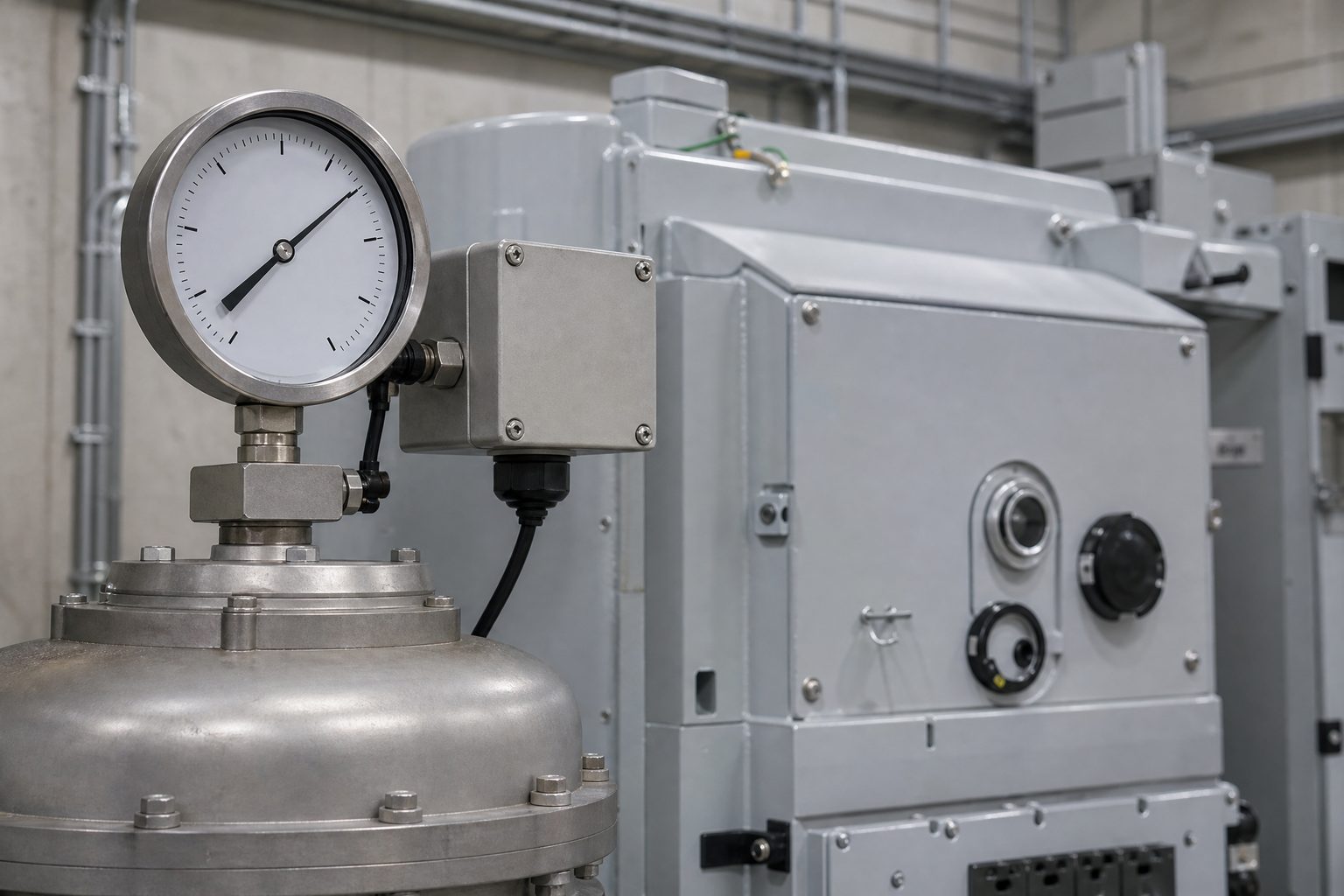
What Is SF6 Gas Density and Why Does It Matter?
Density is mass divided by volume. In a sealed gas compartment the volume is fixed and the mass only changes if gas escapes, so density is the one quantity that tracks the actual amount of insulating medium present.
That matters because the electrical performance of the compartment — dielectric strength between live parts and earth, and the arc-quenching capability of a gas-interrupting device — depends on how much gas is there, not on the pressure the gauge happens to show at the current ambient temperature. A tank that reads low on a cold night may be perfectly sound. A tank that reads normal on a hot afternoon may already have lost gas.
Pressure and density diverge because of a physical relationship that every operator eventually meets: at constant volume, the pressure of a gas rises in proportion to its absolute temperature. Any change in ambient temperature therefore produces a corresponding change in pressure while the density stays constant. A pressure-only instrument cannot tell the difference between that and a leak.
Why Does a Pressure Gauge Mislead on a Cold Morning?
Walk past an outdoor RMU at dawn in winter and the gauge will read lower than it did at midday yesterday. Nothing has escaped. The gas has simply cooled, and its pressure has followed.
The operational consequences run in both directions. A technician who treats the low reading as a leak may add gas to a compartment that was already correct, which is both an emissions event and a change to the equipment's gas inventory that now has to be recorded. A technician who has learned to ignore low readings in cold weather may dismiss a genuine slow leak in the same way. Neither error is visible in a single reading; both become obvious in a temperature-compensated density value.
This is why density monitoring is described as condition-based rather than preventive. The instrument is not checking a calendar; it is reporting whether the insulating medium is still there.
How Does a Temperature-Compensated Density Monitor Work?
A density monitor measures pressure and temperature and presents the result as a density referenced to a standard temperature. Four sensing technologies do this in current practice, and they differ in how the compensation is achieved rather than in the principle.
| How compensation is achieved | Practical consequence | |
|---|---|---|
| Bimetal element | A bimetallic strip between the movement and the measuring tube converts temperature change into a length change, so the dial stays steady while pressure varies | Simple, mechanical, local indication; only a genuine loss of gas moves the reading |
| Metal bellows with external probe | Temperature is measured directly in the gas tank by an external capillary sensor and used to compensate the bellows reading | Compensation follows the gas temperature rather than the instrument's surroundings |
| Reference chamber | A sealed compartment filled with SF6 acts as the benchmark; the measured density is compared against it | Because the reference is hermetic, ambient temperature and atmospheric pressure do not shift the result; no recalibration is required |
| Electronic sensor | A pressure transmitter with integrated temperature measurement calculates density electronically and outputs a signal | Suits remote monitoring, trending and integration with a substation control system |
The reference-chamber design deserves a note because it solves the problem structurally rather than computationally. If the reference gas sits in the same ambient as the measured gas, both experience the same temperature, and the comparison cancels the temperature effect without any electronics. That is why such switches are described as free of false alarms caused by environmental change.
What Do the Alarm Stages Mean?
Most density monitors provide at least two levels of alarm. The lower stage is a warning: density has fallen below a recommended level and maintenance should be planned. The upper stage is critical: density has reached a point where safe operation may no longer be guaranteed, and the appropriate action is to take the equipment out of service rather than to keep watching it.
The setpoints themselves are set by the equipment manufacturer, from the design margins and the requirements of the applicable standards. They are not universal numbers, and they should not be copied from one product to another. What a buyer can reasonably ask is that the setpoints be stated in the documentation, that the contacts be wired to alarm and trip as the scheme requires, and that the values be verifiable on site.
One practical point is often missed in commissioning: because the monitor reports temperature-compensated density, the alarm thresholds remain meaningful across the ambient range. An uncompensated pressure switch would drift with the seasons, which is exactly the failure mode the compensation exists to prevent.
For the switching-technology comparison that sits behind the same enclosure, see SF6 versus vacuum load break switches.
How Do You Verify a Density Monitor?
A monitor that is never verified is an assumption, not an instrument. Verification confirms that the sensor, the compensation and the alarm contacts all behave as intended at the specified density values.
- Simulate the density, do not remove the monitor. Test equipment exists that presents defined density conditions to the monitor in place, so the alarm points can be checked during commissioning or routine maintenance without dismantling the gas compartment.
- Isolate through a dedicated fitting. Verification normally requires the monitor to be isolated from the compartment using a lock valve or similar fitting. That allows testing without releasing SF6, which matters for both safety and environmental compliance.
- Record the measured alarm points. Best practice is to document the results, compare them with the manufacturer's specification, and repeat at defined intervals or after any work on the gas compartment.
- Set the interval deliberately. For critical assets, annual verification is a commonly recommended starting point, with additional checks after gas handling or major maintenance. The right interval for a given fleet depends on criticality and history, not on a single rule.
Warning signs that should trigger an inspection rather than a scheduled check include repeated false alarms, readings that disagree with a second instrument, and alarm behaviour that cannot be explained by temperature.
Density Monitor, Pressure Gauge or Pressure Switch: Which Do You Need?
The three devices look similar on a tank and behave very differently. The choice follows from what the scheme needs to know.
| What it reports | Temperature compensated | Typical role | |
|---|---|---|---|
| Pressure gauge | Raw pressure in the compartment | No | Local indication for filling and general observation |
| Pressure switch | A contact that changes state at a pressure threshold | No, unless specifically compensated | Simple alarm on equipment where seasonal drift is acceptable |
| Density monitor | Density referenced to a standard temperature, with alarm contacts | Yes | Alarm and lockout on gas-insulated MV equipment |
| Density transmitter | A continuous temperature-compensated signal | Yes | Remote monitoring, trending and SCADA integration |
For an RMU in an outdoor enclosure, the density monitor is the appropriate default because the ambient swings are exactly what an uncompensated device cannot handle. Where the scheme also wants trend data, a transmitter with a communication interface adds the history that turns a single alarm into a maintenance plan.
How the monitor sits within the enclosure depends on the RMU configuration itself, which is set out in ring main unit types and configurations.
What Should You Specify When Buying Gas-Insulated MV Equipment?
The monitoring package is part of the equipment specification, not an accessory to be settled later. Six items cover most of what matters.
- Monitoring type. Density monitor, transmitter, or both, and whether local indication is required in addition to contacts.
- Alarm stages and contact allocation. How many stages, what each one does, and which terminals they land on.
- Test provision. A lock valve or test point that allows verification in place without releasing gas.
- Gas tightness evidence. Tightness is part of the routine test regime for gas-insulated equipment, so the routine records should show it for each unit.
- Documentation. Setpoints, compensation reference temperature, contact ratings and the verification procedure, in the language of the destination market.
- Gas handling plan. Who supplies recovery and filling equipment, and what the procedure is for topping up a compartment on site.
Where Is SF6 Regulation Heading?
SF6 is a potent greenhouse gas, and European regulation has moved from handling rules to a phase-down of the gas as an insulating and breaking medium in new switchgear. As summarised in a September 2026 procurement guide, Article 13(9) of Regulation (EU) 2024/573 sets these dates for putting equipment into operation:
- 1 January 2026 — medium-voltage switchgear for primary and secondary distribution, up to and including 24 kV
- 1 January 2030 — medium voltage above 24 kV and up to and including 52 kV
- 1 January 2028 — high voltage above 52 kV and up to and including 145 kV at 50 kA, with a global warming potential of 1 or more
- 1 January 2032 — high voltage above 145 kV or above 50 kA, with a global warming potential of 1 or more
The same source notes exceptions, including orders placed before 11 March 2024 and certain procurement outcomes, and it points to a Commission FAQ for the detail. The practical message for a buyer outside Europe is narrower but still useful: SF6 equipment remains widely specified and supplied, and the direction of travel in the EU is toward dry-air and solid-insulation alternatives. Where a project may later be extended into a European market, that should be part of the specification conversation rather than a surprise at the border.
None of this changes the monitoring requirement. Whatever the insulating medium, the operator still needs to know how much of it is present, and the same pressure-versus-density logic applies to dry air and to gas mixtures.
How Does Density Monitoring Fit an RMU Maintenance Regime?
Gas-insulated MV equipment is largely maintenance-free in the way that vacuum switching is maintenance-free: there is little to adjust. What it needs instead is observation and record-keeping, and the density monitor is the primary observation point.
A workable regime has three layers. First, periodic reading of the density indication and comparison with the previous record, so a slow trend is visible before an alarm. Second, verification of the alarm contacts at a defined interval. Third, a documented response to each alarm stage — who attends, what is checked, whether gas is added, and how the addition is recorded. The third layer is the one most often missing, and it is the one that turns an alarm into an action.
Nahu Group manufactures gas-insulated medium-voltage distribution equipment, including the HXGN15-12 ring main unit and the FKN12A-12 compressed-air load break switch, for 10–35 kV networks. Where a project specifies density monitoring, the engineering team can confirm the monitoring arrangement, the alarm contact allocation and the documentation supplied with the equipment.
Frequently Asked Questions
What is SF6 gas density?
SF6 gas density is the mass of sulfur hexafluoride contained in a given volume inside a sealed compartment. Because the volume is fixed, density changes only when gas enters or leaves, which makes it a reliable indicator of how much insulating medium is actually present.
Why is density used instead of pressure?
Because pressure changes with ambient temperature even when no gas has escaped. At constant volume, pressure rises and falls in proportion to absolute temperature, so a pressure reading alone cannot distinguish a cold morning from a leak. Density, referenced to a standard temperature, can.
What is a temperature-compensated gas density monitor?
It is an instrument that measures pressure and temperature in the compartment and presents the result as a density referenced to a standard temperature. Compensation may be mechanical, through a bimetal element or a reference chamber, or electronic, through a sensor and evaluation circuit.
How many alarm stages does a density monitor have?
Most designs provide at least two: a warning stage indicating that density has fallen below a recommended level and maintenance should be planned, and a critical stage indicating that safe operation may no longer be guaranteed. The setpoints are determined by the equipment manufacturer, not by a universal standard value.
Can a density monitor be tested without removing it?
Yes. Test equipment exists that applies defined density conditions to a monitor in place, with the monitor isolated from the gas compartment through a dedicated fitting such as a lock valve. This allows the alarm points to be verified without releasing SF6.
How often should alarm setpoints be verified?
For critical assets, annual verification is a commonly recommended starting point, with additional checks after gas handling or major maintenance. The right interval for a specific fleet depends on criticality, service history and the manufacturer's instructions.
Is a pressure gauge enough for an RMU?
A pressure gauge gives useful local indication for filling and general observation, but it is not temperature compensated. On outdoor equipment with wide ambient swings, a density monitor or density switch is the appropriate device for alarm and lockout functions.
Does SF6 regulation affect new MV switchgear?
In the European Union it does. Regulation (EU) 2024/573 sets dates from which switchgear using fluorinated greenhouse gases as an insulating or breaking medium may no longer be put into operation, starting with medium-voltage distribution equipment up to 24 kV from 1 January 2026, with later dates for higher voltages. Other markets set their own rules.
Sources and Further Reading
- WIKA — Temperature-compensated gas density monitors for SF6 — the four sensing technologies and the reference-chamber principle
- DILO — SF6 gas density sensor and monitor: how temperature compensation works — density versus pressure, alarm stages, verification practice
- Sinospect — MV switchgear from China: a buyer's guide — Regulation (EU) 2024/573 Article 13(9) dates and routine test scope
- IEC 62271-100:2021 — sealing and tightness in the type and routine test regime
The instrument is small, but it is the only continuous statement about the condition of the insulating medium. Specify it deliberately, verify it on a schedule, and record what happens after each alarm — that sequence is what turns a gauge on a tank into an asset management input.
For 10–35 kV ring main units, gas-insulated load break switches and distribution switchgear, Nahu Group can confirm the monitoring arrangement and the documentation supplied for a project. See the switchgear range, or talk to the engineering team about the specification for your network.
Published October 18, 2026 · Nahu Group (NAHU Electric Technology)