
For an 11 kV three-core indoor termination on an 8.7/15 kV cable, a cold-shrink set with stress control built into the tube is the default answer: no flame, a radial pressure the fitter cannot get wrong, and roughly half the installation time of a taped termination. Every other choice is a variation on three variables — the cable's U0/U class, the pollution at the site, and whether the termination has to be unplugged again.
The five termination constructions in commercial use
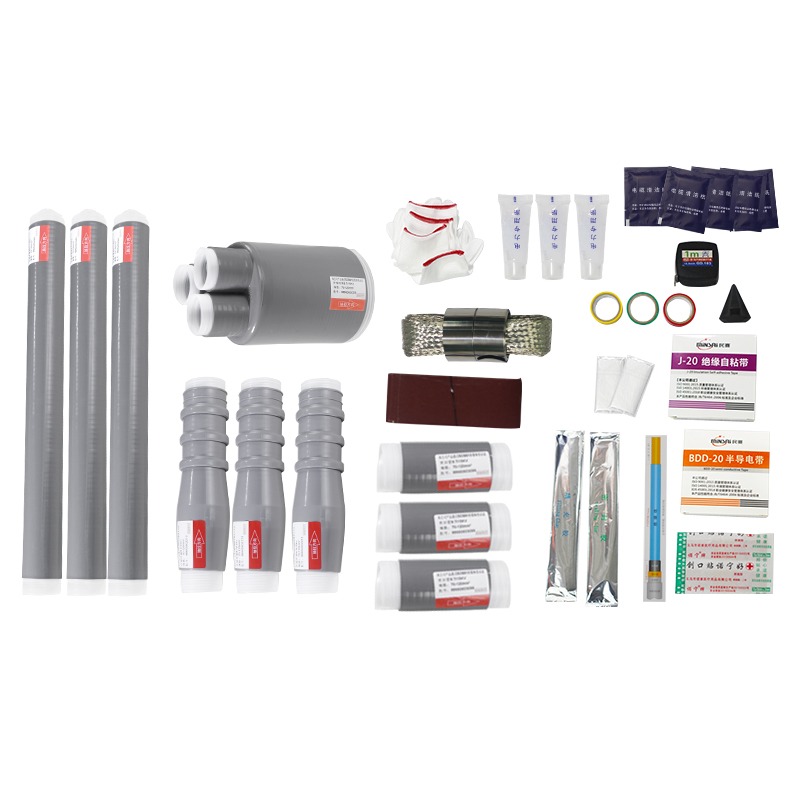
A termination is a function, not a product. It takes a screened, extruded-insulation cable and turns it into a terminal that can be bolted to a busbar, a transformer or a switchgear panel without the electric field at the end of the screen tearing the insulation apart. Five constructions do that job today, and they differ in two respects only: how the insulating body is applied to the cable, and how the field at the screen cut is controlled.
Those two differences decide everything a buyer has to live with — the voltage classes the construction can reach, the cable diameter window it accepts, whether the work needs a torch, and how much of the finished quality depends on the person holding the tool. The table below is the classification to copy into a comparison sheet; the sections after it take each criterion in turn.
| Construction | Insulating body and how it is applied | Stress control at the screen cut | Voltage classes in common use | Indoor / outdoor | Where it is the right answer |
|---|---|---|---|---|---|
| Cold-shrink | Silicone rubber tube, factory-expanded over a removable core; pulling the core lets the tube close onto the cable under its own elastic memory | Molded into the tube as a stress cone or high-permittivity layer; some kits add a stress-control tape | 0.6/1 kV up to 26/35 kV | Both; outdoor versions carry sheds | Flame-free work inside a panel, and a radial pressure that stays uniform for the life of the cable |
| Heat-shrink | Cross-linked polyolefin, expanded at manufacture and shrunk onto the prepared cable with a torch | Separate stress-control tube over the screen cut, with mastic filling the step | 0.6/1 kV up to 36 kV | Both | Crews and stores already standardized on it, and the site permits an open flame |
| Prefabricated (push-on) | One-piece molded EPDM or silicone body with sheds, pushed over the prepared cable with lubricant | Molded into the body, so the geometry cannot vary from fitter to fitter | 12 kV to 36 kV | Both, within the published size range | Large batches where every termination has to measure the same at inspection |
| Separable connector | Molded screened elbow or straight body that plugs onto a bushing and is secured against the panel | Molded into the connector body | 12 kV to 36 kV | Enclosed: indoor, or inside a kiosk or enclosure | Circuits that must be unplugged for testing, or where live working is part of the operating regime |
| Taped | Self-amalgamating and stress-control tapes built up by hand, then overcoated | Stress cone formed by hand from stress-control tape | LV, and legacy MV repair work | Both | Repair of an existing taped termination where no kit matches the cable |
Installation time and skill: where the real cost sits
The kit price is the smaller number in the comparison. The larger one is crew time plus the cost of a second attempt, and both are driven by the construction rather than by the voltage. The ranges below are planning figures for one three-core set on a 3 x 240 mm² 8.7/15 kV cable, with two fitters, the cable already prepared to the drawing and the lugs crimped separately. They exclude cable pulling, scaffolding and testing, and they assume the kit matches the cable — a mismatched kit has no meaningful installation time at all.
| Construction | Tooling it demands | Planning range per three-core set | Skill sensitivity | What forces a second kit |
|---|---|---|---|---|
| Cold-shrink | Core pull, no heat source, no fire watch | 1.5 - 2.5 h | Low to medium | Cable preparation dimensions missed, or a set chosen outside its diameter window |
| Heat-shrink | Torch, heat shield, fire watch, and a wind break outdoors | 2.0 - 3.5 h | Medium | Scorched or under-shrunk tube, or a stress-control tube fitted at the wrong height |
| Prefabricated (push-on) | Lubricant, pushing tool, clean handling | 2.5 - 4.0 h | Medium to high | Body not fully seated on the cable, or cable diameter outside the published range |
| Separable connector | Torque wrench, interface cleaner, bushing adaptor set | 1.0 - 1.5 h per phase | Medium | Connector interface does not match the bushing on the panel |
| Taped | Tapes, varnish, and a fitter who has done it before | 3.0 - 6.0 h | High | Hand-formed cone geometry outside tolerance, visible at the partial-discharge test |
On a fifty-set package, the spread between the fastest and slowest construction is several crew-weeks, which usually outweighs the difference in kit price. That is why the choice belongs in the method statement before the enquiry goes out, not in a site discussion after the drums arrive. If you need the labour side of a program assessed independently, the field test sequence in VLF testing of MV cables is the part that follows termination work on every commissioning schedule.
From 0.6/1 kV to 26/35 kV: what changes inside the set
A low-voltage set and a 26/35 kV set are not the same product at different scales. At 0.6/1 kV the insulation wall is thin and the electrical stress is modest, so the set is mostly mechanical: a tube that seals the cable end, phase identification, and a connection that keeps moisture out of the conductor. From 8.7/15 kV upward the set acquires a third job — controlling the field where the semi-conductive screen is cut back — and that is where the stress cone, the semi-conductive tape and the diameter window start to matter more than the tube itself.
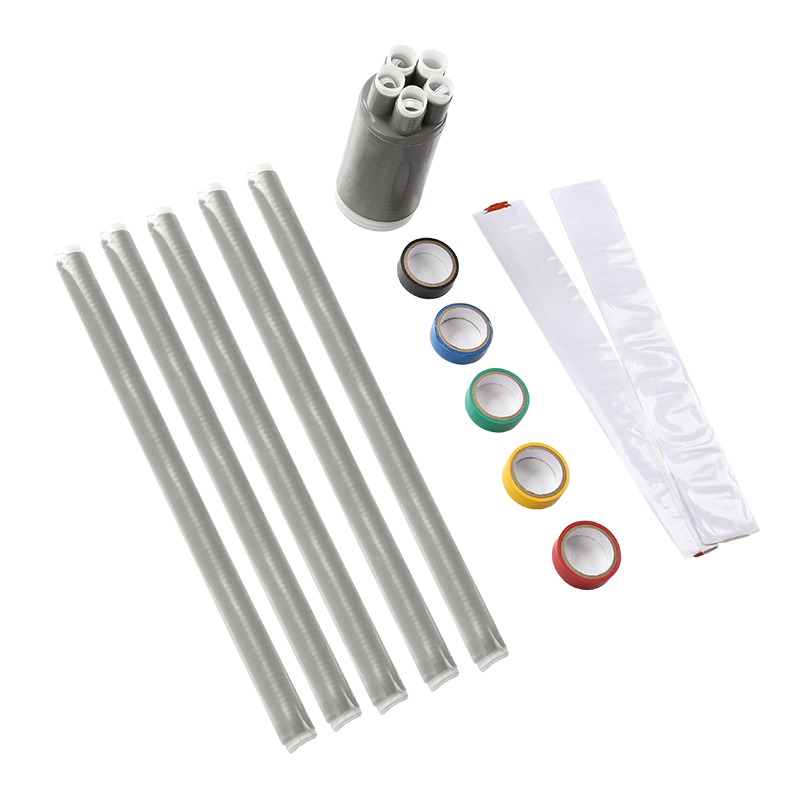
The published data makes the difference concrete. A 0.6/1 kV five-core set covers 10 mm² to 630 mm² in six sizes and weighs under 1.5 kg; a 26/35 kV three-core set covers 50 mm² to 800 mm² in six sizes and weighs around 9 kg, because the tubes, sheds and stress-control parts are dimensioned for a much thicker insulation wall. The set number, not the voltage, is what the store should receive.
| Cable class (U0/U) | Nahu set family | Sizes published | Cross-section range | Main insulation OD as published | Weight per set |
|---|---|---|---|---|---|
| 0.6/1 kV, five-core terminal | TLS1 | 5.0# - 5.5# | 10 - 630 mm² | 18.5 - 75 mm | 0.84 - 1.48 kg |
| 8.7/15 kV, three-core | WLS15 | 1.1# - 1.6# | 25 - 800 mm² | 21.8 - 56.0 mm | 1.76 - 2.17 kg |
| 26/35 kV, three-core | WLS35-3x | 3.1# - 3.6# | 50 - 800 mm² | 86 - 124 mm | 8.46 - 9.30 kg |
| 26/35 kV, single-core | WLS35-1x | 1.1# - 1.6# | 50 - 800 mm² | 38.6 - 70 mm | 3.04 - 3.37 kg |
Two consequences for the buyer. First, the cross-section range overlaps between classes while the diameter window does not, so a set cannot be moved from one cable type to another of the same size. Second, the diameter window is narrow by design: a cold-shrink tube has to close onto the cable with enough residual pressure to stay sealed for decades, and a set chosen at the edge of its range will either not seal or will not pass over the insulation. Send the cable's main insulation diameter, not just the cross-section. The mechanics of that joint are covered in the cold-shrink and heat-shrink comparison if the technology choice itself is still open.
Indoor, outdoor and pollution: the shed is a dimension
Indoor and outdoor versions of the same termination differ in one thing that matters commercially: the external creepage path. An indoor termination can be short, because the air around it is dry and clean by the standards of the installation. An outdoor termination has to carry sheds, and the number and profile of those sheds are set by how polluted the site becomes — coastal salt, cement dust, desert sand, or the exhaust of an adjacent diesel yard.
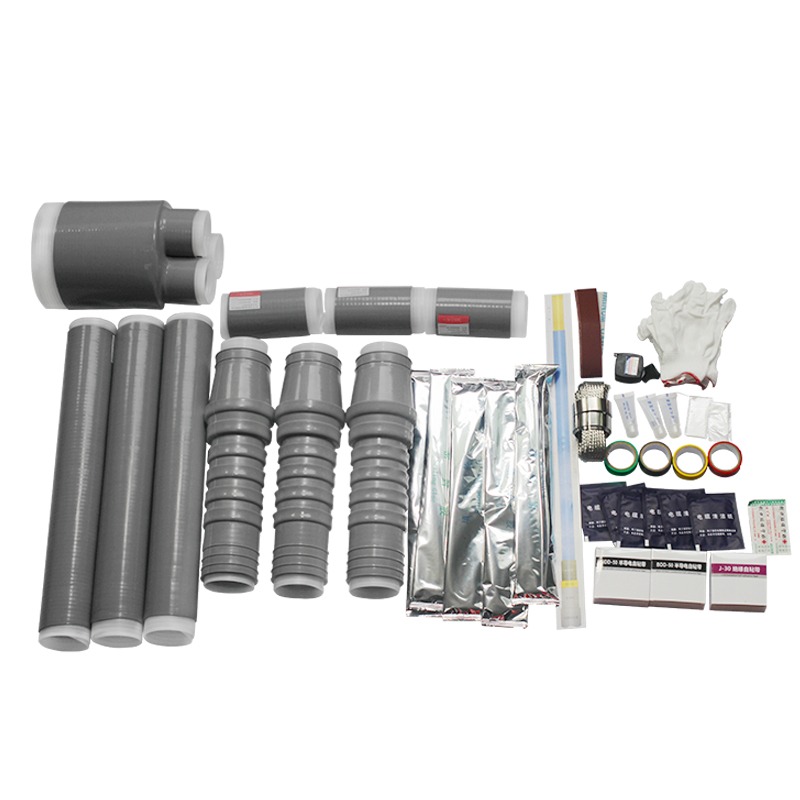
IEC TS 60815-1 treats that as a dimensioning exercise rather than a catalogue choice: it sets out how site pollution severity is characterized and how the required specific creepage distance follows from it, with corrections for shed profile, diameter and altitude. The practical instruction for a specification is therefore short. State the pollution level the site is designed to, require the creepage distance in millimeters to be written on the drawing, and refuse a termination whose shed count was copied from another project. A 26/35 kV indoor three-core set and its outdoor counterpart can look almost identical in a photograph and still be wrong for each other's location.
This is also where enclosure height becomes a constraint. Adding sheds to a termination increases its physical length, and in a compact panel that length competes with clearance to the earthed partition. If the panel drawing has a fixed terminal height, the shed profile has to be selected against that height before the kit is ordered, not after. Outdoor terminations on poles and in kiosks carry the same constraint against the cable box lid.
When the termination has to unplug: separable connectors
A separable connector is the construction to specify when the cable end has to come off the equipment without dismantling the cable. It plugs onto a bushing on the switchgear or transformer, is held by a mechanical device, and can be removed for a test, a fault search or a reconfiguration. That capability is why ring main units and compact substations use them almost exclusively above 12 kV, and why the same cable that would take a cold-shrink termination in a Panel A takes a connector in a Panel B.
The commercial risk sits in the interface, not in the connector. The bushing the connector plugs onto is defined by the switchgear, and its dimensions and screen arrangement are fixed by the standard the panel was built to, not by the cable accessory supplier. An enquiry that says "12 kV elbow connector, 3 x 240 mm²" without the panel make, the bushing type and the required interface will produce a connector that may not mate. Confirm the interface against the switchgear drawing, and order the connector and the bushing adaptor as one item.
Three criteria that decide the order
Work through them in this sequence, because each one narrows the field for the next.
- Voltage class. Read the cable's U0/U and Um from the cable datasheet, not the system voltage from the single-line diagram. An 11 kV system can carry 6/10 kV or 8.7/15 kV cable depending on earthing and fault duration, and the two need different kits.
- Pollution and location. Indoor or outdoor, pollution level, required creepage, and the physical height available at the terminal. This decides the shed profile and often the set family.
- Need to unplug. If the circuit must be disconnected for testing or live work, the answer is a separable connector and the discussion moves to the bushing interface. If not, a cold-shrink or heat-shrink termination will be cheaper and shorter.
For an 11 kV three-core indoor termination on an 8.7/15 kV cable, in a substation designed to a moderate pollution level, with no requirement to unplug, the three criteria converge on one answer: a cold-shrink three-core set sized on the cable's main insulation diameter, with the shed profile kept to what the indoor clearance allows. That is the case the WLS15 range is built for, and it is the case most distribution projects actually have.
Five specification mistakes and their commercial cost
These are the errors that appear repeatedly on enquiries and at inspection, and each has a cost that is easy to state in advance and hard to argue about afterwards.
- Ordering by system voltage. An "11 kV termination" is not a specification. The kit follows the cable's U0/U, and a 6/10 kV kit on 8.7/15 kV cable arrives with too little insulation wall to match the cable. Cost: rejected at inspection, full replacement, and a commissioning date moved.
- Sizing on cross-section alone. Two cables of 240 mm² from different manufacturers can differ in insulation diameter by several millimeters. Cost: tubes that will not pass over the insulation, or that close without sealing pressure.
- Mixing parts across technologies. A cold-shrink body with a heat-shrink stress-control part is an untested combination. Cost: no type-test reference, and a supplier who is entitled to decline the warranty claim.
- Using an indoor termination outdoors. No sheds, insufficient creepage, and the first fog or dust storm finds it. Cost: flashover, outage, and a replacement program across every pole on the feeder.
- Buying a connector without the bushing data. Cost: non-mating parts discovered on site, with the switchgear already energized elsewhere.
The common thread is that none of these mistakes is a manufacturing defect. They are purchasing decisions, and they are all avoidable with three lines of cable data and one line about the site.
What the RFQ and datasheet must state
Write these as requirements, and require the supplier to confirm each one in the quotation. A quotation that answers all of them is comparable with another supplier's; one that answers half of them is not.
- Cable data: U0/U and Um, number of cores, conductor material and cross-section, main insulation diameter, screen and armour construction, and the cable standard the cable was bought to.
- Location: indoor or outdoor, pollution level the site is designed to, required creepage distance, ambient temperature range, and the terminal height or clearance available.
- Connection: lug type and palm dimensions, pad spacing on the equipment terminal, and whether a separable connector is required — with the panel make and bushing interface if it is.
- Earthing: shield and armour bonding arrangement, earth lead cross-section, and whether a separate earth kit is in scope.
- Documents: accessory type-test report with the standard and edition named, routine or QC certificate per set, dimensional drawing for approval, and installation instructions in the language the crew reads.
- Packing and shelf life: sets per box, size marking on the outside, and the date code of the mastic and tape consumables.
Then write the acceptance step into the same document, because it is the only part of the specification that is checked after the crew has gone. On delivery: set number against the cable, consumable date codes, and the instruction sheet in the right language. After installation: shed alignment and phase marking, earth continuity from armour to the panel earth bar, and a partial-discharge measurement at the commissioning voltage. A termination that passes those three checks has been verified as a construction, not merely as a box that arrived on time.
Where Nahu Group Fits
Nahu Group manufactures cold-shrink cable terminals and joints for 0.6/1 kV to 26/35 kV cables, published with a set number, a cross-section range, a main insulation diameter window and a weight for every size, so the store receives an item that can be checked against the cable before it is opened. The range covers LV terminals in two-, three-, four- and five-core versions, 8.7/15 kV three-core indoor and outdoor sets, and 26/35 kV indoor three-core, outdoor three-core and outdoor single-core sets.
To get a configuration, send the cable datasheet page (U0/U, cores, cross-section, insulation diameter), the quantity per size, whether the termination is indoor or outdoor and the pollution level, and the terminal height or panel drawing if it is tight. That is enough to return a set number and a drawing for approval. The full list is on the cable accessories range page, and the two families used most often on 11 kV work are the WLS indoor and outdoor three-core set and the 8.7/15 kV three-core set. For low-voltage work the equivalent starting point is the 0.6/1 kV five-core terminal, and for 35 kV indoor panels it is the NLS-35 indoor three-core set.
Frequently Asked Questions
What are the main types of cable termination?
Five constructions are in commercial use: cold-shrink, heat-shrink, prefabricated push-on, separable connectors and hand-taped terminations. They differ in how the insulating body is applied and how the field at the screen cut is controlled. Voltage class, cable diameter window, indoor or outdoor use and installation time all follow from those two differences.
Is cold-shrink better than heat-shrink at 11 kV?
Neither is universally better. Cold-shrink removes the torch, gives a radial pressure that does not depend on how long the fitter heats the tube, and is faster on a three-core set. Heat-shrink is cheaper per kit and widely familiar to crews. For an indoor 11 kV three-core termination on 8.7/15 kV cable, cold-shrink is the usual specification.
Can an indoor termination be used outdoors?
No. The external creepage path of an indoor termination is too short for rain, condensation and airborne pollution, and it carries no sheds to break the surface path. Using one outdoors usually shows up as a flashover in fog or after a dust storm, by which time the whole feeder may need re-terminating.
What is a separable connector used for?
It connects a cable to switchgear or a transformer through a bushing, and it can be unplugged again. That makes it the standard choice where circuits must be isolated for testing, where the network is reconfigured, or where live working is part of the operating regime. Its dimensions follow the bushing, which is set by the switchgear standard.
How do I size a termination kit correctly?
Use three numbers from the cable datasheet: U0/U and Um, the conductor cross-section, and the main insulation diameter. The set number is fixed by the combination, not by the system voltage. Cross-sections overlap between voltage classes while diameter windows do not, so a set cannot be substituted from a different class of the same size.
Does a termination need a type-test report?
Ask for one, and ask which standard and edition it was issued to. Accessory type tests accompany the cable standard the system is built to, and a report for a different construction or a different cable class does not cover the kit you are buying. Routine or QC certificates per set should come with the delivery.
Sources and Further Reading
- IEC 60502-2:2014+AMD1:2024 — Power cables with extruded insulation and their accessories for rated voltages from 6 kV to 30 kV
- IEC TS 60815-1:2025 — Selection and dimensioning of high-voltage insulators for polluted conditions
- Nahu product datasheets: TLS1 0.6/1 kV five-core terminal, WLS15 8.7/15 kV three-core set, WLS35 26/35 kV three-core and single-core sets (cross-section, diameter window and weight per set as published).
- Related reading on this site: what an 11 kV termination kit contains, and how a joint kit differs from a termination.
Published Nov 19, 2026 · Nahu Group (NAHU Electric Technology)