
A busbar current rating is the continuous current a bar can carry while its temperature stays within the limit allowed for the assembly it sits in. That definition contains the whole problem. The rating is not a property of copper, or of a cross-section, or of a catalogue line. It is the outcome of a bar, a mounting arrangement, an ambient temperature and an allowable temperature rise, and changing any one of them changes the number.
This is why two suppliers can both quote a 1/4 by 1 inch copper bar and mean two different things. One is quoting a 30 degree rise figure, the other a 65 degree rise figure, and both are correct inside their own assumptions. The buyer who compares the numbers without the assumptions is comparing nothing.
The sections below set out what the rating measures, how the published tables are built, what alternating current does to the figure, what else inside a cabinet moves it, and the four questions that will expose a rating that was copied rather than calculated.
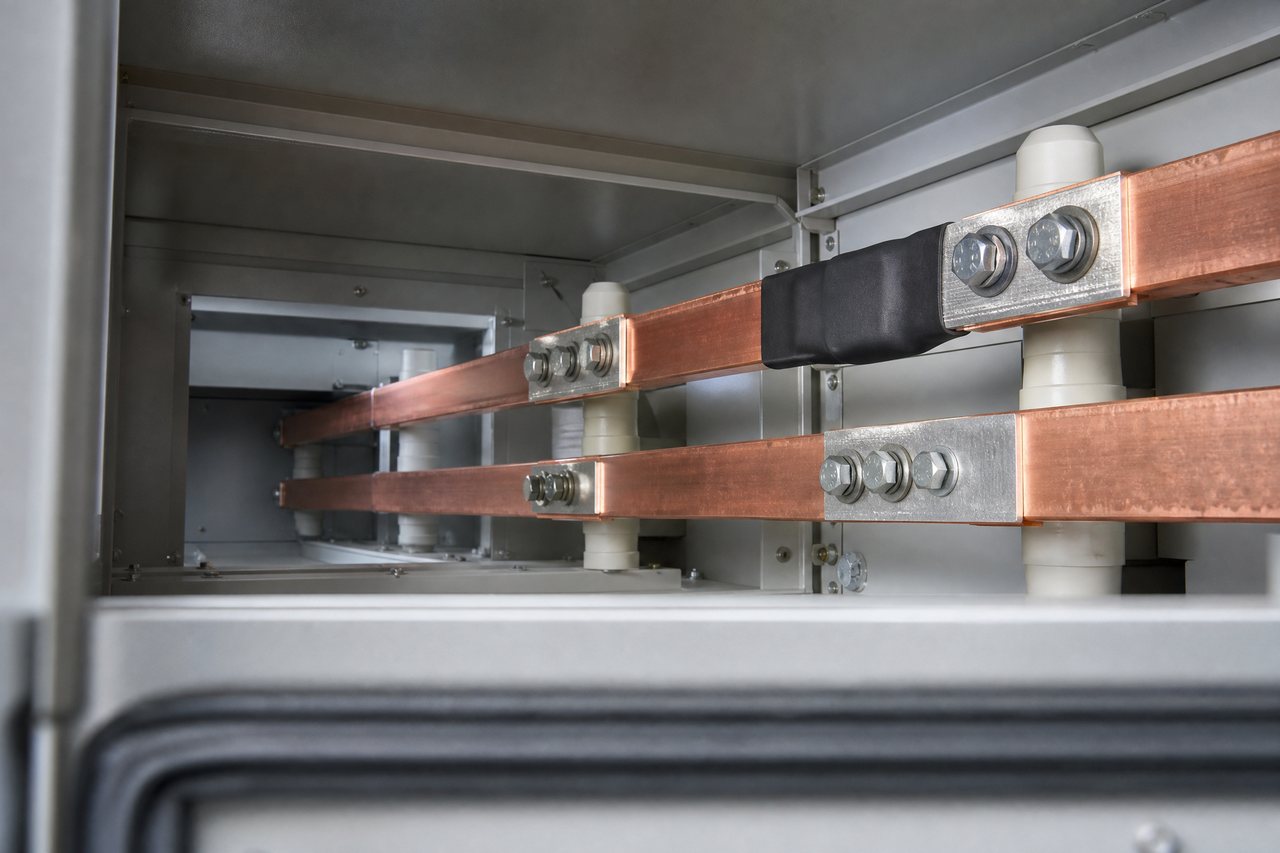
What Does Busbar Current Rating Actually Measure?
Every ampere through a bar produces heat in proportion to the resistance of the metal and the square of the current. The bar sheds that heat from its surface into the surrounding air, and it settles at the temperature where generation and rejection balance. The rating is simply the current at which that balance point lands on the highest temperature the assembly can tolerate.
Tolerable means tolerable for everything nearby, not just for the copper. The limits are set by the insulation and supports in contact with the bar, by the enclosure surfaces, by the cable terminations at each end and by the requirement that a person opening the compartment is not exposed to a surface hot enough to burn. That is why the rating belongs to the assembly: the bar is the heat source, but the constraint comes from its surroundings.
Two consequences follow, and both are routinely missed. First, the rating is expressed as a temperature rise above ambient rather than as an absolute temperature, because the environment supplies the baseline. Second, the surface condition matters: a dark, oxidised or painted bar radiates heat better than a bright polished one, and the reference tables state the emissivity they assume for exactly that reason.
Why Does the Same Bar Carry 400 A in One Table and 620 A in Another?
Because the allowable rise changed. The Copper Development Association publishes ampacities for rectangular copper busbars in three columns: 30, 50 and 65 degrees Celsius rise. All three are measured against the same reference ambient of 40 degrees Celsius, indoors, with the bar mounted horizontally on edge and free from external magnetic influences, at an assumed emissivity of 0.4.
A 1/4 by 1 inch bar appears in that table at 400 A for a 30 degree rise, 530 A for 50 degrees and 620 A for 65 degrees. Nothing about the copper changed between those columns. What changed is how hot the designer is prepared to let the assembly run. A 65 degree rise is a smaller bar for the same current, and a hotter cabinet, a shorter insulation life and a higher risk at every joint.
That is the trade a supplier makes when choosing a bar size, and it is why the rise limit should be stated by the buyer. If the specification says only 1250 A, the supplier is free to meet it with the smallest bar that survives a 65 degree rise, and the quotation will look excellent until the joints start to discolour.
The Same Copper, Three Ratings
The values below are taken directly from the association table for three common bar sizes, so the effect of the rise limit can be read across a single row. They apply to the reference conditions stated above and are not a recommendation for any particular assembly.
| 30 C rise | 50 C rise | 65 C rise | |
|---|---|---|---|
| 1/4 x 1 in | 400 A | 530 A | 620 A |
| 3/8 x 4 in | 1500 A | 2000 A | 2350 A |
| 1/2 x 4 in | 1700 A | 2300 A | 2650 A |
Two things are worth noticing in those rows. The gain from allowing a hotter bar is not proportional: moving from 30 to 65 degrees adds roughly half again to the current, not double, because radiated and convected loss rise with temperature but not linearly. And the gain gets smaller as the bar gets larger, because a bigger bar has less surface area per unit of cross-section, so it is harder to cool. Beyond a point, adding copper thickness is a poor way to add current compared with adding width or splitting into parallel bars.
Does Alternating Current Change the Number?
Yes, and the effect is larger than most people expect on thick bars. Alternating current distributes itself unevenly across the section, crowding toward the outer surfaces, so the effective resistance rises above the DC value. The ratio of AC to DC resistance is the skin effect ratio, and the reference tables publish it alongside each ampacity figure at the temperature of that column.
The tables also give the conversion, which is worth keeping because it separates the two effects: DC ampacity equals AC ampacity multiplied by the square root of the skin effect ratio. For a 1/2 by 4 inch bar at the 30 degree column, the ratio is 1.26, so the DC capability is about 1700 times 1.12, or roughly 1900 A. For a thin bar such as 1/4 by 1 inch the ratio at the same column is 1.02, so the AC and DC figures are almost the same.
The practical lesson is that the ratio grows with bar thickness. A designer who treats a thick bar as a simple multiple of a thin one will overestimate what it can carry on AC, because the extra copper in the middle of the section carries very little current while still adding weight and cost. Flat bars mounted on edge are preferred for the same reason: the geometry puts more surface where the current already wants to flow.
What Else Moves the Rating Inside a Cabinet?
The published table describes a bar in free air. A bar inside a metal-enclosed cabinet is in a different thermal situation, and five factors account for most of the difference.
- Ambient temperature. The table assumes 40 C. A Gulf switch room, or an outdoor enclosure in direct sun, can run well above that, and the same bar then reaches its limit at a lower current. The high ambient and altitude guide covers how the assembly rating is corrected for those conditions.
- Enclosure and compartment volume. Heat that cannot leave the compartment warms the air around the bar, which raises the bar temperature for the same current. Ventilation openings, compartment size and the presence of a pressure relief path all change the balance.
- Neighbouring heat sources. A busbar compartment shared with cable terminations, current transformers or a breaker of significant losses is not an isolated bar, and the assembly has to be rated as a system.
- Joints. A bolted lap joint has more resistance than the bar it connects. If the joint is poorly prepared, under-torqued or unprotected against oxidation, it becomes the hottest point on the run and the effective limit of the circuit.
- Parallel bars and proximity. Two bars per phase do not simply double the rating. They interact magnetically, share current unevenly and sit closer together, which is why a tested arrangement is the only defensible claim.
The temperature of a joint is also the cheapest diagnostic available in service. The busbar temperature monitoring guide covers the measurement options, and the reason they exist is precisely this: a joint that is drifting upward is signalling a rating problem before it becomes a failure.
How Do You Check a Quoted Busbar Rating?
Four questions settle whether a quoted figure means anything.
- What temperature rise is the rating based on? If the answer is a current with no rise, the number cannot be compared with a table or another supplier.
- What ambient is assumed? A 40 C reference and a 55 C site are not the same design, and the correction is not small.
- How is the bar mounted, and in what compartment? Free air, on edge, in a ventilated compartment and in a sealed one are four different ratings for one bar.
- Is the figure tested or calculated, and to what arrangement does it apply? A type-tested assembly has a tested configuration behind it. A calculated figure is legitimate but should be traceable to its inputs.
A worked example shows how the tables are meant to be used. The association's own selection table takes a required 185 A at a 30 degree rise and offers 1/16 by 1 inch bar as a candidate, then confirms it against the ampacity table, which lists that bar at 187 A. The method is candidate then verify, not look up a single number and stop.
The continuous rating is only half of the busbar duty. A bar must also survive the fault current for its stated duration without deformation or joint damage, and that is a separate rating verified by a separate test. The short-time withstand current guide explains the difference between the thermal and peak values, and why a busbar that passes the continuous check can still fail the fault check.
Copper or Aluminium?
Copper carries more current per unit of cross-section and is more forgiving at joints, which is why the reference tables in this article are copper. Aluminium is lighter and cheaper by volume, and it is widely used, but it needs more cross-section for the same current and demands more care at terminations because of its oxide layer and its different expansion behaviour.
The point for a buyer is not which metal is better in the abstract. It is that the rating table for one metal cannot be applied to the other, and a quotation that changes metal without changing cross-section has changed the rating. Ask for the ampacity basis in the same four terms: current, rise, ambient and mounting.
What Should the Specification State?
- Continuous current for the main busbar and for each feeder, stated separately.
- Maximum site ambient and the allowable temperature rise, so the bar size is not left to the supplier's margin.
- Short-circuit current and duration, to fix the fault duty on the same bar.
- Whether the assembly is indoor or outdoor, ventilated or sealed, and the enclosure material.
- Bar material, joint preparation and plating, and the torque method for bolted joints.
- The evidence required: temperature rise test on the assembly, or a traceable calculation for the specific arrangement.
Written that way, the specification is a set of conditions rather than a wish. It also gives the supplier a fair basis on which to optimise, because the rise limit and the ambient are what actually cost money, and a supplier who knows them can propose a smaller bar honestly instead of a larger bar defensively.
How Nahu Group Rates Its Cabinets
Nahu Group builds metal-enclosed distribution cabinets, ring main units and switchgear for 10 to 35 kV networks, and the busbar arrangement inside those cabinets is rated as part of the assembly rather than as a bar in isolation. The current that can be declared depends on the compartment, the ambient at the site and the rise limit agreed with the buyer, which is why those three inputs are requested before a rating is confirmed.
A buyer comparing quotations across suppliers will usually find that the difference in price tracks the difference in rise limit and ambient assumption rather than the difference in copper. Putting both numbers in the enquiry makes the comparison honest, and it is the fastest way to find out whether the bar in the drawing will still be adequate on the hottest day the site ever sees.
Frequently Asked Questions About Busbar Current Rating
What is busbar current rating in simple terms?
It is the continuous current a bar can carry while its temperature stays within the limit set for the assembly it sits in. It is a property of the bar plus its mounting, ambient temperature and allowable rise, not of the copper alone.
Why do two tables give different ampacities for the same bar?
Because they assume different allowable temperature rises or different reference ambients. Copper Development Association data, for example, lists separate columns for 30, 50 and 65 degrees Celsius rise, all at a 40 degrees Celsius ambient. A bar quoted at one rise limit is not comparable with a bar quoted at another.
Does the enclosure change the busbar rating?
Yes. A bar in free air, indoors, dissipates heat differently from the same bar inside a sheet-steel compartment beside other warm components. The published table describes a defined mounting condition, so a rating inside a cabinet has to be confirmed for that arrangement rather than copied from the table.
How does alternating current affect the rating?
Skin effect pushes current toward the outside of the conductor, so the effective resistance is higher on AC than on DC and the ampacity is lower. The reference tables publish a skin effect ratio alongside the AC ampacity so the DC value can be derived from it.
Is the busbar rating the same as the short-circuit rating?
No. Continuous current rating is a thermal limit under normal load. Short-time and peak withstand ratings describe what the bar survives during a fault, and they are verified by a different test. A busbar must satisfy both, and passing one says nothing about the other.
Can I increase the rating by adding a second bar per phase?
Often yes, but not in proportion. Two bars in parallel share current imperfectly, dissipate heat into the same space and change the skin effect, so the combined rating is always less than twice the single-bar figure. It has to be stated as a tested arrangement rather than assumed.
Does plating affect the current rating?
Plating is chosen mainly to keep the joint stable, because a joint that oxidises gains resistance and becomes the hottest point on the run. The bar itself is rated on its cross-section and surface condition; the joint is rated by how it is prepared, tightened and protected.
What should a buyer ask for when a busbar rating is quoted?
The current, the allowable temperature rise, the reference ambient, the mounting arrangement and the test or calculation behind the figure. A single ampacity number without those four conditions cannot be compared with another supplier's number.
Sources and Further Reading
- Copper Development Association — Table 1: Ampacities of copper busbars — the ampacity table used here, with the 30, 50 and 65 degrees Celsius rise columns, skin effect ratios and the stated reference conditions of 40 degrees Celsius ambient, indoor, horizontal on edge and free of external magnetic influence
- Copper Development Association — Table 3: Quick busbar selector — the selection table that maps a required ampacity to candidate bar sizes, and its worked example of 185 A at a 30 degrees Celsius rise resolving to 1/16 by 1 inch bar at 187 A
- Copper busbar ampacity tables, alloy UNS C11000 — the same association data in a single document, including the DC ampacity relation IDC equals IAC multiplied by the square root of the skin effect ratio
Published October 22, 2026 · Nahu Group (NAHU Electric Technology)