
For a new 10-35 kV distribution project, a vacuum load break switch is normally the safer default, and an SF6 load break switch is the option a specifier now has to justify. Both break rated load current, but the medium that extinguishes the arc also decides the size of the cubicle, what has to be inspected over the switch's life, whether the site needs gas handling equipment, and how the equipment is finally disposed of.
This comparison stays on the switching device and its medium: gas, vacuum and air. The device itself, and how it differs from a circuit breaker, is covered in the load break switch guide.
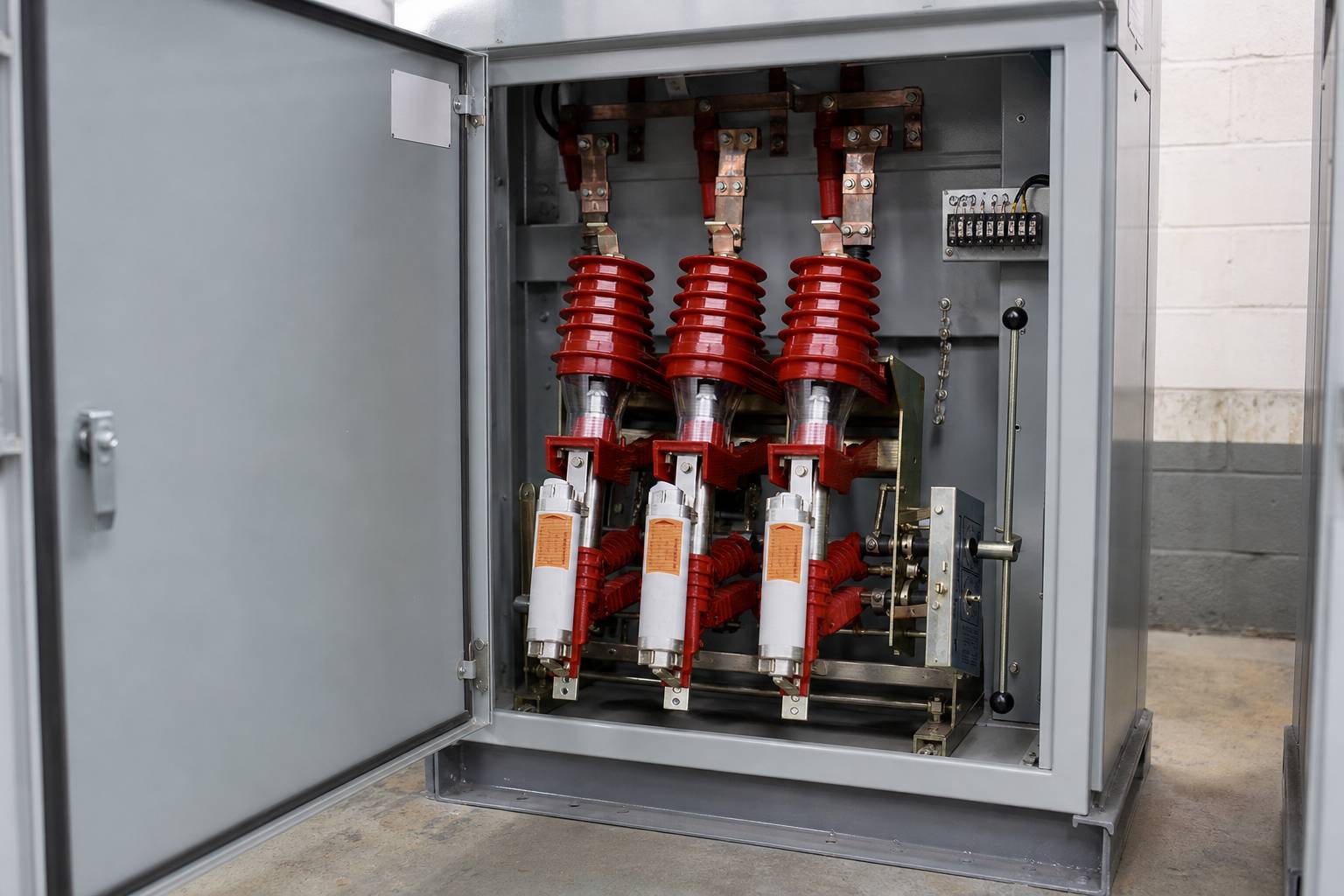
What Arc Does a Load Break Switch Have to Quench?
A load break switch breaks normal load current, and in some designs limited overload or charging current; it is not rated to clear short-circuit current. The arc it draws is a fraction of the network fault current, and any of the three mediums can extinguish it.
When the contacts part, current keeps flowing through an ionised channel until the next current zero. Quenching means cooling and lengthening that channel and denying it free electrons, so the gap recovers dielectric strength before the voltage rises. Load break switch arc quenching is a race against that current zero.
How Does SF6 Quench the Arc and Insulate?
Sulphur hexafluoride is electronegative: its molecules capture the free electrons that keep an arc conducting, forming heavy ions that move slowly, cool quickly and recombine. The arc burns within the gas, which is driven through it by a puffer action or by the arc's own rotation, and the gap regains dielectric strength as the current approaches zero.
The same gas insulates. Its dielectric strength is several times that of air at equal pressure, so live parts pack into a small sealed tank. That is the origin of the compact gas-insulated cubicle, and the reason SF6 enclosed switchgear was adopted wherever floor area was expensive.
The trade-off is that the tank is a pressure vessel: it must stay gas tight for decades and needs gas density indication, so gas work turns an electrical maintenance task into a specialist one.
How Does a Vacuum Interrupter Quench the Arc?
In a vacuum interrupter the contacts part inside a sealed ceramic bottle. With almost no gas to ionise, the arc burns in metal vapour drawn from the contacts themselves; as the current falls towards zero the vapour stops, the metal re-condenses and the small gap recovers its dielectric strength almost instantly.
Two consequences matter. There is no gas pressure to monitor and no interrupting medium that can escape. And the interrupter solves the switching function only: the live parts still need insulation from earth and from each other, which may be solid, air or another gas. A vacuum load break switch is not automatically an air insulated one.
How Does an Air Insulated Load Break Switch Deal With the Arc?
An air insulated load break switch accepts the arc and destroys it geometrically. The arc is driven into a chute of splitter plates that cool the column and cut it into short series arcs, each with its own voltage drop, until the chain can no longer sustain itself at a current zero.
Air also sets every dimension. Atmospheric air has a much lower dielectric strength than compressed SF6 or a solid barrier, so clearances grow, and a chute long enough to kill the arc adds volume again. In return the break is visible and no medium has to be contained, measured or recovered.
SF6 vs Vacuum vs Air at a Glance
| SF6 gas | Vacuum | Air | |
|---|---|---|---|
| Arc quenching | Electronegative gas captures free electrons | Arc burns in metal vapour, clears at current zero | Arc stretched and split in a chute |
| Insulation of live parts | Compressed gas in a sealed tank | Set by the surrounding design | Atmospheric air and solid barriers |
| Enclosure | Smallest, sealed pressure tank | Compact switching module | Largest clearances, biggest cubicle |
| What is monitored | Gas density and leaks | Vacuum integrity, contact wear | Contacts, chutes, insulation |
| Specialist skill needed | Gas handling and recovery | Interrupter replacement | Routine electrical maintenance |
| End of life | Gas must be recovered | Sealed bottle, solid recycling | Metal and contact recycling |
| Fits best where | Space critical, gas fleet exists | Most new distribution projects | Visible break is required |
Read the table as three engineering positions rather than three grades of quality. All three can break the load current a distribution feeder presents; what differs is the enclosure each medium forces on you, the skills it demands, and the questions it raises.
What Does the Medium Do to the Enclosure and Footprint?
The medium sets the enclosure because it sets the clearance and the pressure. Gas compresses the insulation into a tank and wins on floor area. Vacuum makes the switching element small but still needs an insulating system around it. Air accepts atmospheric pressure and pays in distance.
So compare enclosure drawings, not medium names: a vacuum interrupter inside a sealed gas tank, behind solid insulation, and in open air in a metal-enclosed cubicle are three products with three footprints. Pollution, humidity, condensation and altitude then reduce the withstand of an air gap.
What Does the Medium Change About Maintenance and Inspection?
A sealed gas switch and an air switch ask for different maintenance cultures, and the difference is about what can be measured and what can be done on site.
- Gas designs are monitored rather than adjusted: a gas density or pressure check, a visual check for leaks, and a record of any gas added. Gas work needs recovery and filling equipment, the correct procedure and trained people.
- Vacuum designs need no gas monitoring. Check vacuum integrity and contact wear; the mechanism, interlocks and insulation surfaces follow the usual schedule. The interrupter is replaced as a sealed unit if it fails.
- Air designs are the most legible. Contact gap, chutes and insulation are visible, and chute erosion, contact condition and surface pollution set the inspection interval. Most work needs ordinary tools.
IEC 62271-103 covers switches above 1 kV up to and including 52 kV, and its current edition defines a vacuum integrity check after mechanical operations. Gas designs are proved by tightness and pressure, vacuum designs by vacuum integrity, air designs by the condition of contacts and chutes.
There is a human factor too. If staff already maintain SF6 equipment, adding a second medium creates a parallel inventory of tools and procedures; if the site has no gas capability, a vacuum or air design keeps it that way.
Is an SF6 Load Break Switch Still Allowed?
SF6 is one of the most powerful greenhouse gases identified, which makes it a procurement question. The United States Environmental Protection Agency calls sulphur hexafluoride the most potent greenhouse gas known to date, notes that it traps far more heat than an equivalent amount of carbon dioxide over a hundred-year period, and records that it persists in the atmosphere for more than a thousand years. It attributes the largest share of national SF6 emissions to transmission and distribution equipment, largely through small leaks over the equipment's life.
Regulation has followed the science. In the European Union, Regulation (EU) 2024/573 sets the framework for fluorinated greenhouse gases, and for equipment owners the practical content is containment and housekeeping: prevent intentional release, check for leaks at intervals set by the quantity of gas and the type of equipment, keep records, recover the gas from decommissioned apparatus, and use certified or otherwise qualified people for installation, servicing, leak checking and recovery. It also prohibits placing certain switchgear containing F-gases, or F-gases above a defined global warming potential, into operation from the dates it sets out.
Outside the European Union the same pressure arrives through national procurement rules and utility standards, which increasingly ask for the insulating medium to be declared, for a leak management plan on gas-filled equipment, or for SF6 to be excluded from new installations. SF6 switchgear has not stopped being made, but a new SF6 specification now needs a reason, and in some markets a documented one.
End of Life: Gas Recovery Versus a Sealed Interrupter
A gas switch cannot simply be scrapped. The gas has to be recovered before the tank is opened, using recovery equipment and the correct procedure, and then reclaimed or destroyed. IEC 62271-4:2022 sets out handling procedures for gases used for insulation and switching through installation, commissioning, repair, overhaul, normal and abnormal operation and disposal at end of life, and its current edition also covers alternatives to SF6. The European rules reinforce the practice by requiring recovery from decommissioned equipment by qualified people.
A vacuum load break switch has no process gas to recover for the switching function, so disposal is a dismantling and materials task: the interrupter is a sealed ceramic and metal item, and the rest goes into ordinary recycling. Air is simpler again. Neither is impact free, and IEC TS 62271-320:2025 gives guidance on environmental aspects and life cycle assessment for high-voltage switchgear.
The asymmetry is capability. Removing an air or vacuum switch needs no gas competence; removing a gas switch needs a gas team or contractor, and that dependency lasts for the whole life of the asset.
When Does an Air Insulated Load Break Switch Still Win?
Air is not a legacy technology to be tolerated. It wins when the break has to be visible, when the switch room is clean, dry and roomy enough for proper clearances, and when maintenance is deliberately local rather than supported by gas equipment, cylinders and trained technicians.
It loses when any of those fails. Tight floor space, polluted or coastal air, condensation, high altitude and higher system voltages all push towards a sealed design, because each attacks the performance of an air gap or forces clearances to grow until the cubicle no longer fits.
Nahu Group manufactures 10-35 kV distribution equipment, including load break switches in more than one medium, together with ring main units, vacuum circuit breakers, instrument transformers, metering boxes, surge arresters, drop-out fuses and cable branch boxes.
How Should a Specifier Choose?
Work through these questions in order; the first two usually eliminate a medium outright.
- Which jurisdiction and standards apply? Establish whether the destination market restricts or discourages fluorinated gases for new equipment, and whether the utility has its own medium policy.
- What maintenance capability exists on site? No gas competence argues for a vacuum or air design; an existing SF6 fleet with trained staff argues the other way.
- How much space is really available? Measure the switch room or kiosk, not just the cable trench, because clearances, cable bending radii and operating access all take floor area.
- What will the environment do to an air gap? Pollution, salt, dust, condensation and altitude change the insulation level an air design needs.
- Is a visible break required? If operating procedures demand one, that single requirement can decide the medium on its own.
- What is the end-of-life route? Name the disposal path at tender stage: a gas design needs recovery, a vacuum design needs a route for the interrupter.
Nahu Group builds load break switches and the wider 10-35 kV distribution set, from instrument transformers and metering boxes to ring main units, vacuum circuit breakers, surge arresters, drop-out fuses and cable branch boxes, and works with specifiers on matching the switching medium to the network and the maintenance regime.
Frequently Asked Questions About SF6 vs Vacuum Load Break Switches
What is the difference between an SF6 load break switch and a vacuum load break switch?
The difference is the medium that extinguishes the arc. A gas design uses electronegative gas to capture free electrons and recover dielectric strength, while a vacuum design interrupts inside a sealed vacuum interrupter where the arc burns in metal vapour and clears at current zero.
Which is better, SF6 or vacuum, for a load break switch?
For most new distribution projects vacuum is the default, because the switching function needs no process gas and the interrupter is sealed for life. SF6 designs remain relevant where a compact sealed enclosure is already the standard or the site already runs an SF6 fleet.
How does arc quenching work in a load break switch?
A load break switch only breaks normal load current rather than fault current, so the arc is modest. Air designs force it into a splitter-plate chute, gas designs cool it in an electronegative medium, and vacuum designs let it burn in metal vapour until the supply stops at current zero.
Is SF6 switchgear still allowed?
Yes, SF6 equipment is still manufactured, sold and operated in most markets, but it is increasingly regulated. Regulation (EU) 2024/573 sets containment, leak checking, record keeping and recovery duties for fluorinated greenhouse gases, so the answer depends on the destination market and the type of switchgear.
Why is SF6 a greenhouse gas concern in switchgear?
Because it is extremely effective at trapping heat and extremely persistent. The United States Environmental Protection Agency states that SF6 traps far more heat than carbon dioxide over a hundred-year period, stays in the atmosphere for more than a thousand years, and is emitted mainly by transmission and distribution equipment.
Does a vacuum load break switch need less maintenance?
The switching function does, because there is no gas pressure to check and no gas to top up or recover. A vacuum interrupter still has to be checked for vacuum integrity and its contacts for wear, and the mechanism, interlocks and insulation surfaces need the same attention as any other switch.
What happens to a gas load break switch at end of life?
The gas has to be recovered rather than vented. IEC 62271-4:2022 sets out handling procedures for gases used for insulation and switching through to disposal at end of life, and the European rules require recovery from decommissioned equipment by certified or qualified personnel.
Can a gas load break switch be replaced by a vacuum unit in an existing cubicle?
Sometimes, but the enclosure usually decides it. A replacement has to fit the same busbar spacing, clearances and cable terminations, and the mechanism and interlocks must suit the original scheme. In a sealed gas-insulated cubicle, replacement normally means changing the whole switching module.
Sources and Further Reading
- EUR-Lex summary of Regulation (EU) 2024/573 - containment, leak checking, record keeping, certification and recovery duties, and the restrictions on placing certain F-gas switchgear into operation.
- US EPA, Sulfur Hexafluoride (SF6) Basics - the greenhouse gas and persistence description, and the share of emissions attributed to transmission and distribution equipment.
- IEC 62271-103:2021, AC switches above 1 kV up to and including 52 kV - the switching device standard, including the vacuum integrity check after mechanical operations.
- IEC 62271-4:2022, handling procedures for gases for insulation and/or switching - gas handling from installation through to disposal at end of life, now including alternatives to SF6.
- IEC TS 62271-320:2025, environmental aspects and life cycle assessment rules - guidance for comparing environmental impacts across the life cycle.
Standards and regulations change; the edition your project calls up governs.
Bringing the Medium Decision Together
The medium inside a load break switch should not be left to a supplier's standard offer. It decides how much space the switch takes, what your team must be trained to do, which obligations follow the asset, and how the equipment leaves the site.
Fix the switching duty and the enclosure requirements first, then test each medium against the environment, the maintenance capability you actually have, and the rules in the destination market. Where the outcome is close, the deciding factors are usually the existing fleet and the end-of-life route.
For 10-35 kV load break switches, ring main units and the rest of the distribution set, Nahu Group can review the duty, the environment and the maintenance regime with you and advise on whether an SF6 load break switch or a vacuum or air design suits the project. See the load break switch range for the equipment, compare a specific vacuum design in the FZN25-12 vacuum load break switch overview, or talk to the engineering team. Where a defined isolating duty also has to be confirmed, the isolating switch guide covers that separate function.
Published September 23, 2026 · Nahu Group (NAHU Electric Technology)