
When an overhead line goes to ground or a feeder short-circuits, someone has to find the fault before power can be restored. On long rural feeders the search can take hours of driving and patrolling. A faulted circuit indicator (FCI) — also called a fault indicator or line fault indicator — is a simple device that removes most of that guesswork.
Clamped onto the conductor or mounted on the line, the indicator monitors the current passing through it. When a fault occurs, it trips and displays a bright flag or blinking light. Crews drive the line, follow the indicators that have tripped, and stop at the last one before the healthy section — the fault is right there.
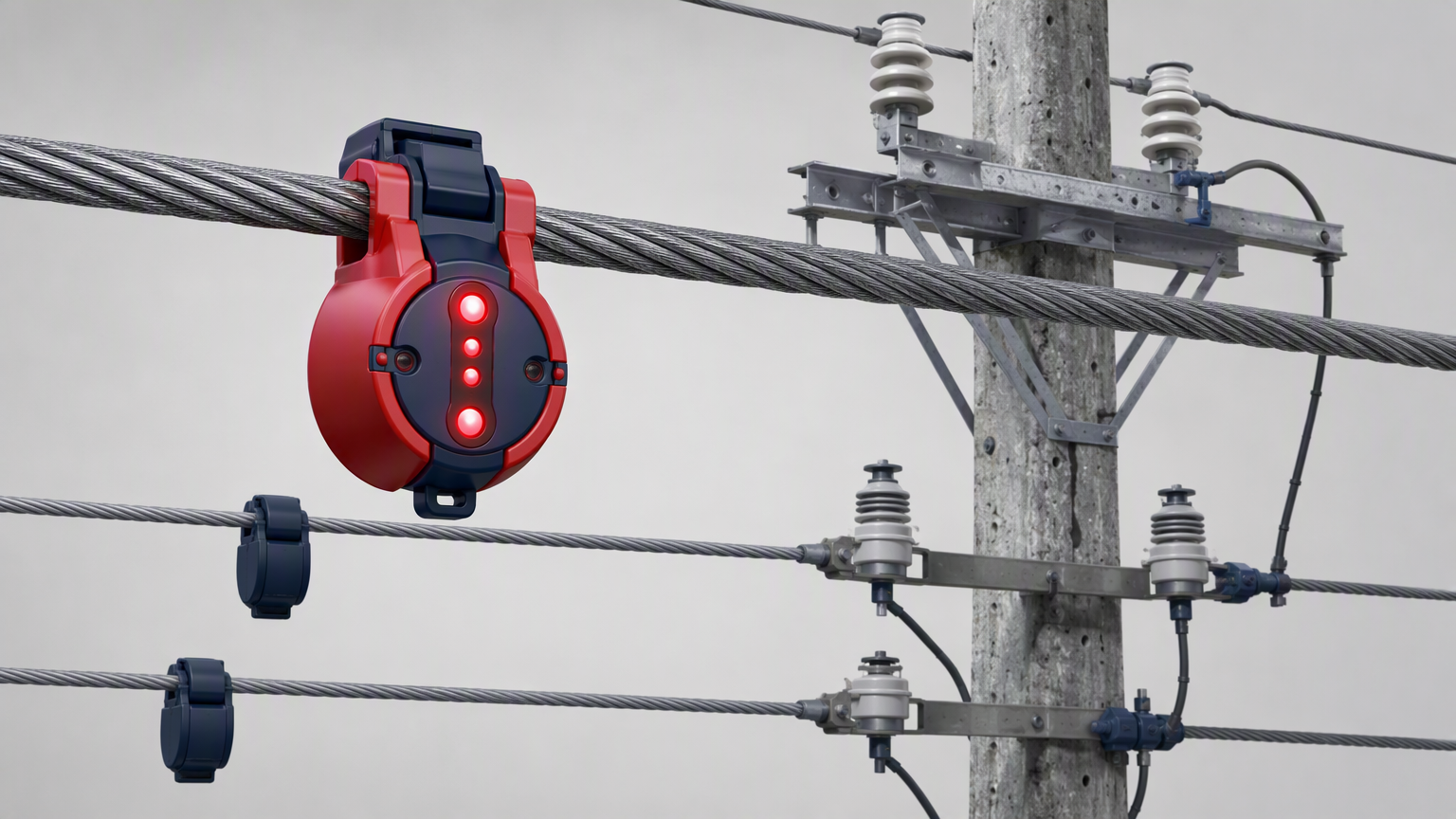
What Is a Faulted Circuit Indicator?
A faulted circuit indicator is a field-mounted monitoring device that detects abnormal current conditions on a distribution circuit and gives a visible signal when one has occurred. It is the middle ground between no information at all and a full SCADA system: it costs a fraction of a remote terminal unit, needs no communication network, and still tells patrol crews exactly which section of line to inspect.
Most FCIs are self-powered. They harvest operating energy from the magnetic field of the conductor itself, which means they can be installed on energized lines with a hot stick and forgotten about for years.
How Do Faulted Circuit Indicators Work?
The working principle is straightforward. The indicator senses line current through an internal current transformer or Rogowski coil wrapped around the conductor. Its control logic is programmed with thresholds:
- A short-circuit (overcurrent) threshold — if current jumps above a set value for a set time, the unit trips
- An earth-fault (zero-sequence) threshold — sensitive detection of unbalanced current typical of ground faults on ungrounded or resonant systems
- A transient-characteristic mode — distinguishes momentary inrush or capacitor switching from genuine faults
After tripping, the indicator latches in the fault position so the signal stays visible even after the breaker has reclosed and the line is back in service. Reset is automatic — the unit clears itself when normal current returns for a defined period — or manual by a reset magnet or remote command.
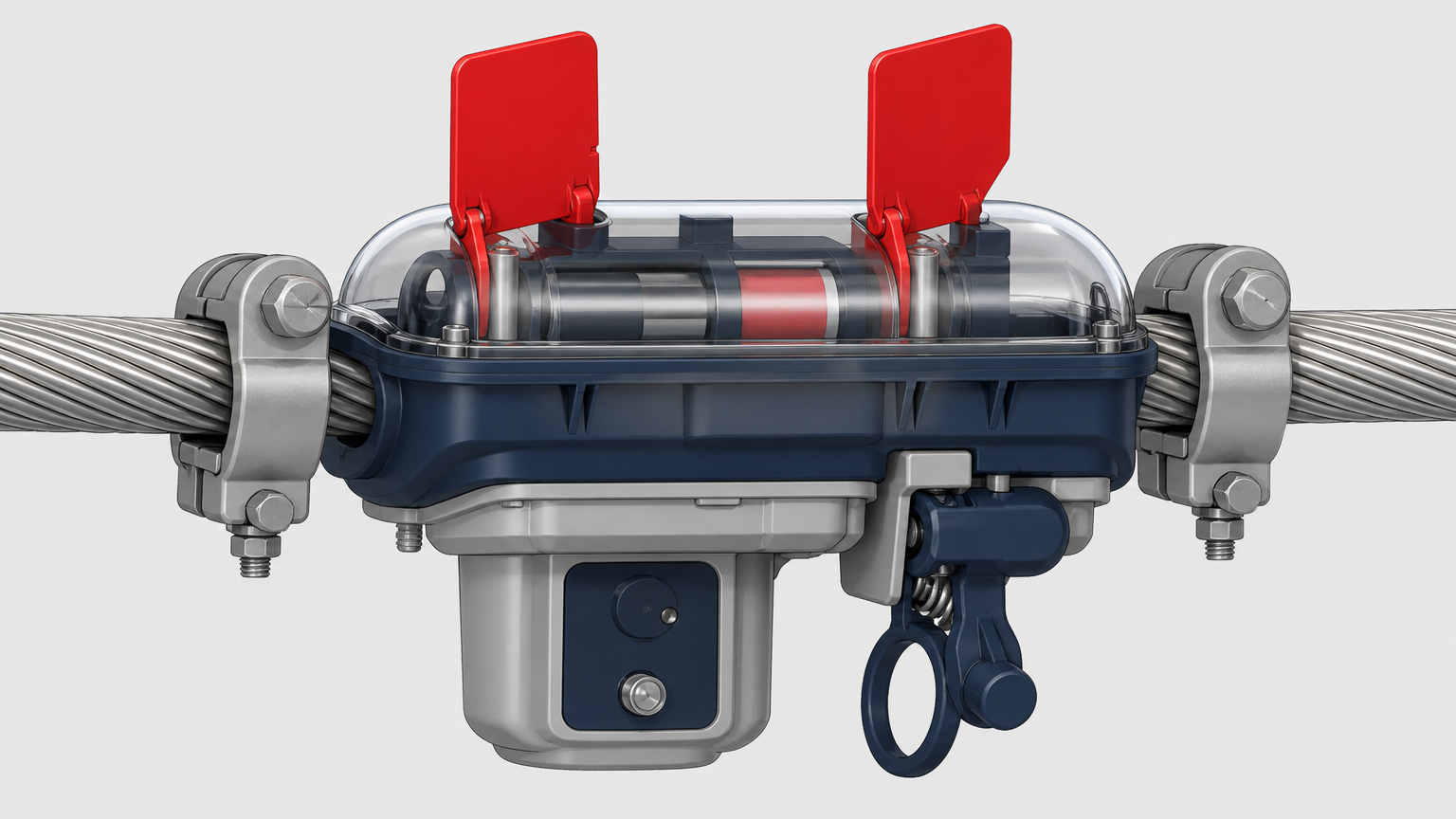
Main Types of Fault Indicators
Not all faults are the same, so indicators come in application-specific types:
- Grounding (earth-fault) indicators — for detecting earth faults, essential on isolated-neutral and resonant networks
- Short-circuit indicators — for phase-to-phase and overcurrent faults, with adjustable pickup current
- Transient-characteristic types — combine both functions with sophisticated fault discrimination
- Two-in-one, four-in-one and six-in-one combinations — one unit covering several detection functions for mixed networks
There are also line-mounted (clamp-on) units for overhead conductors and cable-mounted units for underground circuits, plus panel-mounted versions for RMU and switchgear cabinets.
Why Utilities Rely on Fault Indicators
The economics are simple: outage minutes cost revenue and penalties, and restoration time is dominated by fault location. Fault indicators deliver three measurable benefits:
- Faster restoration — patrol crews go straight to the faulted section instead of inspecting every span
- Lower labour cost — fewer patrol hours and fewer crews needed per outage
- Better network data — indicators that record fault counts help engineers identify weak sections before they fail repeatedly
For feeders with distributed generation, indicators also show which direction the fault current flowed, which is essential when multiple sources can feed a fault.
How to Choose a Faulted Circuit Indicator
Selection starts with the network, not the catalogue. Ask these questions:
- System voltage and earthing — determines insulation class and whether you need earth-fault detection
- Conductor type and size — the clamp must fit the conductor diameter, from small bare wire to covered conductor
- Load range — the pickup threshold must sit above normal load but below minimum fault current
- Fault types to detect — short-circuit, earth fault, transient, or a combination
- Indication style — high-visibility LED (visible day and night) or mechanical flag, plus remote reporting if the network has communications
- Standards — units tested to IEC and with thermal ratings matching the line's maximum fault current
A common mistake is undersizing the thermal withstand: an indicator clamped on a 35 kV feeder must survive the full short-circuit current of the line without damage.
Installation and Field Notes
Line-mounted indicators are designed for live-line installation with a hot stick, so placement follows the same rules as any line work: respect approach distances, verify the clamp seats fully on the conductor, and orient the unit so the display faces the patrol road. Cable units are fitted in the termination or joint bay. After installation, verify the unit's reset and trip behaviour with a test current before commissioning.
Q&A
Question: Do faulted circuit indicators need a power supply?
Short answer: Most line-mounted units are self-powered from the conductor's magnetic field, so they need no batteries or auxiliary supply and can be installed live with a hot stick.
Question: How does the indicator reset after a fault?
Short answer: Automatically, when normal current returns for a preset time; or manually with a reset magnet. Some models also reset by remote command.
Question: Can one indicator detect both short-circuit and earth faults?
Short answer: Yes — two-in-one, four-in-one and six-in-one models combine short-circuit, earth-fault and transient-characteristic detection in a single unit.
Question: Where should indicators be installed on a feeder?
Short answer: At the substation exit, at every main branch and sectionalising point, and at regular intervals along long runs — the goal is to bracket every segment you might have to isolate.
Nahu Group (NAHU Electric) manufactures overhead and cable line fault indicators — grounding, short-circuit, transient-characteristic and two-in-one / four-in-one / six-in-one types for rapid fault location. For application guidance and specifications, see our faulted circuit indicator range, or contact our engineering team.
Published August 12, 2026 · Nahu Group (NAHU Electric Technology)