
A ring network needs a place where one cable can become two or three — a compact, outdoor, fully screened junction that does not need a building around it. The European-style cable branch box is that place: a small metal enclosure with busbar-mounted separable connectors, used across Europe, Asia and Africa to T-off from ring main units and feed transformers.
This guide covers how the DFW branch box works, the separable connector family that plugs into it, and the operating rules that keep the people using them safe.
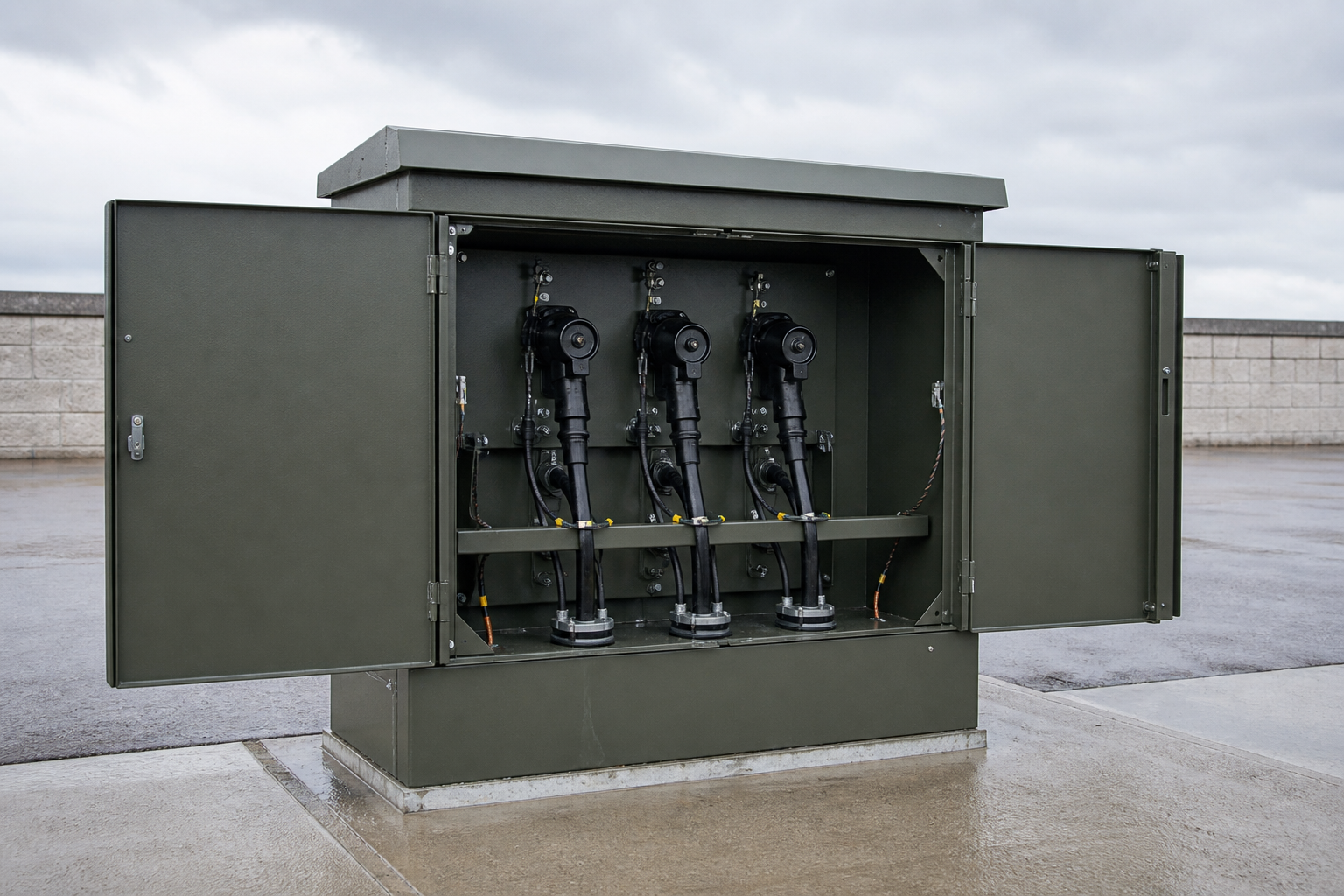
What Is a Cable Branch Box?
A cable branch box is an outdoor T-off point. One medium-voltage cable comes in, and two or three outgoing circuits go out, each on its own connector. In a ring network the box often sits at the point where a transformer spur leaves the ring, letting the ring stay closed while one branch is served.
- DFW-12KV European-style branch box — the Nahu design, rated for 12 kV, with an outdoor enclosure and busbar-mounted connectors
- Typical roles — ring main unit tee-offs, compact substations, and feeding pad-mounted transformers
- Why a box — it keeps terminations screened, touchable and protected from weather and pollution, without the cost of a cable chamber
The Separable Connector Family
Everything inside a European branch box plugs together with separable connectors — screened plug-in components that mount on the box's bushings or busbar and mate with the cable ends. The Nahu family covers every position in the box:
- JBK12KV-630A rear connector — the plug that fits the bushing on the back of the busbar, taking the incoming or outgoing cable
- JB12KV-630A front connector — the same 630 A interface on the front of the busbar for direct cable connections
- ZT-15KV-200A elbow-type connector — a compact 200 A elbow for transformer and smaller branches
- JYM12KV-630A insulation cap — the cover that seals unused connector positions
- HBLQ-12KV arrester with rear connection — surge protection mounted directly on the connector
- DJTG-12KV-630A butt sleeve — for joining screened cables busbar-to-busbar
Every connector in the family is fully screened — a conductive outer layer bonded to earth — and touchable, so the enclosure can be opened and the connectors handled by trained staff with the right precautions.
Touchable vs Non-Touchable, Dead-Break vs Load-Break
Two distinctions do most of the work in understanding separable connectors:
- Touchable vs non-touchable — a touchable connector has a conductive screen bonded to earth, so its outer surface stays at earth potential and is safe to handle when the circuit is de-energised; a non-touchable connector leaves the live parts effectively bare
- Load-break vs dead-break — a load-break connector is rated to make and break current under load, operated with a special tool (the 200 A elbow is load-break rated); a dead-break connector may only be plugged or unplugged when the circuit is de-energised (the 630 A family is dead-break)
Put together: the 200 A elbow can switch under load with the correct tool, while 630 A connectors are strictly connect/disconnect-when-dead, and everything is touchable when earthed.
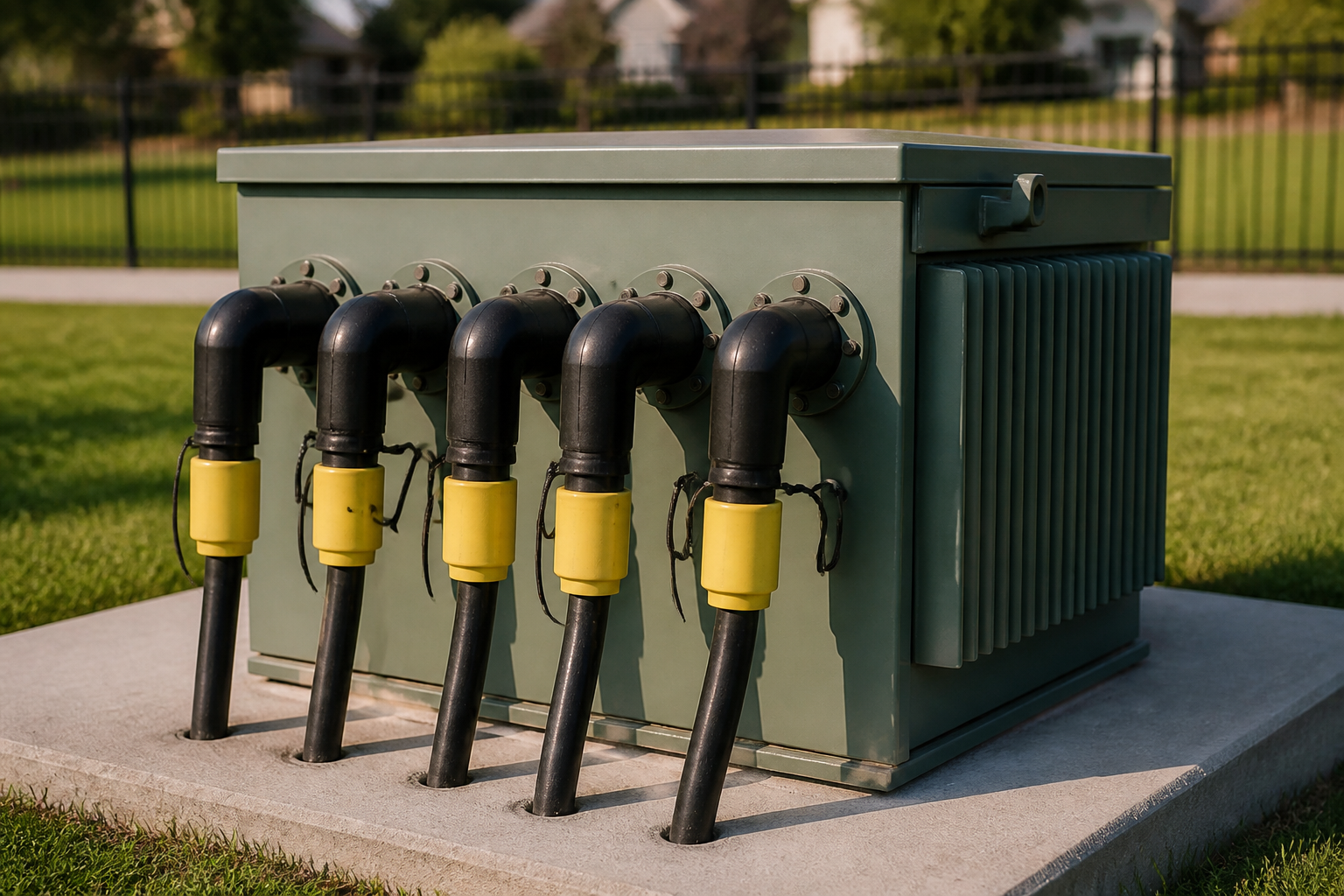
Where They Are Used
The branch box and its connector family show up wherever a distribution network has to split a cable circuit outdoors:
- Ring main units — T-off points and transformer spurs on the ring
- Pad-mounted transformers — the screened, touchable connection on the transformer bushings
- Compact substations — where space rules out a conventional cable chamber
- Solar and wind collection networks — outdoor T-offs on collector circuits, where the same screened, touchable principle applies
Safety and Operation
Operating rules for separable connectors are simple but absolute:
- De-energise before plugging or unplugging any 630 A (dead-break) connector, and verify with a voltage detector
- Use insulated gloves and the correct operating tool — especially when switching a load-break 200 A elbow
- Cap every unused position with a JYM insulation cap so no live bushing is left exposed
- Earth the connector screens — the box and all its connectors share one earth bond; check it before opening
- Inspect the box — look for water ingress, tracking marks and damaged caps before working on it
How to Choose
Specifying a branch box comes down to a short list of questions:
- System voltage — 12 kV or 15 kV class, matching the network and the connector ratings
- Current rating — 200 A for transformer and small branches, 630 A for feeders and ring-through positions
- Cable size and conductor — the connector must suit the cable cross-section and conductor type
- Touchable requirement — specify fully screened, touchable connectors for pad-mount and public access
- Bushing type — front or rear connection, matching the box and the transformer bushings
- Arrester integration — add the HBLQ-12KV arrester with rear connection where surge protection belongs at the T-off
Q&A
Question: What does "touchable" mean on a connector?
Short answer: A touchable connector has a conductive screen bonded to earth, so the outer surface stays at earth potential. Trained staff can work around it with the circuit de-energised; it is not a substitute for live working rules.
Question: When should I use a 200 A elbow instead of a 630 A connector?
Short answer: Use the elbow for smaller branches, transformer connections and where you need load-break switching with a tool. Use 630 A connectors for feeders and ring-through positions, where the current is higher and the connection is dead-break.
Question: Can you plug a separable connector in under load?
Short answer: Only a load-break connector, operated with its correct tool. The 200 A elbow is load-break rated; 630 A connectors are dead-break and must only be plugged or unplugged when the circuit is de-energised and verified dead.
Question: Why must unused positions be capped?
Short answer: An uncapped bushing leaves a live, energised surface exposed and lets moisture and pollution into the box. The JYM insulation cap keeps the position sealed, screened and safe until a cable is connected.
Nahu Group (NAHU Electric) manufactures the DFW-12KV European-style branch box and the complete separable connector family — 630 A front and rear connectors, 200 A elbows, insulation caps, surge arresters and butt sleeves — for ring main units, pad-mounted transformers and compact substations. For ratings, bushing dimensions and layout drawings, see our cable branch box range, or contact our engineering team.
Published August 20, 2026 · Nahu Group (NAHU Electric Technology)