
EMC certification is proof that a piece of electrical or electronic equipment can work in its electromagnetic environment without causing unacceptable interference to anything else — and without being disturbed by it. It is demonstrated by testing the product against EMC standards, usually at an accredited laboratory, and recording the result in a test report.
That report is then used to make a legal declaration. In the European Union, that means the CE marking under the EMC Directive 2014/30/EU, which has applied since 20 April 2016 and replaced Directive 2004/108/EC. In the Gulf and in Central Asia, the same IEC-based test evidence feeds separate national and regional schemes, which is why one laboratory report so often has to satisfy several authorities.
This guide covers what EMC actually means, the standards behind a certificate, how EMC certification differs from CE marking, what drives the cost, and why medium-voltage switchgear, metering equipment and instrument transformers are judged more strictly than most people expect.
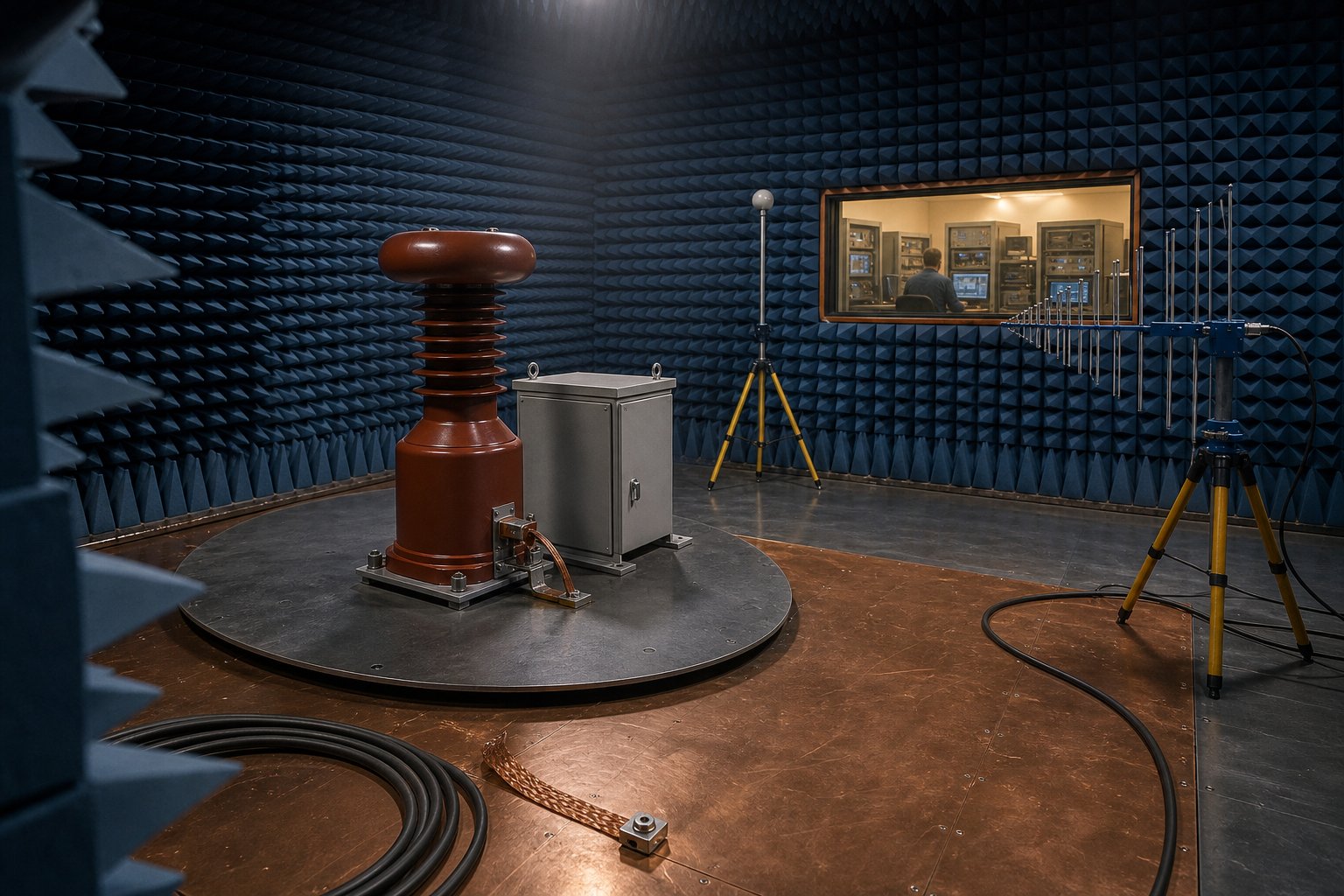
What Does the Term EMC Certification Actually Mean?
EMC stands for electromagnetic compatibility. The concept covers two obligations that pull in opposite directions:
- Emissions — the equipment must not send out electromagnetic disturbance above the permitted limits, whether that disturbance leaves through the cables or radiates through the air
- Immunity — the equipment must keep functioning as intended while disturbance arrives from outside, from static discharge, switching transients, surges or nearby radio transmitters
The word "certification" is used loosely in the trade. Strictly speaking there is no single worldwide EMC certificate. What a manufacturer normally receives is a test report issued by a laboratory working to ISO/IEC 17025, sometimes accompanied by a certificate of conformity. That document proves the tests were performed and describes the configuration that passed.
A test report is evidence. A declaration is a legal act. Under the EMC Directive the manufacturer must carry out a conformity assessment, draw up the technical documentation, issue an EU declaration of conformity and affix the CE marking; the file has to be kept for ten years. Importers and distributors carry their own verification duties. Understanding that split matters, because a supplier who says "we have an EMC certificate" is not necessarily saying "we have complied with your market's law".
A note on the name: if you arrived here looking for EMC Corporation — now part of Dell — this page is unrelated. Dell EMC certifications are information-technology credentials. This article is about electromagnetic compatibility in electrical and electronic engineering, which is the meaning the term carries in power grid and industrial equipment.
How Is EMC Certification Different from EMI Testing?
The two terms are constantly mixed up, and the difference is simple once you see it:
- EMI — electromagnetic interference — is the disturbance itself, the unwanted signal
- EMC — electromagnetic compatibility — is the property of coexisting with that disturbance
So an EMI test measures how much noise a product produces, while an immunity test measures how much noise it survives. EMC is the umbrella term that contains both. When a procurement document asks for "EMC certification", it is asking for evidence across the full set: emissions and immunity, tested to a named standard, at a named laboratory, in a defined configuration.
What Does an EMC Test Actually Measure?
A full EMC programme is a list of separate tests. Which ones apply depends on the product standard, but the families below cover the great majority of industrial and utility equipment.
| Test family | What it checks | Typical reference |
|---|---|---|
| Conducted emissions | Disturbance the equipment injects back onto the supply and signal cables, measured at the mains port | CISPR 11 / product standard |
| Radiated emissions | Radio-frequency fields the equipment radiates through its enclosure and cables | CISPR 11 / product standard |
| Electrostatic discharge (ESD) immunity | Direct and indirect static discharge applied to the enclosure, controls and accessible metalwork | IEC 61000-4-2 |
| Radiated RF immunity | Behaviour of the equipment inside a strong external electromagnetic field | IEC 61000-4-3 |
| Electrical fast transient (burst) immunity | Repeated fast switching transients on supply and signal lines | IEC 61000-4-4 |
| Surge immunity | High-energy surges, such as those induced by lightning or large switching operations | IEC 61000-4-5 |
| Conducted RF immunity | Radio-frequency disturbance injected directly onto cables | IEC 61000-4-6 |
| Power-frequency magnetic field immunity | Behaviour close to transformers, reactors and heavy cables carrying power-frequency current | IEC 61000-4-8 |
| Voltage dips, short interruptions and variations | How the equipment responds when the supply itself sags, drops or returns | IEC 61000-4-11 |
The immunity tests matter to the grid far more than most catalogues suggest. A relay that resets during a switching transient, or a meter that loses a pulse count during a voltage dip, creates a problem that no accuracy class can repair afterwards.
Which Standards Sit Behind an EMC Certificate?
Three layers of standard usually appear on a test report, and a well-written report names all of them.
- Basic standards — the IEC 61000-4 series. These define how to perform a test, not what a given product must achieve. IEC 61000-4-2 for electrostatic discharge was most recently published in 2025, and IEC 61000-4-3 for radiated RF immunity dates from 2020.
- Generic standards — applied when no product-specific standard exists, with separately defined limits for residential and industrial environments.
- Product-family standards — the decisive layer for grid equipment. CISPR 11:2024 covers emission requirements for industrial, scientific and medical equipment across the frequency range from 9 kHz to 400 GHz. IEC 61869-1:2023 states the general requirements for instrument transformers.
In the European Union, testing to a standard that has been listed as harmonised gives a presumption of conformity with the EMC Directive. The European Commission maintains the official list of harmonised EMC standards, and it is worth checking the current version before commissioning a test — the edition matters, and testing to a superseded edition is a common and expensive way to fail an audit.
Outside Europe the reference point changes but the physics does not. In the United States, unintentional radiators fall under 47 CFR Part 15 Subpart B, where radiated emission limits are set in section 15.109 and products are divided into Class A and Class B depending on where they will be used.
Is EMC Certification the Same as CE Marking?
No, and the distinction is frequently blurred in supplier documents. EMC testing is one input into CE marking, not a substitute for it.
| EMC test report | CE marking under the EMC Directive | |
|---|---|---|
| What it is | A technical record of tests performed by a laboratory | A legal declaration by the manufacturer that the product meets the applicable requirements |
| Who issues it | An accredited testing laboratory | The manufacturer, who signs the EU declaration of conformity |
| What it covers | The configuration tested, on the date tested | All applicable EU legislation, which may include several directives |
| Who is responsible | The laboratory, for the accuracy of the tests | The manufacturer, and the importer within the EU |
One point that catches grid suppliers repeatedly: the EMC Directive covers fixed installations as well as ordinary apparatus, but the responsibilities are framed differently. For equipment to be incorporated into a fixed installation, Member States set the rules identifying who is responsible for establishing compliance — and that party is not always the equipment manufacturer. If your switchgear or metering assembly is going into a substation rather than onto a shelf, clarify in the contract which side carries that duty.
The directive also excludes equipment that falls within the Radio Equipment Directive, along with inherently benign equipment and certain other categories. Scope decisions like these are worth settling before testing starts, because they change the whole test plan.
Class A or Class B: Who Decides?
Emission limits are usually published in two classes, and the choice is made by where the equipment will be used, not by what the manufacturer prefers.
| Class A | Class B | |
|---|---|---|
| Intended environment | Industrial, commercial and utility installations | Residential, domestic and light-commercial locations |
| Emission limits | Less stringent | More stringent |
| Typical product | Substation switchgear, industrial control panels, metering cabinets in a substation yard | Equipment that may be installed inside a home or close to one |
| Practical consequence | The installation manual must state the environment and may need a warning about radio interference | The product must meet the tighter limits, which is a real design constraint |
Class A is not a loophole. It comes with the obligation to declare the intended environment clearly, and equipment installed outside that environment can be treated as non-compliant. When a specification is written for a project that mixes a substation yard with residential feeders, deciding the class early is cheaper than redesigning filters later.
How Does the EMC Certification Process Work, Step by Step?
The sequence below is the one that wastes the least time and money. Reversing steps 1 and 4 is the most expensive mistake in the list.
- Classify the product and choose the standard. Decide whether a product-family standard applies, whether the equipment is a fixed installation, and which class of emission limits is relevant.
- Check the current edition. Confirm the standard revision your target markets accept today, and note the transition dates for any revision already published but not yet in force.
- Run pre-compliance testing. A quick scan on your own bench or at a friendly laboratory catches filter and grounding problems while they are still cheap to fix.
- Freeze the configuration. Fix the enclosure, the PCB layout, the cable routing and the firmware. Anything that changes afterwards invalidates the evidence.
- Test at an accredited laboratory. Provide the samples, the technical documentation and the operating modes; agree the test plan and the acceptance criteria in writing first.
- Review the report before you file it. Check that the model numbers, ratings, software version and configuration description match what you actually ship.
- Compile the technical documentation and declare conformity. Under the EMC Directive the manufacturer draws up the file, signs the EU declaration of conformity and affixes the CE marking, then keeps the documentation available for ten years.
- Maintain the file through the product's life. Treat any change that can alter electromagnetic behaviour as a trigger to reassess.
What Drives the Cost and Timeline of EMC Testing?
There is no useful single price for "EMC certification", because the scope changes by an order of magnitude between a small electronic module and a medium-voltage assembly. What a quotation depends on is predictable, and these are the variables worth putting in front of a laboratory:
- How many test families apply, and whether the product standard adds tests on top of the generic set
- Physical size and power rating — a large switchboard may not fit a standard chamber and can require on-site measurement instead
- The number of ports, cables and operating modes that have to be exercised and documented
- Whether a bespoke test plan has to be written and agreed with the end user or the utility
- The number of samples required, and whether production-representative units are ready
- Retest risk — budget for at least one iteration, because first-pass failures are normal rather than exceptional
- How many markets the evidence has to serve, since each scheme adds its own administrative and sometimes its own witnessing requirement
Timeline follows the same logic. The laboratory time itself is rarely the bottleneck; the wait for samples, the design changes that follow a failure, and the rebooking of chamber time are what stretch a project. Ask for an itemised quotation that separates the test days, the report and any market-access work, so you can see which line you are actually buying.
Why EMC Matters More on Switchgear, Metering and Instrument Transformers
On a medium-voltage system, the secondary circuits are the weak point, and they are exactly where the consequences of poor EMC land.
A current transformer secondary works at 5 A or 1 A and a voltage transformer secondary at 100 V. Interference that would be irrelevant on a 400 V power circuit is a significant signal on a measuring circuit. Noise coupled onto a secondary cable does not simply add a little error — it can shift a billing measurement, cause a protection relay to see a condition that is not there, or make a relay miss one that is.
Industrial and utility equipment is also a source, not only a victim. Vacuum interrupters, contactors, variable-speed drives and switch-mode supplies all generate fast transients. In a substation, the equipment producing the disturbance sits in the same enclosure or on the same panel as the equipment that has to measure accurately.
Practical design measures follow from that reality: twisted or screened secondary wiring with the screen earthed at one point only, surge protection on secondary circuits, bonded metal enclosures rather than plastic where the environment is harsh, filtered auxiliary supplies, and physical separation between power and measuring looms. These are design decisions taken long before a laboratory sees the unit — which is why EMC is better treated as a design requirement than as a test at the end of the project.
Nahu Group builds current transformers, voltage transformers and metering equipment for 10–35 kV networks, where the measuring and protection circuits sit directly in that electromagnetic environment. For projects that specify EMC evidence, the type-test documentation accompanies the equipment and the engineering team can confirm which standard editions and configurations apply to your enquiry.
EMC Requirements in Gulf and Central Asian Markets
If your equipment is heading to the Middle East or Central Asia, the IEC report is the technical foundation — but it is usually not the last step. Three schemes come up most often on grid and industrial projects.
- Gulf Conformity Mark (G-Mark). The Gulf Standardization Organization operates a mandatory conformity marking for low-voltage electrical equipment and appliances across the GCC member states. It is a market-access requirement, not a voluntary label.
- ECAS in the United Arab Emirates. The Emirates Conformity Assessment Scheme is the UAE's product conformity programme, administered through the Ministry of Industry and Advanced Technology, and issuable as a certificate for regulated products.
- TR CU 020/2011 in the Eurasian Economic Union. This technical regulation on electromagnetic compatibility of technical means governs equipment placed on the EAEU market and carries the EAC marking. Compliance is described by certification bodies as a prerequisite for market access.
The practical consequence is a planning one. Test evidence is expensive to produce and cheap to reuse, so decide early which markets the product will serve, then design a single test programme that covers all of them — rather than discovering at the port that a certificate valid in one country means nothing in the next. Because national schemes and scope lists change, confirm the current requirement for your specific product with the buyer or the destination authority before shipment.
Five Planning Mistakes That Fail an EMC Test
- Testing to a superseded edition. A report against an old revision may be technically sound and commercially worthless. Confirm the accepted edition before booking.
- Testing a prototype that is not the shipped product. If the enclosure, the filter or the cable routing changes afterwards, the evidence no longer describes what you sell.
- Leaving grounding and shielding decisions until after the test. These are the two most common causes of a first-pass emission failure, and both are cheapest to fix at layout stage.
- Treating fixed-installation equipment like a benchtop product. Large assemblies may need on-site measurement, different documentation, and a clearer allocation of responsibility in the contract.
- Assuming one market's report satisfies every market. The technical core travels well; the legal declaration does not. Plan the market-access steps separately.
Frequently Asked Questions About EMC Certification
What is EMC certification in simple terms?
EMC certification is proof that a piece of equipment can operate in its electromagnetic environment without causing unacceptable interference to other equipment and without being disturbed by it. It is demonstrated by testing the product against EMC standards and recording the results in a test report.
Is EMC certification the same as CE marking?
No. EMC testing is one input into CE marking. Under the EMC Directive 2014/30/EU the manufacturer carries out a conformity assessment, compiles technical documentation and signs an EU declaration of conformity, then affixes the CE mark. Other directives, such as the Low Voltage Directive, may also apply to the same product.
What is the difference between EMC and EMI?
EMI, electromagnetic interference, is the disturbance itself. EMC, electromagnetic compatibility, is the ability of equipment to coexist with that disturbance. EMC is the umbrella term and covers both emissions the equipment produces and immunity to disturbance it receives.
Which standards are used for EMC testing?
The IEC 61000 series provides the basic immunity and measurement techniques, for example IEC 61000-4-2 for electrostatic discharge and IEC 61000-4-5 for surge. CISPR publications such as CISPR 11 set emission limits for industrial, scientific and medical equipment. Product-family standards, including IEC 61869 for instrument transformers, add requirements for specific equipment.
How long does EMC certification take?
A single-product EMC test campaign usually takes days to a few weeks at a laboratory, once documentation and samples are ready. Planning should start earlier, because pre-compliance testing, design changes and retests are what extend the schedule in practice.
Does EMC certification expire?
A test report describes a specific configuration tested on a specific date, so it does not cover a redesigned product. Any change that can affect electromagnetic behaviour, such as a new switching supply, a different enclosure or altered wiring, should be assessed and may require retesting.
Is EMC certification required in the Middle East and Central Asia?
Many markets apply their own scheme on top of the IEC test report. The Gulf states require the G-Mark for low-voltage electrical equipment, the UAE runs the ECAS product conformity scheme, and the Eurasian Economic Union requires compliance with TR CU 020/2011 with the EAC mark. Confirm the current requirement for your product and destination before shipping.
Is this the same as Dell EMC certification?
No. Dell EMC certifications relate to information technology products and are unrelated to electromagnetic compatibility. This article covers EMC in the electrical and electronic engineering sense, where the term stands for electromagnetic compatibility.
Sources and Further Reading
- Directive 2014/30/EU on electromagnetic compatibility — the consolidated legal text on EUR-Lex
- EUR-Lex summary of the EMC Directive — scope, manufacturer duties and the amending Directive (EU) 2024/2749
- European Commission — EMC Directive
- Harmonised standards for electromagnetic compatibility — the Commission's official list
- IEC 61000-4-2:2025 — electrostatic discharge immunity requirements and test methods
- IEC 61000-4-3:2020 — radiated radio-frequency electromagnetic field immunity
- CISPR 11:2024 — emission requirements for industrial, scientific and medical equipment
- IEC 61869-1:2023 — general requirements for instrument transformers
- 47 CFR Part 15 Subpart B — FCC rules for unintentional radiators, including section 15.109 radiated emission limits
- Gulf Standardization Organization — Gulf Conformity Mark
- UAE Ministry of Industry and Advanced Technology — conformity certificates for regulated products (ECAS)
- TR CU 020/2011 electromagnetic compatibility and the EAEU market
EMC certification is best understood as a chain rather than a stamp: a defined configuration, tested against a current standard edition, recorded in a report, and then declared by the manufacturer for a named market. Get the first link right — the classification and the standard edition — and everything after it becomes a paperwork exercise. Get it wrong, and no amount of testing will produce a document your customer can actually use.
For 10–35 kV current transformers, voltage transformers and metering equipment, Nahu Group supplies the type-test documentation that project approvals depend on and can advise on the standard editions and configurations relevant to your market. See the product range, or talk to the engineering team about the evidence your project requires.
Published September 17, 2026 · Nahu Group (NAHU Electric Technology)