
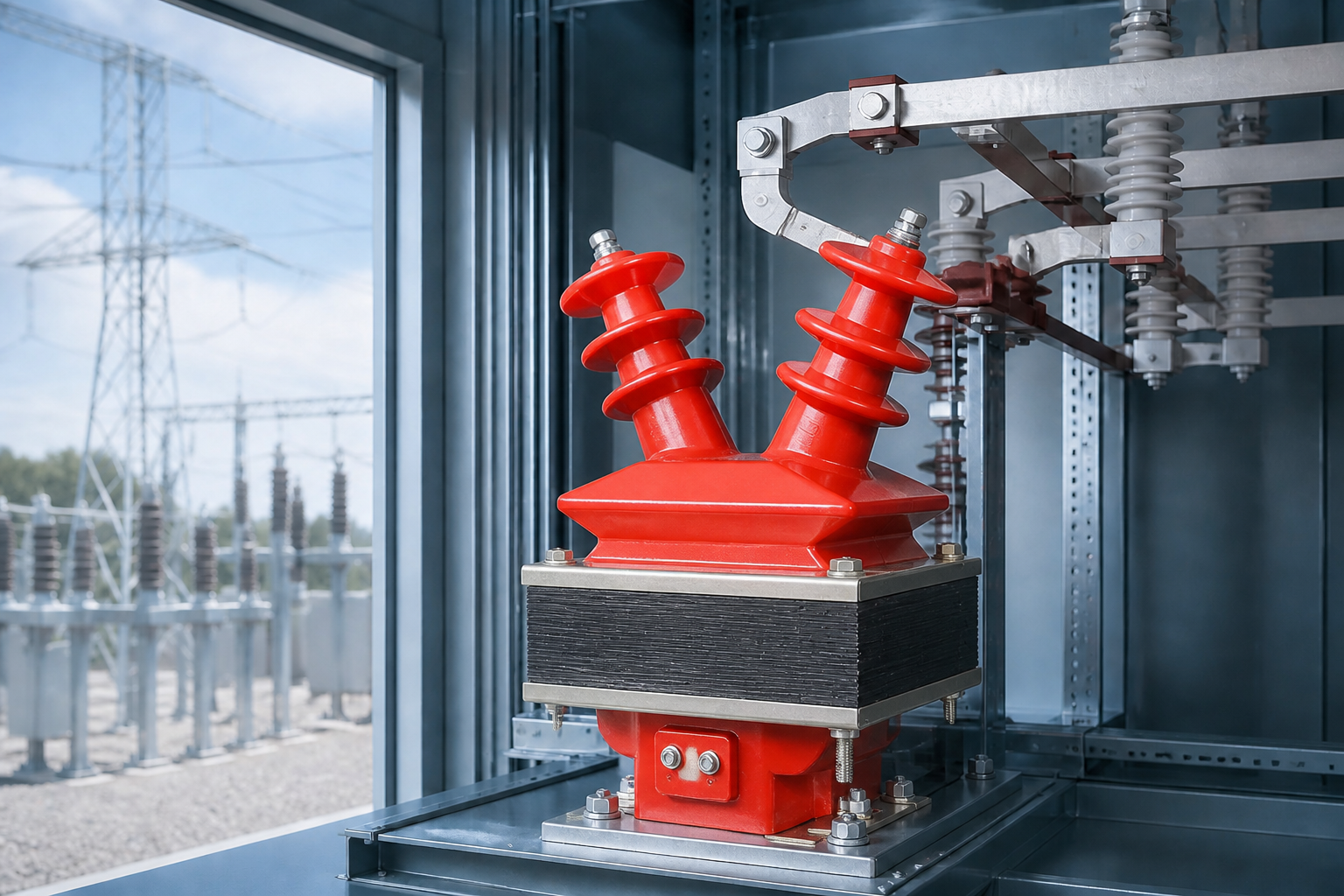
The grid hub
To transmit energy, power systems carry it to users over AC circuits at high voltage and high current. Those levels cannot be measured or used directly. An instrument transformer scales AC voltage and heavy current down proportionally to values an instrument can read. Every point in the network where one sits is effectively a hub, where high voltage and heavy current are converted into a safe, usable signal.
The safety barrier
Beyond that metering role, instrument transformers matter during maintenance on high-voltage lines. They convert extra-high voltage into a low voltage that poses no hazard to people, so measurement can be carried out safely.
A century of development
Instrument transformers appeared in the late 19th century. Across a hundred years of growth in the power industry, their voltage classes and accuracy classes have improved enormously. The two have advanced together: building a power system at a given voltage class and scale requires instrument transformers of matching voltage class and accuracy to serve its measurement, protection and control needs. Every transformation of the power industry has driven a corresponding generation of instrument transformers — and progress in instrument transformer technology is part of what has made that industrial progress possible.
The two families: CT and VT
Instrument transformers come in two families with opposite connection rules. The current transformer (CT) is connected in series with the line and steps the current down to a standard 5 A or 1 A secondary; its secondary must always be closed through a meter, relay or shorting link. The voltage transformer (VT) is connected in parallel across the line and steps the voltage down to the standard 100 V secondary; its secondary is a low-impedance voltage source that must never be short-circuited. Together they scale the two quantities an energy meter multiplies — current and voltage — down to safe, standardised levels that instruments can handle.
Why accuracy grading exists
An instrument transformer is graded by its accuracy class, and the class is chosen by the job. Revenue metering uses 0.2 or 0.5 class (with the "S" suffix for accuracy at low load), general monitoring uses 0.5 or 1.0, and protection uses 5P or 10P so relays still see a faithful fault signal. The grading matters commercially as well as technically: a 0.2S metering core can be worth several times more than a 10P core of the same ratio, because the core steel, the design and the testing are all different. When you specify an instrument transformer you are really specifying a permitted error budget for the measurement.
Frequently asked questions
What do CT and VT stand for?
CT is the current transformer and VT is the voltage transformer (also called a PT, potential transformer, in some regions). Both are instrument transformers.
What is the difference between an instrument transformer and a power transformer?
A power transformer transfers bulk energy with an efficiency of over 99%. An instrument transformer delivers a tiny, precise, scaled-down replica of current or voltage for measurement and protection.
Why is the accuracy class so important?
Because every percentage point of error is real money in billing and real risk in protection. The class is the contract between the manufacturer and the accuracy of your measurements.
How do instrument transformers protect people?
They isolate meters, relays and control circuits from the high-voltage network. Personnel work with low-voltage secondary equipment that is galvanically separated from the live system.