
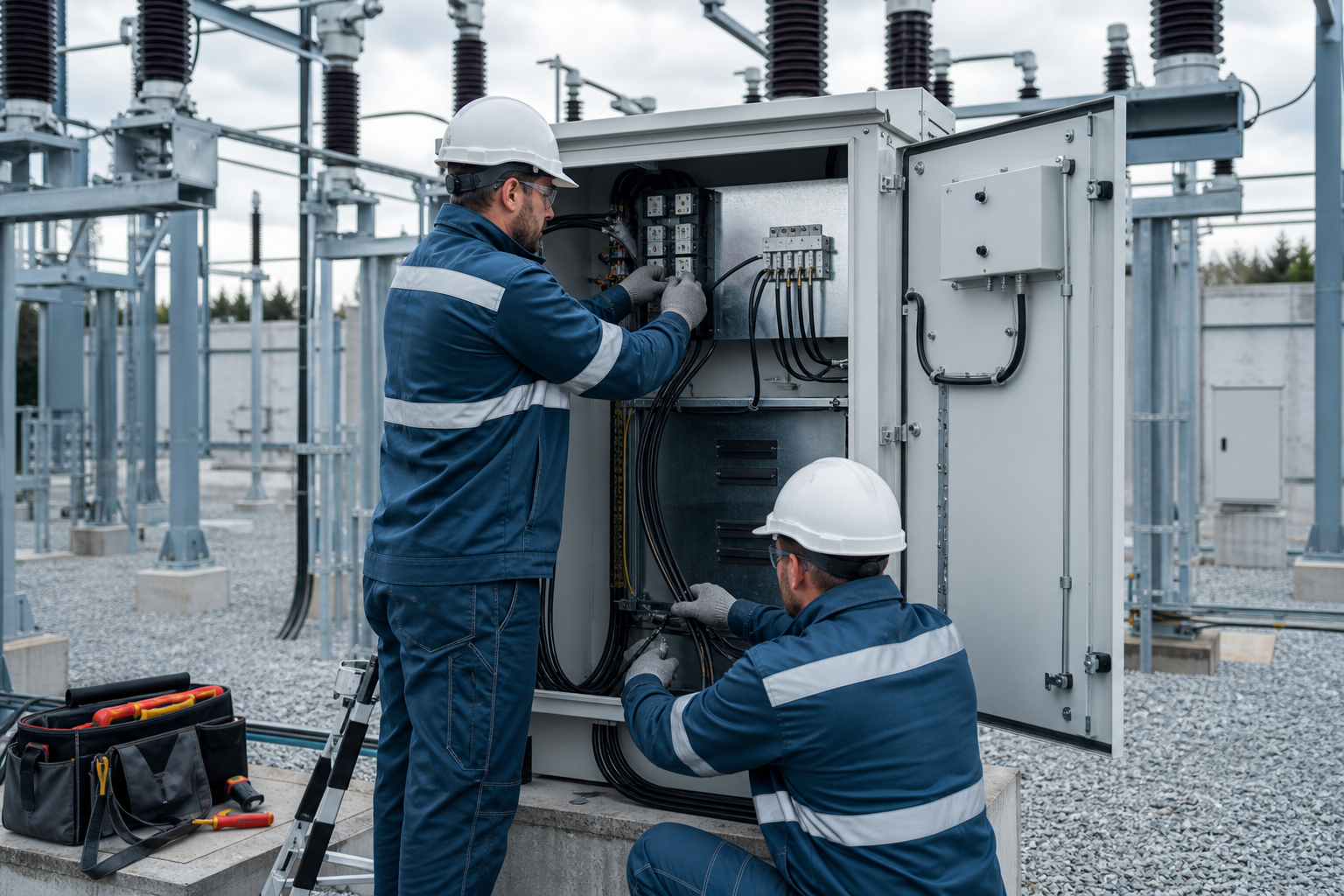
A high-voltage metering box only performs to its accuracy class if it is mounted and wired correctly. This is the sequence our engineers follow on site.
1. Mounting
Mount the metering box level. On a pole, the installation height should be no less than 300 mm above ground, and the energy meter must sit vertical — it must not be allowed to tilt in any direction.
2. Surge protection
A zinc-oxide surge arrester of the matching voltage class must be fitted at the supply end (the primary incoming side), with an earthing resistance of 10 Ω or less. This protects the line equipment and the customer load against lightning overvoltage, switching overvoltage and power-frequency transient overvoltage.
3. Phase sequence
Identify the network phase sequence A, B, C and connect each phase to the corresponding A, B, C conductor bar of the metering box. Correct positive phase sequence is mandatory. P1 is the incoming terminal, P2 the outgoing terminal.
4. Dual-ratio connection
Where a dual-ratio current transformer is fitted, the ratio is selected on the secondary side: link S1–S2 for the lower ratio (leaving S3 free), or S1–S3 for the higher ratio (leaving S2 free).
5. Earthing the secondary
On a single-ratio unit, connect current transformer secondary S2 to voltage transformer secondary terminal b and earth it. On a dual-ratio unit, earth S2 together with VT terminal b when using the low ratio (S3 free), or S3 together with terminal b when using the high ratio (S2 free).
6. Conductors and bonding
Where the high-voltage line is aluminium, use a proper copper-to-aluminium transition clamp for a secure joint. The complete enclosure must be earthed.
7. Commissioning checks
Once installed, energise under load and observe: confirm that both the active and reactive energy meters are turning normally. Only after these checks are complete and satisfactory should the unit be formally placed into service.
Common wiring faults that cause metering errors
Most metering errors on site are wiring errors, not instrument errors. The four most common: a reversed CT polarity (P1/P2 or S1/S2 swapped), which shifts the energy reading by a full phase and can even make the meter run backwards on one element; an incorrect phase sequence, which unbalances the three elements; a loose or corroded secondary connection, which adds resistance and drops the accuracy; and wrong dual-ratio links, which leave the box measuring on a ratio different from the one the meter is configured for. After every connection, physically verify each path against the wiring diagram before energising — a torque check on every terminal is part of the job, not an option.
Inspection and maintenance schedule
A high-voltage metering box is a revenue instrument, so it deserves a routine: visually inspect the enclosure, seals and insulators; check that all secondary terminals remain tight; verify the earth continuity of the box; and confirm the meter readings against the load pattern. The interval is normally annual, or per the utility contract — and always after lightning activity, storms or any fault in the vicinity. If a discrepancy appears in the billing data, test the box (ratio, polarity, insulation) rather than assuming the meter is wrong.
Frequently asked questions
Why must the VT secondary be earthed?
Earthing one point of the VT secondary fixes the potential of the whole metering circuit to earth, so the instruments and wiring never float to a hazardous voltage.
Why does the phase sequence A, B, C matter?
The energy meter sums the three phase elements in a defined order; a wrong sequence unbalances the elements and produces an incorrect total reading.
How often should a metering box be inspected?
Typically once a year, or per the utility metering contract — plus a check after lightning, storms or nearby faults, and whenever billing data looks wrong.
Can a high-voltage metering box be installed indoors?
Yes, if the enclosure is rated for indoor use. Outdoor units are weatherproofed and can be used indoors, but indoor units must never be exposed to weather.