
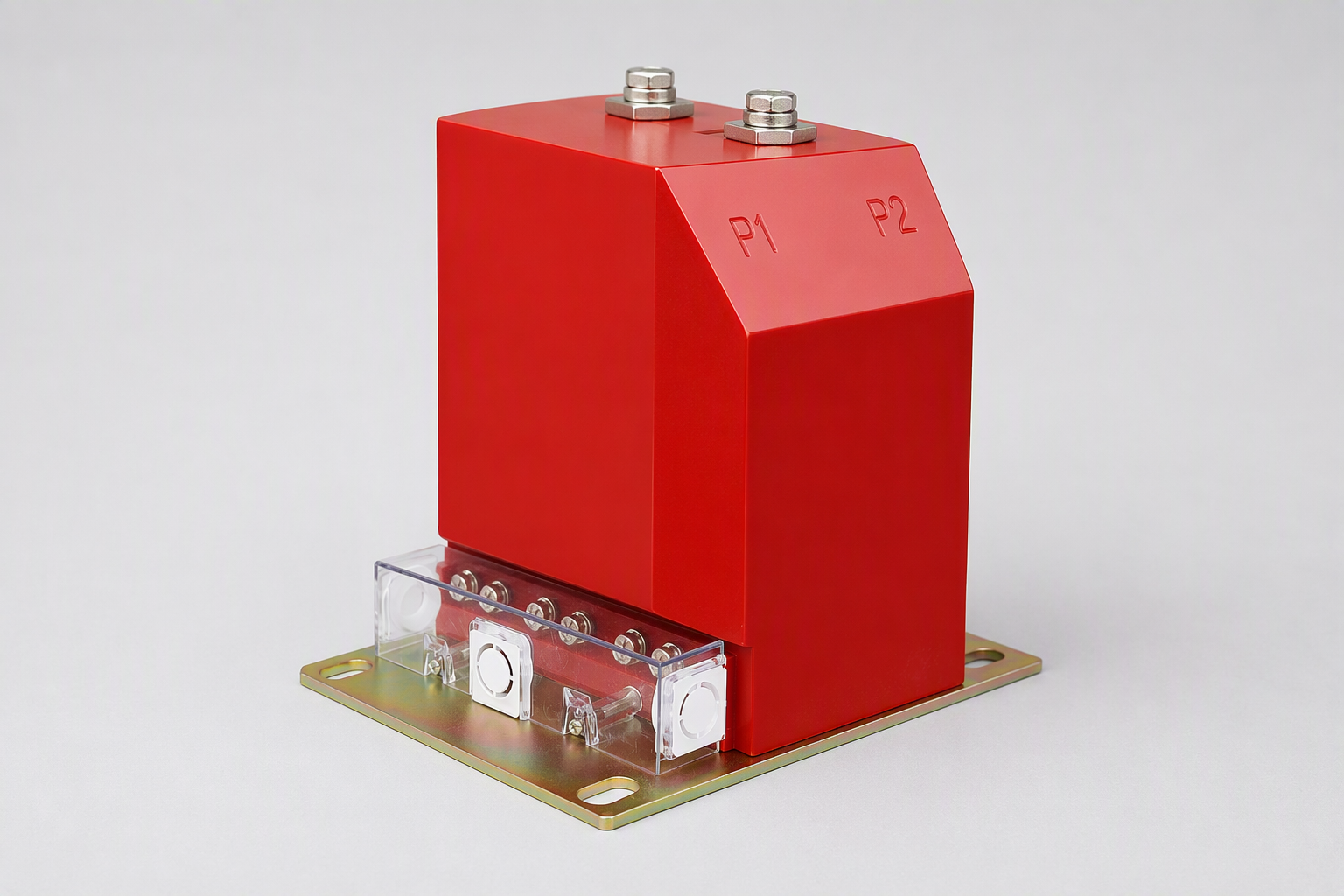
Currents in supply and distribution circuits vary enormously — anywhere from a few amps to tens of thousands of amps. For secondary instruments to measure them, they have to be converted to a more uniform current. Line voltages are also high enough that measuring them directly would be dangerous. A current transformer performs both jobs: current conversion and electrical isolation.
From amps to milliamps
Because most indicating instruments were historically moving-pointer ammeters and voltmeters, current transformer secondaries were mostly specified in amps — 5 A being the standard value. As measurement became digital, the sampling signals computers expect moved to milliamp and low-voltage ranges (0–5 V, 4–20 mA). Miniature current transformers with milliamp secondaries now bridge the main transformer and the sampling circuit. These are known as instrument current transformers — a term that also covers the multi-ratio precision units used in laboratories to extend instrument ranges.
Ratio
A current transformer works on the same electromagnetic induction principle as a power transformer; the difference is simply that it converts current rather than voltage. Winding N1 carries the current being measured and is called the primary winding. Winding N2 connects to the measuring instrument and is called the secondary winding. The ratio of primary current I1 to secondary current I2 is the actual current ratio, K. The ratio at rated operating current is the rated current ratio Kn, where Kn = I1n / I2n.
The current-source behaviour and why it matters
A current transformer behaves like a current source, not a voltage source. The primary current is set by the network load, and the secondary current is forced to follow it divided by the turns ratio. The secondary circuit must always be closed — through a meter, a relay or a shorting link. If it is opened while the primary is energised, the magnetising flux has nowhere to be balanced and a dangerous voltage appears across the open terminals. This single rule — "never open a CT secondary" — is the most important safety rule in instrument transformer work.
Saturation: what happens when the core saturates
Every CT core saturates at some point: above the knee point, extra primary current no longer produces proportional secondary current, the output waveform flattens, and both ratio and phase errors grow quickly. Measuring cores are designed to stay accurate over the normal load range and may be allowed to saturate on heavy faults. Protection cores are designed with a higher knee point so the relay still receives a usable signal at through-fault current. When you compare two CTs of the same ratio, the difference in price is largely the difference in core steel and knee point.
Frequently asked questions
How is a current transformer ratio written?
As two numbers, for example 200/5 A: 200 A of primary current produces 5 A of secondary current. Digital metering increasingly uses 200/1 A or 200/0.2 A for lower burden and better resolution.
Why is a CT secondary always connected or shorted?
Because an open secondary converts the CT into a step-up transformer with a very high induced voltage — a shock hazard that can also puncture the insulation.
What is CT saturation?
The point where the magnetic core can no longer carry more flux, so the secondary current stops following the primary. The output flattens and the errors grow sharply.
What is the difference between a measuring CT and a protection CT?
A measuring CT is accurate over the normal load range; a protection CT keeps a higher knee point so it still reproduces fault current for the relay. Many transformers house both cores.