
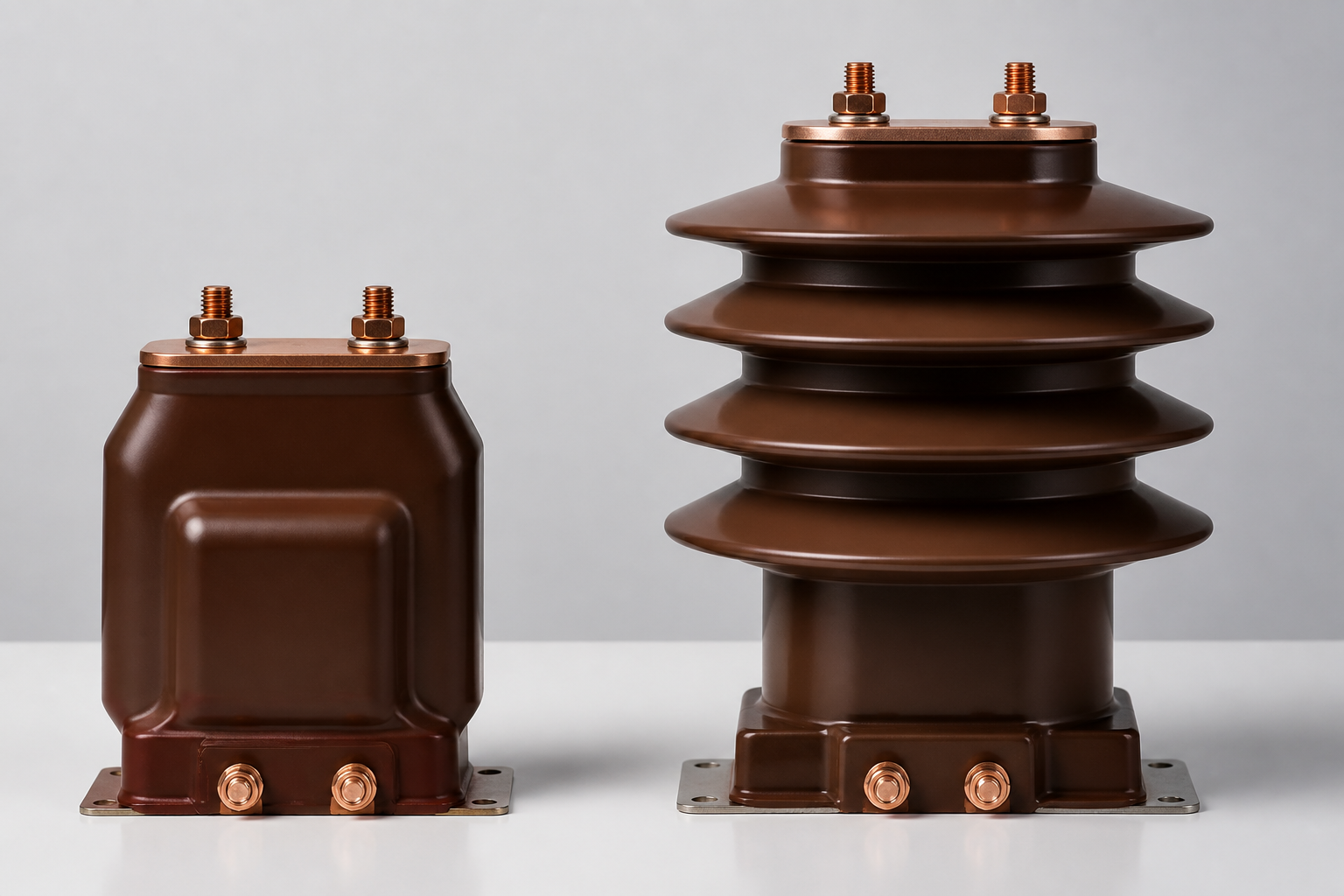
The same ratio and accuracy class can be built as an indoor unit or an outdoor unit, and the physical difference between them is small — but the difference in the environments they survive is enormous. Choosing the wrong type fails fast, sometimes within the first rainy season.
The creepage distance is the real difference
An outdoor unit carries umbrella skirts on its insulators to lengthen the surface path between live parts and earth. More skirts mean more creepage, which resists rain films, salt spray and pollution flashover. Indoor units run with smooth or lightly shedded insulation because indoor air is dry and clean by comparison.
Weather resistance and materials
Outdoor epoxy insulation is formulated for UV exposure, thermal cycling and humidity; outdoor metering enclosures use stainless steel or powder-coated steel with sealed cable glands. Indoor units prioritise compactness and panel mounting, and their insulation has no UV or salt requirement at all.
Mounting and footprint
Indoor CTs and VTs are post-type or bushing-type units that bolt into switchgear panels and RMU cubicles; height and footprint are the limiting dimensions. Outdoor units are self-standing on galvanised structures or pole platforms, sized for the open-air clearance distances required at their voltage class.
How to decide for your site
If the unit lives inside a switchgear room or panel — indoor. If it lives on a pole, a tower or an open substation yard — outdoor, with a creepage distance matched to the local pollution level. For coastal or desert sites, specify the higher creepage option even at the same voltage class. When in doubt, send us photos of the installation point and we will confirm the right build.
Creepage distance and pollution levels
The single biggest difference between an indoor and an outdoor instrument transformer is the creepage distance — the length of the insulating surface measured along the sheds between the live parts and earth. Outdoor units face rain, fog, salt spray and industrial pollution, so they need longer creepage, deeper sheds and weather-resistant insulation such as outdoor-grade silicone rubber or porcelain. Indoor units are protected by the building and can use compact resin insulation with a much shorter creepage path.
IEC pollution classes help you choose: Class I (light) needs roughly 16 mm/kV, Class II (medium) about 20 mm/kV, Class III (heavy) about 25 mm/kV, and Class IV (very heavy, coastal or industrial) about 31 mm/kV of the highest system voltage. An outdoor transformer selected for a coastal substation is therefore a different product — with more and deeper sheds — than one selected for a clean desert site.
Altitude, temperature and derating
Above 1000 m the air is thinner and its insulating strength drops, so standard air-insulated clearances and external creepage must be derated or the unit re-designed with longer insulation. The same rule applies to high-temperature sites: rating and continuous-load capability are specified for a reference ambient temperature, and hot climates may require a derated or reinforced unit. When you buy for a high-altitude or tropical site, state it in the inquiry — it changes the design, not just the price.
Frequently asked questions
Can an outdoor instrument transformer be installed indoors?
Physically yes, but it wastes space and money — the outdoor unit's long creepage and weatherproofing are unnecessary indoors. Fit the type that matches the environment.
What is the minimum outdoor creepage distance?
It depends on the pollution class of the site — from roughly 16 mm/kV in clean areas up to 31 mm/kV in heavy pollution. Outdoor units usually carry a declared creepage of at least 20–25 mm/kV.
What does the pollution level of a site mean?
It grades how much conductive soiling the insulator will face (dust, salt, industrial fumes). Higher pollution requires longer creepage to avoid tracking and flashover.
How does altitude affect instrument transformers?
Above 1000 m the air insulation weakens, so clearances and creepage must be increased or the unit derated. Always state the site altitude when ordering.