
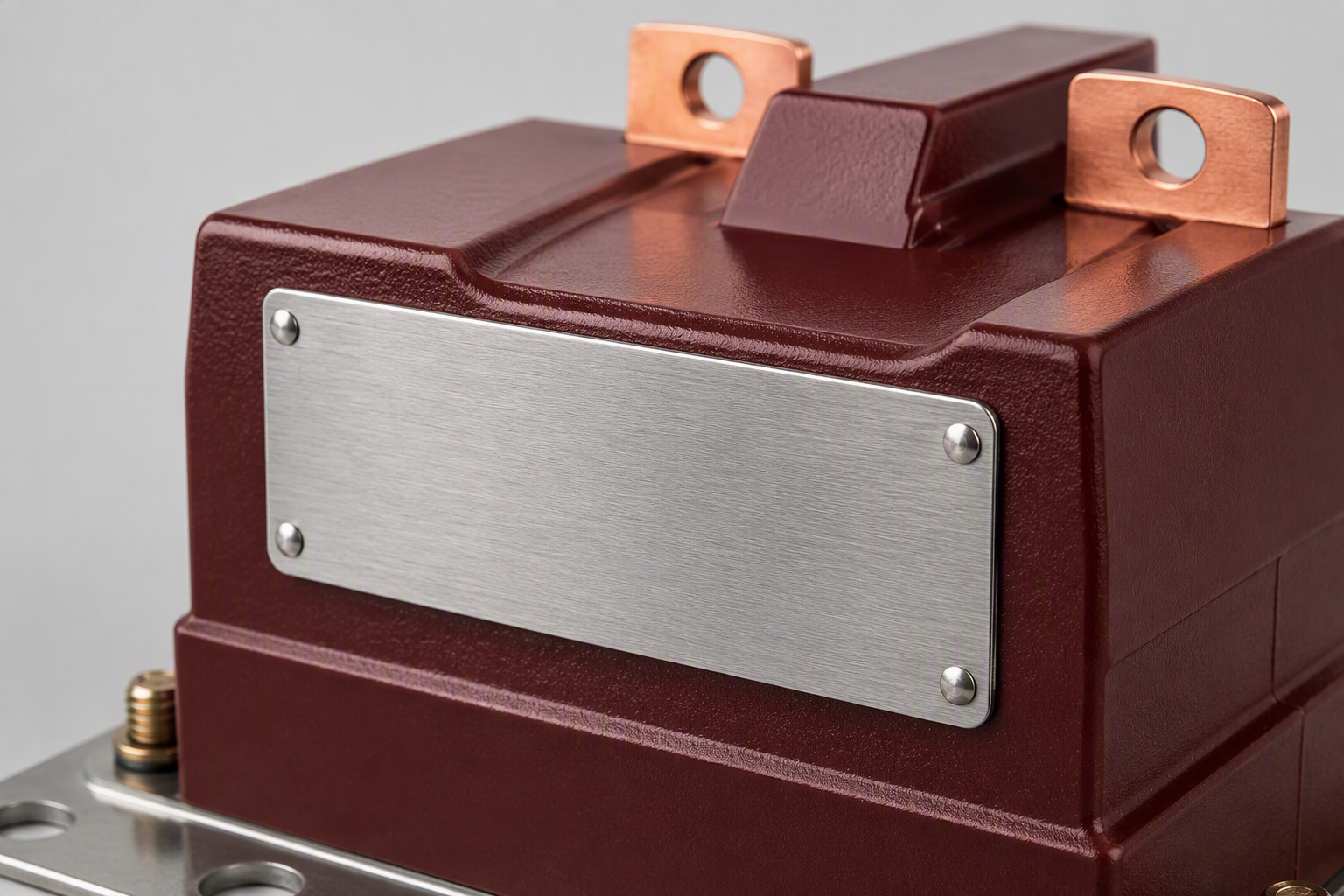
The nameplate of a current or voltage transformer packs the whole specification into a few lines. Once you can read it, you can check a delivered unit against the order, spot a mismatched ratio, and answer most commissioning questions before they become problems.
The ratio line
A current transformer reads e.g. 100/5 A or 100–200/5 A. The first number is the primary rating — a single value for a fixed-ratio unit, or a range for a dual-ratio unit whose ratio is selected on the secondary terminals. A voltage transformer reads e.g. 10000/100 V, meaning the primary is 10 kV and the secondary is the standard 100 V metering output.
Accuracy class and rated burden
The line 0.2S 10 VA means the unit holds class 0.2S accuracy up to a 10 VA secondary burden — and the S suffix guarantees performance down to 1% of rated current, which matters for wide-range metering. A protection core reads differently: 10P10 30 VA means a 10% composite error limit at 10 times rated current, valid at 30 VA.
Insulation and standards lines
Rated insulation level is written as two numbers, e.g. 12/42 kV: 12 kV is the highest system voltage and 42 kV the power-frequency or impulse withstand — it tells you the unit belongs on a 10 kV network, never on a 35 kV one. Standards references (IEC 61869, GB/T, GOST) identify the design rules the unit was built and tested to.
What else to check on delivery
Match the serial number against the packing list and test certificate, confirm the rated frequency (50 Hz is standard), and check the connection diagrams printed on the unit. On dual-ratio CTs, confirm which terminal links give the lower and higher ratios before wiring the meter.
What every abbreviation on the nameplate means
Take a typical CT nameplate: "200/5 A, 0.2S, 30 VA, 50 Hz, 12/42/75 kV, IEC 61869". Each item is a commitment. The ratio 200/5 A says 200 A of primary current produces 5 A at the secondary. The class 0.2S fixes the allowed current and phase errors across the load range. The 30 VA is the rated burden the transformer can supply while holding that class. The insulation level 12/42/75 kV means the unit is built for a 12 kV system and withstands 42 kV power-frequency and 75 kV lightning impulse. The standard reference tells you which test regime the unit complies with.
On a voltage transformer you will see the same structure in a different form: a ratio like 10/0.1 kV, an accuracy class like 0.5, a rated output in VA, the frequency, and an insulation level such as 12/42/75 kV. Three-phase VTs add terminal labels — 1a-1n, 2a-2n and sometimes an open-delta pair — which identify each winding's function.
Nameplate checks before installation
Before mounting, compare the nameplate with the project documentation: ratio and class must match the metering design, the rated burden must be greater than or equal to the connected burden, the insulation level must suit the system voltage, and the frequency must match the network (50 Hz or 60 Hz). Record the serial number — it is the reference for the test certificate and for any future warranty claim. If the nameplate and the datasheet disagree, resolve the discrepancy with the supplier before energising.
Frequently asked questions
What does 12/42/75 kV on a VT or CT nameplate mean?
Rated voltage 12 kV, power-frequency withstand 42 kV and lightning-impulse withstand 75 kV. It is the insulation coordination of the unit, not a continuous operating voltage.
What is the rated secondary load on a VT nameplate?
The maximum VA the secondary winding can supply to meters and relays while keeping the declared accuracy class.
Why are two accuracy classes listed on one plate (e.g. 0.5/3P)?
The transformer has two windings with different jobs: one measuring winding (0.5) for metering and one protection winding (3P) for relays.
What does the standards line (IEC 61869, GB/T 20840) tell me?
It identifies the standard under which the transformer was designed and type-tested — the legal basis for its error limits, insulation tests and construction requirements.