
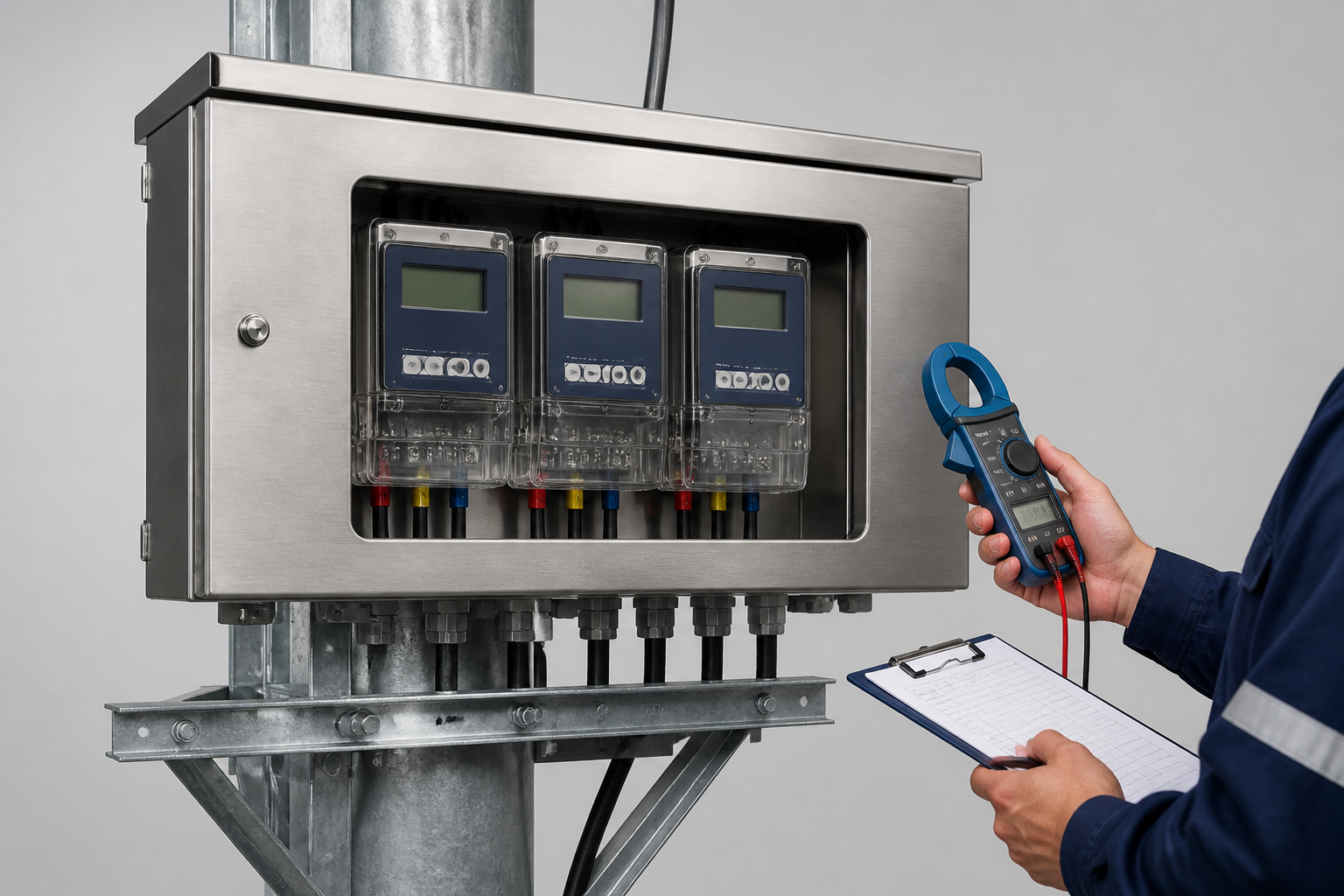
A high-voltage metering box is the revenue meter of a medium-voltage network. Sizing it correctly means choosing the right primary current, ratio, accuracy class and enclosure — and each choice follows from the service transformer and the tariff that will be billed.
Start with the service transformer rating
The metering point sits on the primary side of the customer or distribution transformer. Its full-load current at the primary voltage sets the lower boundary for the metering box ratio. Divide the transformer kVA rating by √3 × the line voltage to get the full-load current, then round up to the nearest standard CT primary rating.
Pick the primary and secondary ratios
For a 630 kVA transformer at 10 kV, full-load current is about 36 A, so a 50/5 CT ratio is a common choice; at 35 kV the same transformer draws roughly 10 A, calling for a 20/5 or 30/5 ratio. The VT side steps 10 kV or 35 kV down to 100 V / 100/√3 V. If load is expected to grow, choose the next standard ratio up rather than a non-standard value.
Choose the accuracy class for the tariff
Revenue metering that feeds a utility billing system should use 0.2S or 0.5S CT accuracy with a class 0.2 or 0.5 VT. Many utility tariffs also require a protection output on the same unit — combined classes such as 0.2S/10P10 keep one physical unit while satisfying both the meter and the relay.
Check the burden of the connected meters
Every meter and relay connected to the secondary adds burden in VA. Sum the burdens of all instruments on the circuit and make sure the chosen CT and VT rated outputs cover them with margin. Undersized outputs degrade accuracy exactly where the tariff is most sensitive.
Select the enclosure and installation type
Outdoor pole or platform mounting calls for a weatherproof stainless-steel enclosure with a separated, sealable meter compartment and armoured secondary wiring — the configuration used by utilities to deter tampering. Indoor panel installations use the same metering core but in switchgear-mounted form, where footprint and panel height matter more.
Leave room for future load growth
Metering boxes are replaced rarely, so size for the next tariff period, not today's load. A dual-ratio secondary or a next-standard-up primary rating costs little but lets the utility re-rate the point without opening the enclosure — a practical habit that keeps commissioning and audit costs down over the life of the installation.
Combined metering box or separate CTs and VTs?
A combined high-voltage metering box integrates the current transformers, the voltage transformers, the metering wiring and the terminal arrangements in one enclosure. Choose it when space is tight, when the installation must be factory-matched and tested, or when you want a single point of responsibility for accuracy. Separate CTs and VTs make sense when the instruments are already specified, when the metering point is inside existing switchgear, or when the accuracy class required is unusual. For most pole-mounted and small-substation revenue points, the combined unit is the more economical and more accurate choice.
Voltage class and insulation level
The box must match the system voltage class, not just the transformer nameplate: a 10 kV network calls for a 12 kV rated unit with 42/75 kV insulation (12/42/75), while a 35 kV network calls for 40.5 kV rated insulation (40.5/95/185). Also confirm the frequency (50 or 60 Hz) and the altitude of the site — above 1000 m the air insulation may need derating or a reinforced unit. Give the supplier the service transformer rating (kVA), the expected load growth, and the metering scheme (active/reactive, tariff class) so the ratios and accuracy classes are chosen correctly the first time.
Frequently asked questions
How do I choose the CT ratio for a metering box?
Start from the service transformer: primary current = kVA / (√3 × kV). Then pick the nearest standard ratio at 1.2–1.5 times the full-load current so the meter works in its accurate band and the box handles growth.
What is a dual-ratio metering box?
A box whose CTs offer two ratios selected on the secondary side (for example linking S1–S2 for the low ratio or S1–S3 for the high ratio). It suits sites where the load is expected to grow.
Does a high-voltage meter need both CT and VT inputs?
Yes, for kWh billing above 1 kV: energy is the integral of voltage × current × time, so the meter needs scaled current from the CTs and scaled voltage from the VTs.
What is the standard VT ratio inside a 10 kV metering box?
Typically 10/0.1 kV — the network phase-to-phase voltage scaled to the 100 V secondary standard. On earthed systems the phase-to-earth winding is 10/√3 : 0.1/√3 kV.